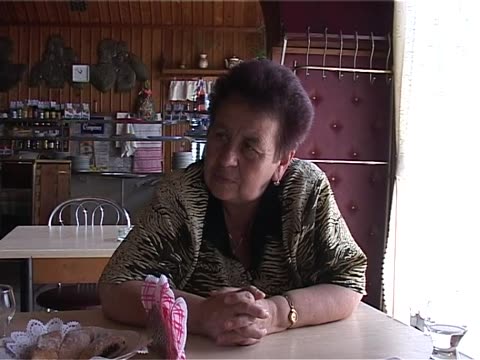
The continuation of the formal interview with Rita Davidovna Shveibish in a café in Tul'chyn. (Part 2 of 2. See MDV 708) She talks about the Jewish community and life in Tul'chyn today and before World War II. In the past, there was a thriving cultural life in Tul'chyn. She talks about ghettos during the Romanian occupation. She continues to answer a series of dialectology questions about the Yiddish language. She then discusses religious practices immediately after the war. She provides more information about local Yiddish speakers in towns nearby.
Shveibish answers dialectological questions on words for colours (blue and light blue), pigeon, 'also', near, late, ceiling, floor, face and cleanliness, and on the dreydl game. She also talks about Tul'chyn: its Jews, today's Jewish concerts, pensions for camp survivors and the religious revival. She describes the one postwar synagogue, the shoykhet, and prayer meetings broken up in the 1960s. Kerler and Katz ask about Jews in nearby towns (Mohyliv, Vinnytsia, Nemyriv, Bratslav, Uman, Sharhorod) and about the Romanian-run ghettos and Pechera during the war.
The catalogue sentence is accurate; the transcript adds Jewish concerts, the schools and shoykhet, and Jews in other towns.
In her office Shveibish shows the visitors an old damaged Torah scroll and a gravestone, and talks about the synagogue taken down before the war. The talk then turns to the old market inn, and a Jewish innkeeper named Rubin is mentioned (name uncertain). The speech is partly garbled and little is clear.
Kogan's formal interview begins. He gives his name as Iosif Abramovich Kogan and says he was born in Bershad. Kerler states the date of the interview, 14 July, and Kogan gives his address in Tul'chyn.
Kogan provides personal information and discusses his family. His father passed away during the Great Hunger in 1933. Kogan's father was also born in Bershad and was a soap-maker. His mother was also born in Bershad and was a candy-maker. Kogan moved to Tulchyn from Zhabokrych in 1960. Kogan lists the kind of candy his mother would make.
Kogan gives his Yiddish name as Yosl and his birth as 12 August 1927 in Bershad. He lived there until the war. His parents were both from Bershad. His father was a soap-maker who died of hunger. His mother, Gitl, was a candy-maker whose sweets he describes, and she died in the 1960s. He moved to Tul'chyn in 1960 and has lived there about thirty years (the figure is unclear).
The transcript gives Kogan's Yiddish name, his mother's name Gitl and the candies she made, and her death in the 1960s.
Kogan talks about his siblings. His half-brother Peyshe was from his mother's other husband and went to Iași. His mother had two husbands, and Kogan is from the second, Avrom.