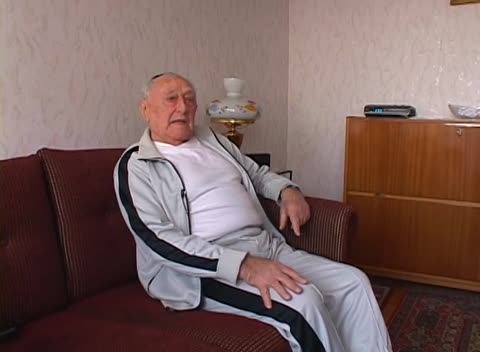
Smajovics speaks about his visits to America. He then speaks about his family. Smajovics's brother lived in Israel and his sister lives in America.
From the machine transcript
Smajovics describes meeting two elderly Yiddish speakers in America and talks about visiting his sister in Queens and his daughter in Miami, including Passover there. Kerler also talks about his own life in America and Israel, and a short exchange about the recording and papers follows. The beginning is partly garbled.
Kerler's remarks about his own life in Moscow, Israel and Indiana, and Passover in Miami.
The formal part of the interview begins. Smajovics provides personal information and speaks about his family's life in his hometown Velyka Kopanya (Yiddish: Groys Kopanye) before the war. Smajovics grew up with two brothers and one sister, as well as four half-siblings. His father was field worker and owned horses. Smajovics explains that he was killed by his horses in 1926.
From the machine transcript
The formal interview begins. Smajovics says he lived in Velyka Kopanya, ten kilometers from Vynohradiv, gives his birth year as 1922, his Hungarian and Yiddish names and the nickname Bumi, and names a man from Debrecen with Maramureş parents. He explains that his mother was an orphan, and that his father, a field worker who broke in horses, was killed by them in 1926, leaving four children.
The question about names and the nickname Bumi, and a mention of a Debrecen man who speaks Yiddish.
Smajovics speaks about his before World War II. He attended a Czech school and then began his blacksmith apprenticeship under Hungarian occupation in 1939. When Smajovics's apprenticeship ended in 1942 he moved to Budapest to work in his profession. Smajovics continues that he was "drafted" into the forced labor battalion of the Hungarian army in 1943.
From the machine transcript
Smajovics says his father was a field worker. He went away to learn blacksmithing and was in Budapest when the war began. He came home in the summer of 1943 and was called up that October into a labor battalion.
Smajovics speaks about his life during the war in the forced labor battalion of the Hungarian army, stationed in Pest, and then under German occupation in 1944. He states that he worked as locksmith for the Germans, before being deported to Ercsi, Hungary. In Ercsi, Smajovics worked for the Germans during the day and in the evenings he would go around as peddler. He then shares an episode about an encounter with a Czech-speaking German soldier. Smajovics then speaks about his liberation by the Red Army December 1944.
From the machine transcript
Smajovics describes his labor battalion service, working as a locksmith with German tools. After the Germans arrived in 1944 he was taken to Ercsi on the Danube to dig trenches. He tells of a conversation in Czech with a German soldier whose sister was in a concentration camp. He describes the Soviet crossing of the Danube and his liberation in December 1944.
The catalogue's 'peddler' detail is not clear in the transcript.
Smajovics speaks about his life after the war and return to his hometown in Transcarpathia with his two brothers. He also shares episodes about the encounter with Red Army soldiers. Smajovics recalls how siblings returned. He continued to work in his profession as blacksmith, before working at a factory in 1947. It was the time of the kolkhozy, he explains. Shortly thereafter, Smajovics moved to Vynohradiv, where he lived until 1978. In Vynohradiv, Smajovics worked as locksmith at a factory between 1949 and 1952. In 1952, Smajovics began working at a small furniture factory, where he worked for one and a half years. He then switched jobs again in 1954, when Smajovics worked at a warehouse for nine years. He then addresses the socio-political conditions in the 1960s. Smajovics was also the head of a parking lot and worked as chauffeur. He moved to Budapest in 1978.
From the machine transcript
Smajovics describes liberation near Ercsi, about 120 km from Budapest, and the journey back to the Carpathians with two other boys. He recalls meeting Soviet officers, including Jewish ones, and being offered a place in the Czech army. He tells how his sister returned and how he took up work as a blacksmith. The coming of the kolkhozy, his move to Vynohradiv and his jobs there (a factory, a small furniture factory, warehouses, a garage) are covered, with the 1960s mentioned, and his move to Budapest in 1978 when he bought a flat. He mentions his two daughters and his pension.
The meeting with Jewish officers and the Czech army offer.
Smajovics speaks about his family. He raised two daughters, one of whom lives in America. He then talks about his education. Smajovics attended a religious school (cheder) at the age of four. In 1926, he began to study at a Czech school. Between the age of thirteen and sixteen, Smajovics studied at the local yeshiva.
From the machine transcript
Smajovics talks about his education. He began cheder at four, following his older brother. He learned to pray early and was taught by the dayan, then celebrated his bar mitzvah in Adar. He then attended the local yeshiva until about 1938. He also says his grandfather was not a Hasidic man.
The bar mitzvah preparation and the grandfather's non-Hasidic outlook.
Smajovics addresses prewar Jewish life in Velyka Kopanya. According to him, sixty families lived in his hometown. He then speaks about his life in the late 1930s. Smajovics worked odd jobs, including coach man and field worker.
From the machine transcript
Smajovics says about sixty families lived in Velyka Kopanya and that it had a large synagogue. He left his studies in 1938 at the time of the Czech mobilization, at around sixteen and a half, and took over the field work and driving for the household. Then the war came.
The Czech mobilization of 1938 as the reason he left his studies.
Smajovics speaks about his family, particularly how he met his wife after the war. He also mentions how he reunited with his brother in Israel in 1982, after not having seen him for forty years.
From the machine transcript
Smajovics tells how he met his wife at a wedding in the winter of 1945. He recounts how he found his brother Mordechai in Israel and first visited him in 1982 after forty years. He describes his nervousness on the flight and his nephew who served in the army. His brother's descendants, visits to Israel and the death of his wife are mentioned, and Kerler states the date for the recording.
The wedding where he met his wife and the nephew's military service.
Smajovics speaks about his family. His father was a field worker. Both of his parents were also born in Velyka Kopanya. Smajovics also addresses the fate of his family members during World War II.
From the machine transcript
Smajovics answers questions about his parents. His father was a field worker and his mother was Golde, and both were from Velyka Kopanya. He names his father's birth year as 1897, his sister Beyle in Brooklyn, and his paternal grandparents Moshe and Motl. His grandmother Motl was deported to Auschwitz and came from Oylak (?), 25 km away.
Details of the grandparents' names and the grandmother's deportation.
Smajovics shares an episode about meeting a relative during his time as forced laborer in the Hungarian army. He then explains how his father was killed by a horse in 1926.
From the machine transcript
Smajovics tells how, in the Hungarian labor battalion, he met an older man in a camp who turned out to be a relative of his grandmother. Kerler asks him to describe how his father was killed by young horses in 1926, and he does so.
The meeting with the relative.
Smajovics talks about his family. In particular, he recalls his grandmother's charity. He then remembers visits to Israel and lists Hebrew words that are part of the Yiddish language. He also speaks about life today.
From the machine transcript
Smajovics recalls his grandmother's charity in giving shelter and food to the poor, and tells of a man who remembered her. He talks about a loan he and his wife made, collecting money, and Kerler asks about Yiddish and Hebrew terms for money and for non-Jews and a few other words. He describes the Miami building full of Jews where Carpathian relatives gather at Passover. He also recalls the expulsion from Spain, and visits to Israel.
Kerler's elicitation of money and Hebrew-origin vocabulary.
Smajovics shares a proverb and then speaks about his religious education. He recalls prayers and examinations in cheder. Smajovics then speaks about a childhood friend that he met again in Israel after the war.
From the machine transcript
Smajovics gives a saying about stealing under the Russians. Kerler asks about Talmud study, and Smajovics recalls cheder, his grandfather's non-Hasidic style, and learning prayers by heart under examination by the teacher. He tells of a childhood friend he met again in Israel, a farmer who studies in the study house, and of their visit.
The childhood friend in Israel.
Smajovics addresses his education, particularly the Czech school. He studied at the secondary school until 1936 and religious school until 1938. In 1938, Smajovics worked in the fields and then started his blacksmith apprenticeship.
From the machine transcript
Answering Kerler's questions, Smajovics says he went to cheder from age four and to the Czech school from four and a half until 1936, and kept to cheder until 1938. He describes learning to write and reckon, and working in the fields after the 1938 mobilization. He started his blacksmith apprenticeship at seventeen in 1939 and worked until 1942.
The Czech mobilization of 1938 and his work in the fields.
Smajovics speaks about Jewish life in the region in the late 1930s. He recalls Polish refugees. He then briefly addresses his time in the forced labor battalion of the Hungarian army.
From the machine transcript
Smajovics speaks about the late 1930s, when he worked at shoeing horses, and mentions the arrival of Polish refugees. He says he could not speak Hungarian at that point, but learned it in the forced labor battalion from Hungarian boys.
Learning Hungarian in the labor battalion.