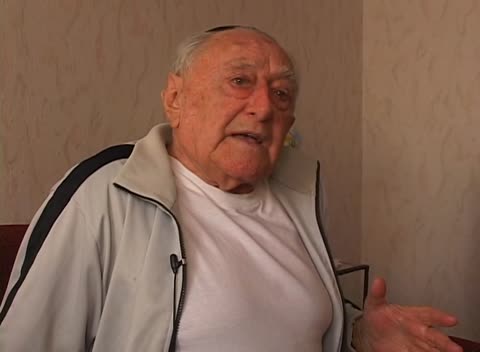
Smajovics addresses his religious school (heder) education and teacher (melamed). He talks about prewar Jewish life in Transcarpathia and visits of a rebbe to Velyka Kopanya.
Smajovics recalls his cheder teachers and an older student in the cheder, and how a teacher was addressed. He answers Kerler's questions on whether non-Jews converted to Judaism, on rebbes who came to the village and on an early rebbe who emigrated to Palestine, including disputes in a nearby town about rebbes. He mentions Rebbe Meir, who gave sermons, and a teacher of girls.
A rebbe who emigrated to Palestine, disputes over rebbes in a nearby town and the Sapinka rebbe in Seliš (?) are also mentioned.
Smajovics talks about non-Jews who spoke Yiddish. According to him, Jews used a different kind of Yiddish, so non-Jews would not understand. He then addresses yeshivot in the Transcarpathian region and describes his cheder.
Smajovics says non-Jews who knew Yiddish lived nearby, and that Jews spoke Hungarian or a different Yiddish so as not to be understood. He gives his parents' birth years as asked and says that the region had no yeshiva of its own, so boys were sent to yeshivot in Seliš, Khust, Mukachevo and Slovakia. He describes the big cheder with outside boys who ate at different homes, and the age limit of 13 or 14 for studying there.
Also gives the parents' birth years and the term for bar mitzvah.
Smajovics speaks about prewar holiday celebration, including Passover. He explains how they distributed jobs to boys as part of the communal matzo baking effort.
Smajovics describes how cheder boys earned a little money before Passover by working at the communal matzo baking, as water, flour or wheel workers. He mentions matzo for poor large families and a communal collector. A word for secret deliveries of food is discussed, as is a term for a healer or miracle-worker.
Smajovics talks about prewar Jewish life. He specifically touches upon a religious court case that took place in his hometown. Smajovics speaks about life and charity today.
Smajovics talks about a rabbinical court case in his hometown against two men, and about the hardship for their wives and children. He recalls Red Cross parcels, and that the Czech teacher decided which children received clothing and books. He tells how the boys gave concerts and recitations to raise money and went on a trip to the forest paid for from the funds, with milk brought for poor children.
The passage turns to the school's charity and children's concerts in prewar life rather than 'life today' as the catalogue says.
Smajovics talks about the prayer books he used and says that his village synagogue was Ashkenazic. He tells how a Sephardic-style service in Israel (with his brother) and a stay in Tokaj, with an American Jew who objected to his Torah reading, differed from his own practice. He compares the Sephardic and Ashkenazic ways of saying kaddish, and then recites kaddish at Kerler's request, with the transcript largely garbled for the recitation.
Smajovics finishes reciting kaddish and talks about his present prayer practice. He attends a Reform-style synagogue (Teleki Jud?) in Budapest, where he says kaddish after each service. He says his own rabbi tried to organize weekday minyanim, and Kerler asks whether a Jew in Tokaj speaks Yiddish and whether he remembers Sabbath songs.
Kaddish recitation is followed by the account of his synagogue in Budapest.
Smajovics briefly says that he has not taken part in the Sabbath-end gatherings since the war, and Kerler asks about holiday songs and Hanukkah songs. He then sings a Yiddish song about a son and his mother's worries over money and love, in which the girl has a rich suitor. Kerler has him repeat the song line by line, and they discuss an unknown word in it, glossed as 'critique' or 'send away' (?). A second woman joins in the song.
The song is performed and discussed in detail with Kerler, and a second woman joins in.
Smajovics sings a Yiddish song about a couple on a stroll who talk about marriage, in which the man declines the proposal after the woman's teasing. Kerler has him repeat the text line by line and asks about words like 'speculate' and 'mock', and the second woman helps with the lines. He then sings the whole song through again.
Smajovics describes his life before the war, when he sang with his friends. He then addresses prewar Purim celebrations and food customs. Smajovics then describes how children performed plays (Purim shpiels) and girls dressed up in Hungarian attire.
Smajovics says he sang with his friends on Sabbath afternoons, learned Hungarian songs from his Hungarian master without knowing the words, and remembers little of them. He describes Purim in the village: baking 'kindlekh' with honey (a dough with honey cut into pieces), Purim plays by children and older boys, and collecting money for the poor with a sack. Kerler asks about words for these customs.
The passage also covers collecting for the poor and the term 'kindlekh' for Purim pastry.
Smajovics speaks about Hanukkah doughnuts (pontshkes) both before the war in his village and in Israel, where he bought them at a bakery in Jerusalem. He says that latkes were not made in his village and that potatoes were called krumpirn there, with other words discussed for them.
Kerler also asks about words for potato and a related term.
Smajovics answers dialectological questions from the AHEYM Yiddish linguistic questionnaire. He then speaks about prewar Passover celebrations and food customs. Smajovics then speaks about his family and passing on the Yiddish language to his daughters. Smajovics states that he prepared his grandson for his bar mitzvah.
Smajovics answers questions about the word for attic and for a bridge, and describes Passover food (matzo with milk, dumplings, kugel), before saying that a woman in a restaurant recognised him as a Carpathian Jew by his Yiddish for the seder. He says that few Yiddish speakers remain in the area and that his daughters can understand but do not speak it. He says that he taught his grandson in America bar mitzvah, and that the grandson is now religious and 31 and unmarried.
Contains the dialectological questions, Passover, the daughters' Yiddish and the grandson's bar mitzvah preparation.
Smajovics answers dialectological questions from the AHEYM Yiddish linguistic questionnaire. He then addresses his life in Budapest before and after the war in the late 1970s. He worked there for nine months.
Smajovics answers a question about the word for 'sick' and then describes his time in Budapest, where before the war he worked for nine months in 1942 (?) and lodged with an old Carpathian Jew who spoke Yiddish. He says that he settled in Budapest in 1978, with his daughter having come earlier, that the move was difficult, and that he met a friend from cheder again.
Starts with a dialect question, and also covers his friend and the hard move in 1978.
Smajovics answers dialectological questions from Kerler. They cover greetings and replies, polite phrases (please, thank you, 'be so good'), expressions for luck or bad luck, and the words for house and for belly.