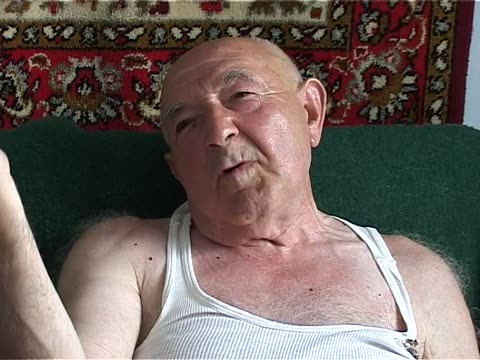
Kogan addresses prewar Jewish life in Bershad, including Jewish and non-Jewish relations. Kogan also recalls non-Jews who spoke Yiddish. He then talks about the local Yiddish school in Bershad. According to him, non-Jews also attended the school. Kogan then addresses his school education.
From the machine transcript
Kogan introduces Bershad' as a Jewish town. He recalls non-Jewish locals who spoke Yiddish better than he did and names some friends. He then talks about the Yiddish school there, where Yiddish itself was not taught, and about the subjects he studied and the languages he knows.
Kogan gives the school curriculum, and Kerler asks for names of Yiddish-speaking non-Jews.
Kogan talks about Jewish life in Bershad during World War II and recalls refugees arriving in the ghetto. Kogan was imprisoned in the Bershad and Pishchanka ghettos. He describes the journey from Bershad to Pishchanka, as well as the living conditions in the Pishchanka ghetto.
From the machine transcript
Kogan recalls being driven from Bershad' to Pishchanka on foot during the war and a night's walk there. He describes the hunger in the Pishchanka ghetto and sleeping on cement floors. Kerler's questions appear briefly, and the transcript is partly unclear.
Refugees from Bukovina are mentioned in passing.
Kogan speaks about his life during the war, particularly the escape from the Pishchanka ghetto and return to Bershad in fall 1943. Kogan describes the period, when he hid in a chimney at a neighbor's house.
From the machine transcript
Kogan recounts escaping from Pishchanka and returning to Bershad', where his mother was still alive. He hid in a chimney and then in a non-Jew's attic for about a week. He mentions being drafted at seventeen and spending two months at the front, reaching Berlin. The year is given as 1944, with Kerler adding the month.
Kogan also mentions the Romanian guards and being drafted at seventeen.
Kogan speaks about his life during the war, when he served in the Red Army and fought at the front for two months. He was drafted at the age of seventeen. Kogan then speaks about his experiences in Berlin in 1945, before he discusses socio-political terminology.
From the machine transcript
Kogan tells an episode of his time in Berlin. He then answers Kerler on why one should say peasants rather than a word for a non-Jew, and on the Russian word for a Jew. He talks about antisemitism, and an anecdote set in Tashkent.
Kogan speaks about his wife's experiences during the war. She was born in Zhabokrych and imprisoned in the Zhabokrych ghetto. According to Kogan, only three people survived the massacre in Zhabokrych. Kogan also speaks about their life today.
From the machine transcript
Kogan speaks about his wife, who was born in Zhabokrych. He describes the massacre of the town's Jews and how only a few people survived by hiding in a cellar and an attic. Kerler asks for the town's name and district and about children, and Kogan answers that he has none.
Kogan also says he and his wife have no children.
Kogan talks about the daily life in the Bershad ghetto and addresses the fate of refugees. He then speaks about postwar religious life in Bershad, before addressing prewar Passover celebrations.
From the machine transcript
Kogan describes conditions for refugees from Bukovina and Bessarabia in the Bershad' ghetto. He recalls going to the synagogue under Soviet rule and saying Kaddish for his father. Kerler asks about prayer houses, and Kogan recalls Passover observance in private homes before the war.
Kogan talks about postwar Jewish life, after his return to Bershad. He recalls how the community gave secret donations to keep the synagogue open. Kogan then addresses his life in Tulchyn, where he worked in a procurement office.
From the machine transcript
Answering Kerler about Bershad' after the war, Kogan recalls Jews gathering and paying money to keep the synagogue going under Soviet rule. He says he came from Zhabokrych to Tul'chyn around 1960. He worked in a procurement office, and he also recalls saying Kaddish for his father.
Kogan describes his work in a procurement office.
Kogan talks about his life and religious customs in Bershad before the war. According to Kogan, there were three synagogues. He then addresses Passover celebrations at home, as well as his family.
From the machine transcript
Kogan recalls that a man taught him to say Kaddish after his father died in 1933 and that there were three synagogues in prewar Bershad'. He describes who prayed in the study house and how Passover seders were held in private homes. Not every family kept Passover. S2 asks about Passover observance, Kerler asks about the four questions, and Kogan says he no longer remembers them.
Kogan names the three prewar synagogues and discusses Passover observance.
Kogan talks about his time in the Red Army and mentions fellow Jews. He then addresses his Yiddish songs, which he wrote during the German occupation.
From the machine transcript
Kerler asks whether Kogan remembers Chad gadya and asks about the songs he wrote. Kogan says he wrote many Yiddish songs, including during the occupation, and talks about the ghetto and the camp as their subject. He also speaks of his parents and his Red Army service, and mentions a Hanukkah song written by someone else.
Kogan names his own songs, with the ghetto and camp, as the subject of what he wrote.
Kogan recites the Yiddish song "Chanike" (Hanukkah), written by Ester Ostrovksy.
From the machine transcript
Kogan recites the Yiddish Hanukkah song, which he says was written by a woman named Ester Ostrovsky who later emigrated to Israel. He then begins a song of his own about the front and Jewish hopes.
Kogan recites his Yiddish song about the Jewish fate and hopes during the war.
From the machine transcript
Kogan continues reciting his Yiddish song expressing the Jews' hope for deliverance, the rest being poorly captured. Kerler then says he has only a few short questions left.
Kogan answers dialectological questions from the AHEYM Yiddish linguistic questionnaire. He then talks about his life today.
From the machine transcript
Kerler puts questionnaire items to Kogan, who gives words for "face" and the Hebrew term tsere, and for "probably", "back" and "also". Kogan answers partly with Russian equivalents, and Kerler asks him to sing further songs. Kogan then speaks about his health and a fall that injured his hand.
The segment also includes Kogan's account of his health and an injury.
Kogan sings his Yiddish song "Aheym briderlekh aheym" (homeward, brother, homeward).
From the machine transcript
Kogan sings his Yiddish song "Aheym, briderlekh, aheym", about Jews returning to their homeland and the hope that all Jews will be freed. He then says he will sing another song about the camp.
Kogan sings his Yiddish song "Dos lagerl" (the camp), which he tailored to the Bershad ghetto experience.
From the machine transcript
Kogan explains that he composed his song about the camp to a tune known from Bershad' after the Pechora camp. He sings it, with its refrain and its verses about the town and the Bershad' cemetery.