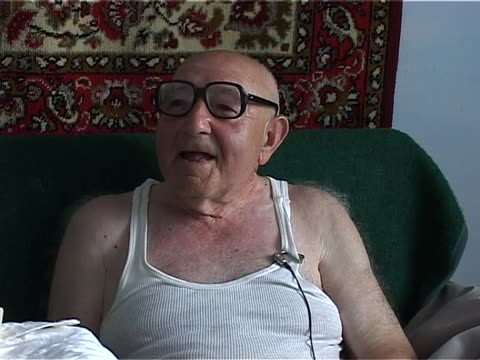
Kogan sings or recites the song about the camp near Bershad, with its refrain about Jews fasting and the Sabbath-eve atonement chicken. Kerler asks to record it again later. Kogan chats briefly with the interviewers about the notebook he reads from, then starts reciting another song, "Aheym, briderlekh, aheym."
Kogan sings "Aheym, briderlekh, aheym," a song about the Jewish people's return and eventual liberation. He then says that he wrote the songs during the occupation, fearing he would be arrested or killed. He mentions being sent to a place whose name is unclear in the transcript (Pishtyanka?) and then begins to read another song.
Kogan also says when and why he wrote the songs, in the occupation and in fear of arrest.
Kogan recites the words for his Yiddish song "Tsezeyt un tseshpreyt" (scattered and dispersed) about his Bershad ghetto experience upon the arrival of refugees.
Kogan recites his song "Tsezeyt un tseshpreyt," about Jewish refugees from Bukovina and Bessarabia arriving in the Bershad ghetto. They arrive hungry and cold, with bundles and small children, and the song hopes for liberation. He then starts to introduce a poem he took from a Jewish writer whose name he cannot recall.
Kogan recites the partisan song "Zog nit keyn mol," and with Kerler's help tries to recall who wrote it. Kerler says he wants to hear Kogan's own songs. Kogan starts the Bershad camp song again.
Kogan sings the whole camp song again. The verses are about Jews in the camp, the shoykhet Gedalye at the gate, the Bershad cemetery and the refrain about atonement chickens. He then starts "Aheym, briderlekh, aheym."
Kogan sings "Aheym, briderlekh, aheym" again and, answering Kerler, says that he wrote it in 1942 (?). He then sings the first lines of "Tsezeyt un tseshpreyt," about the ghetto and the fence around the town.
Kogan briefly talks about his life after the war, as well as his education at a Yiddish school in Bershad. Kogan enjoyed six years of Yiddish education. He also recalls his teachers and lists Yiddish writers.
Kerler asks whether Kogan wrote songs after the war. Kogan says he spent seven years in the army and stopped writing. He then discusses his Yiddish schooling in Bershad, six years of Yiddish before Ukrainian, Russian and German in the seventh. He names two teachers, one of them Soprun (?), recalls Soviet-era Yiddish literature and grammar, and lists Mendele, Sholem Aleichem and others, with translations from Ukrainian authors.
Covers his army years and the Yiddish literature he read and the translations from Ukrainian.
Kogan speaks about prewar Jewish life in Bershad, including locals. He then briefly addresses prewar holiday celebration at home, as well as his family. Kogan's father visited America before World War I. He grew up with one brother, who lives in America and two sisters.
Kerler asks about Bershad figures such as a shoykhet and cantor who was killed, and Kogan describes a prayer house that still exists and fear of the militia when baking matzo after the war. He says his father had been in America and returned. A brother (younger) lives in Indianapolis, where Kerler also lives, and he had two sisters who died. The conversation turns to Kogan's contact with his brother, his brother's illness and whether Kerler can carry greetings or a photograph.
Adds the shoykhet and cantor and the prayer house, plus the brother in Indianapolis and the two sisters.
Kerler puts the dialectological questionnaire to Kogan. The items include the verb forms of a sentence, words for a cross, a baptized Jew, luck and fortune, and a headache. They also cover cold, matzo, 'make' and 'do', 'ask' and 'bed', adverbs such as 'also' and 'again', and body words such as breath, belly and ear. Further items are an idiom for an empty market, 'head' and 'deaf', with some Russian prompts. At the end Kogan returns to family talk about his brother in America.
Kogan continues talking about his brother in Canada and a niece, and the difficulty of finding him. Kerler returns to the questionnaire: the word golem, and words for quickly, later, near and 'come here', with Kogan giving adverbs and phrases.
The catalogue entry mentions family and terminology, but the transcript shows family talk first and then dialect items such as 'quickly', 'later' and 'near'.