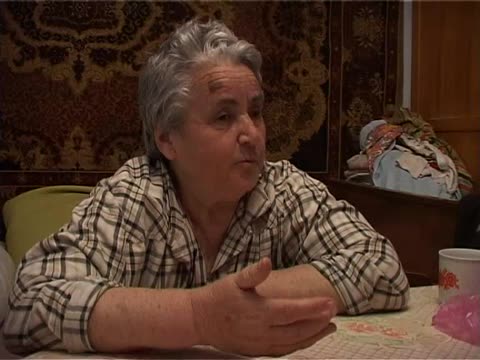
Presler talks about her life during World War II. She was imprisoned in the Pechera concentration camp. Presler remembers children deportations. Shveibish joins the conversation.
From the machine transcript
Presler talks about the first days at the Pechera camp. Small children were brought to the camp and then taken away, and a non-Jewish woman is mentioned in connection with them. Many children were killed, and a second woman asks questions and comments. Kerler asks about recording this on tape.
The transcript is largely garbled, and a second woman interjects with questions.
Presler talks about her arrival at the camp with her immediate family. Presler grew up with two sisters. She then speaks about their daily lives. Her sister, dressed in peasant clothing, snuck out of the camp at night in search for food. In particular, Presler tells an episode when her sister went to the Tulchyn ghetto. According to her, the Jews in the ghetto turned her away and her sister received help from a ethnic German acquaintance. Presler also speaks about the encounter with Romanian soldiers, who took her sister to Bortnyky, where she joined other Jewish prisoners. She then describes their escape plans and how Presler's sister was taken back to Pechera.
From the machine transcript
Presler describes arriving at the camp with her mother and sisters; her older sister Esther was already married. Her middle sister Tsirl, who looked like a non-Jew, dressed as a Ukrainian peasant girl and went out of the camp at night to beg for food in the villages. She walked about forty kilometres to Tul'chyn, where the ghetto Jews would not let her in at first, and a Volksdeutsche acquaintance helped her and raised money from the Jews. On the way back she and another girl were caught by a Romanian detachment and taken to Bortnyky, where they were locked up with other Jewish prisoners who planned an escape.
The transcript also shows the German acquaintance Zhenia (the wife of a relative) and the three girls killed at Bortnyky.
Presler talks about her sister's arrival at the camp, as well as how the Romanian soldiers and Ukrainian police tortured her in 1942. She then describes how officials organized a show trial for her sister, which resulted in beatings and torturing of her older sister and mother as well.
From the machine transcript
Presler tells how her sister Tsirl and another girl were brought back to the camp from Bortnyky, tied to a horse and dragged. The other girl's leg was torn and she died within two hours. Presler's mother and older sister were then questioned and beaten in a staged trial in the camp, and Tsirl was tortured, coughing blood for half a year. Kerler asks for the year, and Presler gives 1942.
Presler continues to speak about her life in the Pechera concentration camp. She recalls the fate of her relatives, before talking about how inmates were deported for forced labor. Presler describes the selection, a month after her family's arrival. According to her, her sisters hid during the selections. Presler also describes the torturing of her family.
From the machine transcript
Presler describes life in the camp. Her mother had six sisters and two brothers, and about forty relatives were driven into the camp together. Presler recounts a selection by the Germans, in which she says the sick and children were set aside, and shooting. She tells how her sisters hid under a wall during it, and how she and her mother stayed, and she describes the cruelty to a relative's child. Kerler asks about the time between arrival and the selection.
The transcript names an aunt, her family and a child hurled against a tree, and Kerler asks for the time of the selection.
Presler talks about another selection by the Germans to take inmates for execution. She states that the Romanian soldiers prevented the deportation in 1942/43. Presler then describes the camp's location, which bordered the Southern Bug river and was located across the German-occupied territory. Presler recalls dead people everywhere, who were shot going down to the river.
From the machine transcript
Presler talks about another German selection in which inmates were driven to trucks to be killed. Romanian soldiers with rifles stood at the gate and blocked it, and the Germans left. She describes the location of the camp on the Southern Bug, with the Germans across the river, and the people shot while going down the rocks to get water. Kerler asks for the year.
Presler returns to the epsiode when Romanian soldiers prevented a deportation. She also speaks about her sister's fate and daily camp life. Presler explains how inmates took care of corpses.
From the machine transcript
Presler returns to the episode in which the Romanian soldiers stopped the Germans, and then speaks about her sisters and daily life in the camp. People hid in the forest in winter, and corpses were laid out and carried off on carts by the inmates, sometimes pulled by people. She mentions a beating by a Jewish policeman and the dying and swollen people, and a second woman adds that no food was given.
The transcript also names a Jewish policeman and the inmates' handling of the dead.
Shveibish and Presler talk about Pechera survivors and the victims who perished. Presler then addresses the living conditions in the camp, including diseases.
From the machine transcript
A second woman and Presler, answering Kerler, speak about how many survived Pechera: about three hundred then, and twenty-three still living. Presler says people were brought from Romania, Bessarabia and Mohyliv. She describes conditions in the camp, including people lying one on top of another, swollen legs and dead bodies every day.
Gives the survivor numbers and the origins of the prisoners.
Presler speaks about the remaining months in the camp, before her liberation. She also talks about her family's fate, as well as the moment when the Germans returned to the camp toward the end of the war in 1944. Presler discusses inmates' escape plans and recalls mass shootings. During that time, Presler continues, she was hiding and then liberated by the Red Army.
From the machine transcript
Presler tells about the last months before liberation. A relative of her mother, Moshe, a specialist held as a worker, urged the inmates to break out when the Germans returned in 1944, and on the Romanian woman's intervention the door was opened. She describes the shooting of those who ran out, hiding under the floor for a day or two, and how she and others were later found by Red Army soldiers and let out of the camp.
The transcript shows the uncle Moshe, a Romanian-speaking woman and the hiding under the floor.
Presler addresses her liberation and recalls the first proper food she received. Presler and Shveibish also remember the execution of criminals. Presler then talks about her return home to Tulchyn, to a destroyed childhood home.
From the machine transcript
Presler talks about the time after liberation, the first food (porridge) and the killing of Germans and police. She and Shveibish remember the execution of a hangman and a policeman named Smetansky (?), who served a sentence and is still alive. Presler describes returning on foot to Tul'chyn to find their house destroyed, and says antisemitism continues to this day.
The transcript adds the discussion of the policeman Smetansky and antisemitism after the war.
Shveibish and Presler discuss the help of Ukrainian peasants during the war. In particular, Presler tells an episode when she, her sister and a friend went out asking for food in a villages. Presler also mentions how they hid from Ukrainian boy shepherds and received beetroot from Christians. Presler then describes how she brought food back to the camp and her mother distributed it among the inmates.
From the machine transcript
Presler and a second woman discuss the help of Ukrainian peasants, without whom they say they would have died. Presler tells how she and two other girls went out from the camp at Passover to beg for food, hiding from shepherd boys and from the police. An old woman gave her bread and potatoes, and she took beetroot mash meant for pigs; she carried the food back to the camp, where her mother shared it with the inmates.
The transcript shows the setting at Passover and the beetroot taken from the pig mash.
Presler talks about her return home to Tulchyn, after her liberation from the Pechera concentration camp. She also addresses her family's fate during the war and housing conditions.
From the machine transcript
Presler talks about coming back home to Tul'chyn after liberation, finding the family house taken, and the fate of her mother's brother, whose wife and children died in the camp. She mentions testifying and the poor housing, and Kerler ends by asking for her name.
Presler provides personal information and talks about her family.
From the machine transcript
Presler gives personal information in answer to Kerler: her name is Donia in her passport but Dobe, after her mother's mother. Tsirl was named after her grandfather, Itsik. Her father was Shoyl and her mother Leah, and her maiden name was Tolbe; Presler is her married name. She says she had three sisters, one of whom has died.