Recordings › Tul'chyn

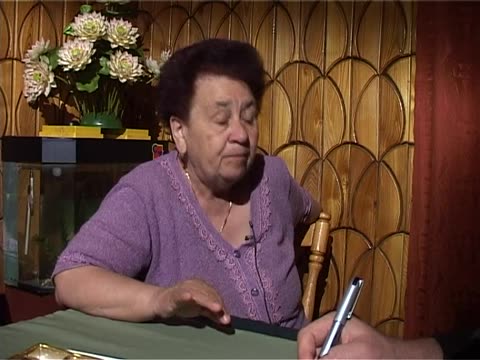
MDV 713 · Rita Davidovna Shveibish; Penia Nukhovich Golfeld

Tul'chyn, Ukraine 20 May 2003 Interviewed by Dov-Ber Kerler, Jeffrey Veidlinger Part 1 of 2 60 min · 6 passages
2 conversations on this tape
  1. 0:00–46:30 · Rita Davidovna Shveibish proposed
  2. 46:30–1:00:59 · Penia Nukhovich Golfeld · also on MDV 714 two sources agree

The division was proposed from the catalogue's descriptions and the machine transcript, not stated by the catalogue (how).

This tape is not yet on the project's channels.
Watch it on Media Collections Online — the time links below open the player there at the right moment.
Passages

0:00

A formal interview of Rita Davidovna Shveibish at a restaurant. She talks about life in Horyshkivka and Tul'chyn before and after the war. She then moves on to discussing today's Horyshkivka. She then discusses the difficulties of working with today’s Jewish institutions in Tul'chyn. She gives a short description of agricultural life before and after the war. She also reflects upon how non-Jews experience postwar times. She talks about pogroms in Horyshkivka and Tul'chyn before the war. The conversation then turns to a series of dialectological questions. She then talks about Jewish food customs and the difficulties of practicing Judaism in today’s Tul'chyn. Shveibish then discusses food customs and recipes. The conversation then moves to the mystical Jewish tradition. The interview concludes with a dialectological questionnaire about the Yiddish language.

From the machine transcript

Shveibish tells about her husband Itsik's family from Horyshkivka. His father came from Tul'chyn after the pogroms, he was a craftsman, and there were six children. She describes the Romanian-era ghetto in the village club, a sister who was shot at and traumatised, the siblings who emigrated or have died, and the parents' graves in Tomashpil. She talks about Horyshkivka as the model for Sholem Aleichem's Kasrilevke, the Yiddish theatre troupe in which her husband's father acted, and pogroms in Tul'chyn and Khmelnytskyi's time. She then describes Jewish life in Tul'chyn today (the community's difficulties, no shoykhet, no minyan, a memorial, aged pensioners), and Jewish food and holiday customs, with a recipe for gefilte fish. The passage includes dialectological questions on words such as store, courtyard, well, potato dishes, thanks and please, and idioms.

Adds the dialectological questions on vocabulary and the passage on Kasrilevke.

46:30

The formal interview with Golfeld begins. He provides personal information and speaks about his family. Golfeld grew up with two siblings.

From the machine transcript

The interview with Golfeld begins, and Kerler introduces him. Golfeld, born in Tul'chyn, gives his mother's name as Eydye and his father's as Nakhum, who went to war and did not return. His mother was left with three children, and he mentions the arrival of the Germans in 1941.

Adds the parents' names and the father's absence at the front.

48:10

Golfeld speaks about his life during World War II. He remembers the assembly and prior disinfection of local Jews in Tulchyn, after the Germans entered town in 1941. Golfeld then describes how he was driven out of Tulchyn in December 1941 to a kolkhoz in Torkiv, where he spent the night. He eventually reached the Pechera concentration camp. Golfeld then describes the journey and arrival in Pechera.

From the machine transcript

Golfeld recalls how the Jews of Tul'chyn were gathered after the Germans' arrival and driven to a disinfection in a bathhouse. They were kept in school no. 2 and then driven out in groups in the rain and winter of 1941, spending a night in a kolkhoz stable, where the first people died. He was nine or ten years old and was driven with his mother some thirty kilometres to the Pechera camp. The camp is a former sanatorium with a gate and bare plank beds.

Adds the kolkhoz stable, a doctor's name, and the thirty-kilometre march.

52:22

Golfeld talks about the living conditions in the camp and remembers shootings from the Germans. He also describes what kind of food was available in the camp and mentions that he became sick. Golfeld then describes how the Germans came into the camp and took inmates for forced labor. Golfeld recalls violence from the Ukrainian police.

From the machine transcript

Golfeld describes the starvation, cold and shooting in the Pechera camp, where Jews were killed by guards for going to the river. He tells of Germans taking inmates to forced labor and killing small children. He recalls Ukrainians throwing food over a fence, eating raw beets, falling ill with fever and walking long distances through the villages in winter.

Adds the killing of children and the food thrown over the fence.

55:50

Golfeld speaks about episodes when he snuck out of the camp in search for food in the villages. He encountered a rebbe in Chechelnyk and joined him for services. Golfeld also addresses his mother's observance. He then remembers a Ukrainian who brought a Torah scroll from the Tulchyn community into the Pechera concentration camp.

From the machine transcript

Golfeld recalls leaving the camp to find food in the villages. In Chechelnyk he met a rebbe (whether Hasidic or a teacher he does not know) who took him in for a service and gave him alms. He then tells how a Ukrainian, Mishka Kotsap (?), hid the Tul'chyn Torah scroll and brought it into the Pechera camp. His mother, who could read Hebrew, is mentioned, and Golfeld praises the man.

Adds the Ukrainian rescuer's name and the mother's ability to read Hebrew.

59:31

Golfeld speaks about his mother's observance and religious dexterity. He recalls prayer services at home. Golfeld then talks about his family.

From the machine transcript

Golfeld speaks about his mother's piety, which the police also respected. She gathered Jews at home for prayer on holidays and had copied out a prayer book in Hebrew. He gives his mother's name as Eydye and her father's as Mordkhe, and starts to speak of other family.

Adds the maternal grandfather's name and a word for 'pious'.