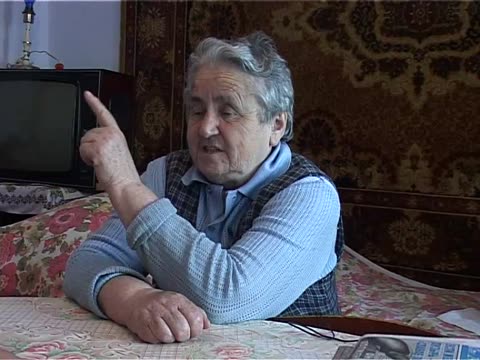
Presler gives her parents' and grandparents' families: both parents were born in Tul'chyn, and her mother had six sisters and two brothers. Her maternal grandfather was a glazier, and her father's family were musicians who played in a klezmer band for weddings, Purim and holidays. She describes growing up in the Kapsynivka quarter by the little river with crowded houses, and the family gatherings there with food, dancing and Yiddish songs. She recalls the 1933 famine, in which a relative died, and the dollars her sisters sent from America. She describes prewar hunger and poverty, and discusses her sisters' wartime and postwar lives, one of them marrying a non-Jewish officer. She answers Kerler's questions about plural forms, Yiddish words and dance names, and recalls Purim and weddings. She also talks about her grandson's singing and her prewar religious life, a synagogue building taken over, and her father's prayer. The passage ends with photographs of Pechera camp survivors, including one from 1990, the year her husband died.
The transcript shows far more than the label: the family and its musicians, the 1933 famine, prewar food, wartime and postwar family fates, and photographs of Pechera survivors.