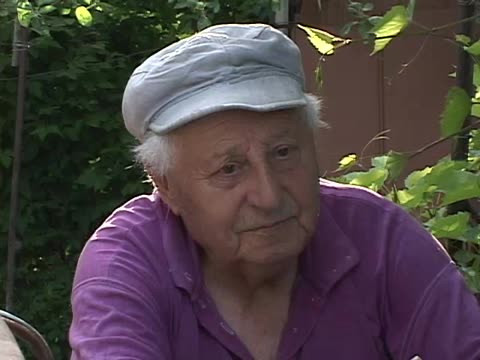
Questions on prewar Tul'chyn: whether the family cooked itself, and how kosher meat was obtained, with shoykhets (a Moyshe shoykhet is named) and a few matchmakers. Kerler presses on the Yiddish way of saying numbers of shoykhets and matchmakers.
Spectrovna speaks about her life and family before the war. She learned how to speak from her grandmother. Yurkovetskij addresses the prewar relatioship between Jews and non-Jews. They also discuss non-Jews who speak Yiddish.
A woman says she learned some Yiddish from her grandmother because her parents did not speak it, and that her mother died when she was young, leaving three orphans. They discuss non-Jews who spoke Yiddish well, whether any are still alive, and Kerler mentions one found in Romania. Lemster and the interviewee talk about trips to Iași and other cities.
The catalogue omits his travels abroad as a worker.
Yurkovetskij says he was freed from camp in 1944 and then went on to travel as a driver to Prague and Vienna. Lemster asks about jokes and anecdotes and about Yiddish writers; Sholem Aleichem, Peretz and Mendele are named, and a writer called Polyanker (?) is discussed. Kerler says Bershad' and Tul'chyn are among the places they have visited, and asks where the speaker is from.
The woman says she was born in Tul'chyn; her mother came from Balta and her father from Tul'chyn. Lemster and Kerler remark on Balta's former status as capital of Moldavia, and ask about her age and whether she would sing. Talk turns to Bershad' and Bukhlovka (?) in the war, and to a man from Bessarabia who had been to Edineț.
Includes a request for a song and mentions of Bershad' and Bessarabia.
Yurkovetskij lists places he visited as chauffeur and speaks about his life after the war. He then recalls names of Jews in official positions during the Soviet period.
Yurkovetskij names places he drove to as a chauffeur (Edineț, Soroca, Bălți) and mentions a writer from Soroca named Zeltser (?). Discussion of beer and drinking and then of Jews who held official positions in Soviet institutions such as a chairman and editor, some before the war.
The catalogue omits the drinking talk and the Soroca writer.
Yurkovetskij talks about prewar Jewish life in Tulchyn. According to Shveibish, there was a local Yiddish school until 1939. Yurkovetskij then addresses food customs, as well as the relationship between Jews and non-Jews before the war.
Question on a Jewish library and school before the war; the answer is that a Yiddish school existed until 1939. The speakers then turn to how Jewish food differs from non-Jewish food, with chicken broth as an example, and to what non-Jews learned from Jews.
The catalogue puts the school statement under Shveibish, which the transcript's Russian line supports.
Yurkovetskij speaks about his best moments in life after the war. He also briefly addresses his life after the war. Yurkovetskij then talks about his family, before the team concludes the formal part of the interview.
Asked about the best years of his life, Yurkovetskij says they were after he returned from the war, when he reunited with his children, rebuilt his life and worked as a driver. Kerler wishes him long life, and they discuss old photographs and sending a message to Tul'chyn natives in America. Photographs for the exhibition are discussed.
Includes the talk of photographs and a greeting for Tul'chyn natives abroad.
A woman, probably Shveibish, explains that Tul'chyn is marking its 400th anniversary this year and that materials on Jewish Tul'chyn will be collected for an exhibition. Lemster thanks her.