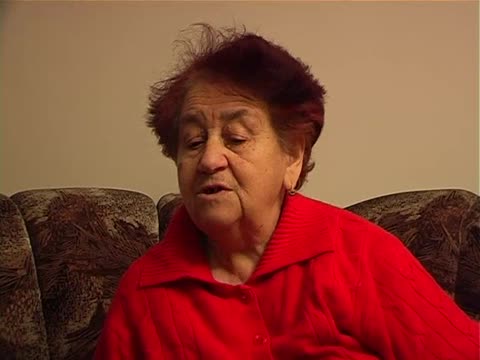
The team arrives at Shveibish's apartment and sets up the interview with her, as well as her husband.
From the machine transcript
Arrival at Shveibish's apartment. Kerler asks for the street and greets the household in Russian and Yiddish; talk turns to vitamins brought as a gift and to a man named Solomon in Bershad' (?).
The formal interview with Shveibish begins. She speaks about her life today, as well as local community life.
From the machine transcript
The interview with Shveibish begins. After exchanges about the gift of vitamins and the cold winter, Kerler asks what is happening in the community. She replies that the community is shrinking and that people are dying, and mentions deaths of local Jews, including a man named Mishe Shvartsman (?) who had been in Pechera.
Names deceased local Jews and the vitamin gift.
Shveibish speaks about organizing visits for high school students to the Pechera concentration camp. She also addresses commemoration and the difficulty to access the killing site, where Jews from surrounding towns were killed. Shveibish then talks about life today.
From the machine transcript
Shveibish talks about arranging visits by schoolchildren to the Pechera camp and the difficult, closed-off road to the site. About sixty-two thousand Jews, from Tul'chyn and elsewhere, are said to be buried there, some brought from Bukovina, Bessarabia and Romania. She discusses commemoration and the effort to keep the place up, then turns to the cold, travel plans and the economic crisis.
Gives the numbers and origins of those buried at Pechera and the access problems.
Shveibish addresses contemporary Jewish life in Tulchyn, including communal support, as well as from abroad for holiday celebration. She also describes her communal work.
From the machine transcript
Shveibish addresses today's Jewish community in Tul'chyn. She says there are few fully Jewish families, perhaps twenty or thirty, and describes help from Hesed, former food aid, and care for elderly people living alone. She also speaks of money and gifts, such as vitamins and Hanukkah candles, sent by a woman in America, and of her own community work.
Includes help from abroad and the remaining families.
Shveibish briefly talks about her life in the Pechera concentration camp. She then addresses contemporary Jewish life in the region, including antisemitic incidents. Shveibish maintains that the numbers of the Jewish population is dwindling. Shveibish provides information on Tulchyn Jewish residents.
From the machine transcript
Shveibish says Yiddish was the only language in Pechera and that some non-Jews still speak Yiddish. She discusses the dwindling Jewish population and the antisemitic remarks heard at the market. She tells of rescuers' children who need help, of local Jews and of Jewish returnees from Israel, and she and Kerler speak about the holidays and the Ashkenazi pronunciation of Shavuot. The interview ends with talk of arranging further visits.
Adds the Shavuot pronunciation exchange and the antisemitism at the market.
The camera cuts to the next formal interview with Kogan. The team greets Kogan, before setting up the interview. Then the formal interview begins and Kogan recites one of his Yiddish poems about the Bershad ghetto experience and survival.
From the machine transcript
Cut to the interview with Kogan. After greetings he prepares to read a text he has written. He recites a poem about the camp and ghetto during the German occupation, calling for survivors to remember and for peace, and ends with greetings in Hebrew.
Kogan's wife talks about her life during the war, when she was imprisoned in the Zhabokrych ghetto. Kogan briefly addresses postwar Jewish life in the region.
From the machine transcript
Kogan's wife says she was in Zhabokrych. Kogan and Kerler talk about his being from Bershad', the surviving Jewish institutions there, and what he saw there during the occupation.
Kogan talks about his life during World War II, when he was imprisoned in the Bershad ghetto. He shares an episode about daily food acquisition, while he encountered Ukrainian police. Kogan then addresses mass killings in the region, before he talks about his brother's fate during the war.
From the machine transcript
Kogan recalls the Bershad' ghetto, an episode with police guarding a bridge near a monastery while he was getting food, and Bukovinian, Bessarabian and Hungarian Jews there. He speaks of the mass killing of Jews, including the shoykhet Gedalye, at the Komuna Voroshilov kolkhoz pit, and of the fate of that man's family. The visitors then take their leave.
Adds the killing pit near Komuna Voroshilov and Gedalye the shoykhet.
Kogan speaks about life today and relations to non-Jews. He then briefly talks about his wife's fate in the Zhabokrych ghetto. Kogan then addresses his and his family's life in the Bershad ghetto. He also remembers Jewish refugees from other areas.
From the machine transcript
Kogan talks about relations with non-Jews, mass killings by the Romanians in Bershad', and a woman's fate in the ghetto (the transcript does not make clear whether it is his wife's). He mentions Jews from Bukovina and his love of Yiddish, and says he wrote in Yiddish and finished seven grades in a Jewish school.
Kogan talks about his school education before the war, including teachers. He studied at the Yiddish school for seven years.
From the machine transcript
Kogan talks about his Yiddish school in Bershad' before the war: subjects such as Yiddish, Ukrainian, Russian and German, arithmetic and grammar taught in Yiddish. He names teachers and the school director and says the schools were later closed.
Adds the teachers' names and subjects, and the later closing of the schools.
Kogan talks about his life in the Bershad ghetto under Romanian occupation. In particular, he remembers the market and (Jewish) policemen gatheringJews for forced labor. Kogan continues that he, as well as Romanian and Bessarabian Jews, were taken for forced labor to Pishchanka. He then describes his escape from Pishchanka back to Bershad. On the way, Kogan carries on, he heard rumors about a forced labor transport to Mykolayiv and thus hid in a chimney.
From the machine transcript
Kogan talks about the arrival of the Romanians and the Bershad' ghetto. He speaks of the market kept by refugee Jews from Bukovina and Bessarabia, and of Jewish police and roundups. He was taken for forced labor at Pishchanka, where his legs swelled, escaped back to Bershad', and hid in a chimney when transports to Mykolayiv were rumored.
Kogan was born in 1927 (?); the catalogue does not mention the dates of the occupation.
Kogan speaks about his liberation from the Bershad ghetto and military draft. He served in the Red Army for seven years. Kogan also describes his experiences when marching toward Berlin via Wrocław, Poland, as well as during the liberation of Berlin. He then returns to his life in the Bershad ghetto under German and Romanian occupation, including forced labor, escape and hiding.
From the machine transcript
Kogan tells of being drafted when the Red Army returned and serving seven years, reaching Berlin, where he wrote his name on the Reichstag wall. He also recalls Wrocław, a factory where many people died from drink, then returns to the ghetto, with its boundaries and the Jewish street, forced labor at Pishchanka, escape and hiding in a chimney.
Kogan talks about his family, especially his father's family in America and his mother's work as candy-maker.
From the machine transcript
Kogan talks about his parents. His father Avrom, called 'of the soap', had been in America and died in the early 1930s (?) in the famine; his mother Gitl, his father's second wife, made candy and died in 1964 (?). He also says that Bershad' was a place of great importance, and Kerler suggests he write a book.
Gives the years of the parents' deaths and that the father's first family lived in America.
Kogan speaks about the Jewish life and individuals in the Zhabokrych and Bershad ghettos. He then recites snippets of his Yiddish songs "Dos lagerl" and "Aheym, briderlekh, aheym."
From the machine transcript
Kogan speaks about Zhabokrych and Bershad' during the war, including killings in Zhabokrych and the Romanian occupation. He names local Jews such as the shoykhet Gedalye Shulman (?) and the hearse-driver Avrom'tse (?) and his wife, with Kerler asking who they were. He then recites parts of his songs 'Dos lagerl' and 'Aheym, briderlekh, aheym'.
Adds the identification of Gedalye the shoykhet and Avrom'tse who carried the dead.
Kogan reads his Yiddish song "Aheym, briderlekh, aheym." He then shares an episode about collecting money in the Bershad ghetto to support partisan activities. Kogan also mentions that the community transferred the dead from a massgrave on the former kolkhoz komuna vorushilov (коммуна ворушилов) near Bershad to the Jewish cemetery, immediately after the ghetto's liberation by the Red Army. According to Kogan, one German helped.
From the machine transcript
Kogan recites his song 'Aheym, briderlekh, aheym', which he says was written after the war. He tells of collecting money in the Bershad' ghetto for the partisans, with the donors' names put into a bottle and later demanded by the prosecutor. He recalls the dead being moved from the pit at Komuna Voroshilov to the Jewish cemetery after the liberation, with Kerler asking about a memorial and the date.
Adds that Kerler asks about a memorial at the killing site.