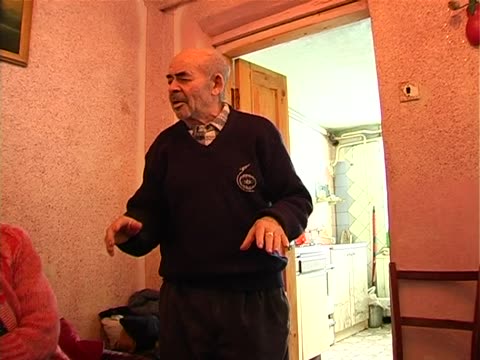
The team sets up the formal interview with the Kolodenkers. They discuss life today.
From the machine transcript
Setup of the interview: Kerler explains to the family that the recording is for an archive used to study Yiddish and Jewish history, and they discuss the visitors coming from America. Some talk of other people from the town and of a blessing is partly garbled.
Lev Kolodenko talks about his life during World War II. He was drafted for military training in the Voroshilovgrad Province and then sent to the Urals, before fighting on the front. Lev was trained in an artillery school and graduated as sergeant. He describes his experiences during training and when he was in command of seven soldiers on the front through Poland to Berlin. Lev also briefly addresses his father's fate during the war. He fought in the First Belarusian Front under Zhukov.
From the machine transcript
Lev tells of being sixteen when the war began, of young people being gathered and sent to Voroshilovgrad province in Ukraine and then to the Urals, and of evacuees there. He says his father was taken into the army and did not return. At eighteen he was drafted, finished artillery training as a sergeant, commanded seven soldiers, and fought under Zhukov through Poland and across the Vistula toward Warsaw and Berlin.
adds his father being drafted and not returning, and the route through Poland to Berlin
Lev provides personal information and talks about his family. His father was also born in Tulchyn and worked as coachman. He then addresses the fate of the Tulchyn community when the Germans occupied the region in 1941. Lev describes forced assemblies, disinfection in the local Yiddish school and forced marches to the Pechera concentration camp. He then speaks about his family's fate, as well as living conditions among Jews from different regions in the camp. Among other themes, Lev addresses cannibalism, forced labor, mass graves in a near-by forest and burial.
From the machine transcript
Lev gives his birth in Tul'chyn, where his father was also born, and then describes the German occupation. Families were registered by police and stripped in the bath, the old were shot or hanged on the march, and a great-aunt tried to hang herself. He describes the Pechera camp, where Jews from many districts were held behind fences, hunger and deaths, and the pits in the forest where the dead and the shot were buried, some after digging their own graves.
adds a doctor (a non-Jew) in the camp and the great-aunt's attempted suicide on the march
Lev speaks about commemoration of the Pechera camp. He also addresses Yenta's family's fate in the camp.
From the machine transcript
Lev speaks of a memorial obelisk made at the Pechera site where many Jews were killed. Yenta recounts her father's three sisters in the camp, one of whom carried out her dead children day after day and made up a song about it. Her husband came back from the army to find seven children born and lost in the camp.
adds the story of the woman who composed a song after losing seven children
Pesia recites the words of a Yiddish song they heard from a woman in the camp. Lev then mentions how Ukrainian acquaintances threw food over the camp's fences. Alexandr explains the occupational structure of the camp, before Pesia shares episodes of daily life, including water acquisition from the Southern Bug river and living arrangements. She also talks about her family's life in the camp.
From the machine transcript
Pesia gives the words of a camp song, then Lev recalls how his father, a coachman, was helped by Ukrainian acquaintances who threw food parcels over the fence. Kerler asks about Romanian and German guards on the two sides of the Southern Bug, and a word for plain water is explained. Aleksandr describes the crowded rooms, and Pesia speaks of the thirst, the water, her mother and Bukovinian Jews in the camp.
adds Kerler's questions on the guards and a word explained to him
Pesia recalls the moment when she fell sick with typhus and mentions cannibalism in the Pechera camp. She speaks about other inmates and recalls the help of her former neighbor, Ayzik who worked as barber, "visiting" the camp. Pesia then shares more episodes about daily life, including violence by the Ukrainian police during food acquisition. They also mention the persecution of a Ukrainian police officer after the liberation.
From the machine transcript
Pesia recounts falling ill with high fever in the camp, her mother, and a neighbour Ayzik who helped them. She describes begging in nearby villages for bread, the cruelty of Ukrainian policemen, and a Jew shot over something he bought from a villager. Kerler asks about a Yiddish word for icicles.
adds the shooting of a Jew and an exchange about the Yiddish word for icicles
Pesia talks about an episode from the Pechera camp, when she was forced to go into the river. She explains how she received help from a young Romanian group that spent time by the river, while a police officer watched. Pesia also recalls daily deaths, burial and numbers of victims.
From the machine transcript
Pesia tells how she nearly drowned in the river while a policeman watched, and how young Romanians from Bukovina made a chain of hands to rescue her. She describes daily deaths in the camp, among them a woman with six children, the burial and the pits. Kerler asks how many lie there, and a figure of fifteen thousand is mentioned (?).
Lev talks about his life after the war, including the relationship to non-Jewish neighbors. Yenta and Lev spent eleven years in Israel and frequently visited Tulchyn. Yenta then speaks about her family. She has one sister.
From the machine transcript
Lev says non-Jews helped Jews in the camp, then speaks about later life: about ten years in Israel (eleven by Yenta), and eight or nine return visits to Tul'chyn, where a Christian neighbour kept their house. They describe loneliness in Israel, a brother and sister in Tul'chyn, their son and grandchildren, and Yenta's age.
adds Kerler's question on the length of stay, a Christian neighbour and relatives in Tul'chyn
Pesia returns to daily life in the camp. She specifically addresses hygiene, starvation, as well as remembers formerly wealthy inmates. Alexandr also provides a picture of camp life.
From the machine transcript
Pesia describes camp conditions: hygiene, starvation, and well-off inmates, including a wealthy family from Mohyliv(?) and a well-dressed Bukovinian girl who died soon after. The others add reflections on camp life, including shaved heads.
Lev and Pesia address Ukrainian contemporary politics and reflections on the Great Hunger in 1932/33.
From the machine transcript
Lev and Pesia discuss current Ukrainian politics and the Great Hunger of 1932–33. They argue about how the famine is described and blame the Soviet grain requisitions. Pesia also says kulaks hid grain in cellars.
Pesia provides personal information, before Lev addresses his life before the war. He worked in the Tulchyn shoe factory. They also briefly discuss life in the postwar Soviet period, including leisure activities.
From the machine transcript
Kerler asks Pesia about her illness in the camp. Lev then speaks of working at fifteen in the Tul'chyn factory, of factories closing, prices and cooperative housing in the Soviet period, and of leisure with music. He says Tul'chyn had fifteen thousand Jews before the war.
adds the figure for Tul'chyn's prewar Jewish population
Lev speaks about prewar Jewish life in Tulchyn. Pesia addresses prewar cultural life, as well as her education at a Yiddish school for five years.
From the machine transcript
Lev and Pesia speak about prewar Tul'chyn: Yiddish was heard on the streets, there were Yiddish theatre and schools. Pesia says she completed five classes at a Yiddish school, though her parents wanted it. Kerler asks until when Yiddish was heard on the streets.
Lev talks about his life after the war, including how he fixed up his house. They then talk about life today. Alexandr and Yenta then provide personal information.
From the machine transcript
Lev tells how he rebuilt his house after the war with the help of a Ukrainian specialist, and they chat about life today. Kerler asks Yenta and Aleksandr their ages, and her maiden name is given as Tolkovitz; the passage ends with Kerler asking what it means to be a Jew.
adds Kerler's question on what it means to be a Jew
Lev surveys Jewish history, before Yenta addresses postwar religious life in Tulchyn. Her father was a baker and frequently attended services after the war. Lev's mother was born in Tomashpil.
From the machine transcript
Lev surveys Jewish history (Solomon, David), and Kerler asks how Solomon is said in Yiddish. Yenta says that after the war her father, a baker, always went to pray in his tallis. Tomashpil is named as the birthplace of a mother, whose is not clear.
adds Yenta's father's work as a baker and the exchange about a Yiddish name for Solomon
Lev talks about antisemitic sentiments concerning Jews not fighting in the war. Yenta then provides personal information.
From the machine transcript
Lev and Yenta speak about Jewish war heroes and honours, and about Jews' part in the war. Kerler then asks Lev to talk about his medals. The passage is badly garbled.
the catalogue mentions antisemitism and personal information, which the transcript does not clearly show
Lev explains his military awards and decorations. He then speaks about his achievments and positive feedback from his soldiers. Lev states that he did not get an award due to antisemitism in the Red Army.
From the machine transcript
Lev shows and explains his medals, for the liberation of Warsaw, the capture of Berlin and victory over Germany, and notes an Israeli award bearing a menorah. He tells how he led his soldiers across the Spree and was not decorated, which he attributes to antisemitism. A Gypsy colonel (Gumerov?) and a Polish soldier named Skibitsky(?) figure in the story, and Lev says he had it from his soldiers that he was a good sergeant. Much is in Russian.