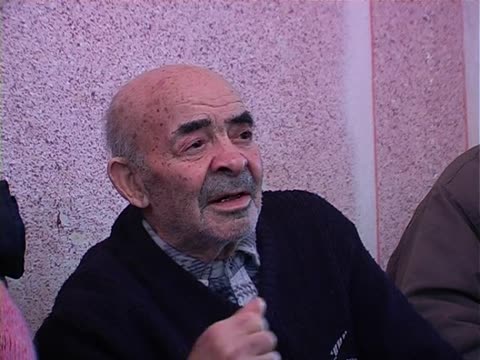
One conversation with Aleksandr Shayevich Kolodenker; Lev Shayevich Kolodenker; Pesia Kolodenker; Yenta Usherovna Kolodenker, continuing over MDV 728, MDV 729.
Lev talks about his military achievements, before he discusses his service in the Red Army after the war. Lev explains that he was too young to be demobilized when the war ended. He was sent to Saransk, Mordovia and was discharged in 1950, after seven years of service in the artillery division.
Kolodenker discusses a mix-up in his documents and surname with other family members, who join in; the passage then turns to his army service. After the war he was sent to Mordovia (Saransk) because he was too young to be demobilised. He served seven years in the artillery, and says he returned to Tul'chyn around 1950.
Opens with the family discussing a documents and surname mix-up, which the catalogue does not mention.
Lev speaks about his life and work after the war, when returned from his military service to Tulchyn. He took chauffeur lessons and worked as truck driver. Lev then talks about his family, particularly his son.
Kolodenker speaks about learning to drive and working as a driver after the war. He then talks about his son, an engineer who works on Japanese equipment and lives in Canada; Kerler asks about him.
Pesia speaks about Jewish life before the war, particularly recalling the Great Hunger of 1932/33. Specifically, she describes how her grandmother would collect scraps in the cafeteria she worked at. Pesia also describes persecution during the Great Purge (1934 to 1939), as well as talks about her family. They also mention wealthy local people.
Pesia Kolodenker describes the famine of 1933 in Tul'chyn: her grandmother's work and how a non-Jewish woman brought grain and a cow to the family. She mentions wealthy people, including non-Jews, who were deported. Kerler and the others then discuss what made someone wealthy and whether Tul'chyn had Jewish millionaires.
Also covers deportation of wealthy people and a discussion of Jewish millionaires.
Yenta Kolodenker's father's names (Usher, Khayim and Pinkhes) are discussed, followed by Pesia on naming a child after a deceased relative and for protection. The talk turns to Israel and America: the Yiddish spoken in Israel, Pesia's years there, prices and the families' children abroad.
Includes discussion of life in Israel and America, and of Yiddish there.
Pesia talks about prewar Jewish life in Tulchyn, particularly wedding celebrations and customs. Lev and Yenta also speak about contemporary local life.
Pesia and others describe a Jewish wedding in prewar Tul'chyn: the music, dancing until morning and the sharing of cake among relatives, and a dance with the in-laws (the transcript is unclear). They go on to talk about mothers-in-law and daughters-in-law and about living alone, and an anecdote about a man from Moscow who bought a house in Israel.
Includes the Moscow man's anecdote and talk of mothers-in-law.
Pesia speaks about prewar Jewish life and mentions anecdotes about the wealthy Jew Roytshulem (Sholem Royt). Pesia states that her school organized excursions to his house.
Pesia tells about the rich Jew Roytshulem, who was said to have hidden in his own vault with his gold. Kerler asks about the sources, where his house stood and the sites connected with Count Potocki; Pesia says her school took the children on an excursion there. Several people then talk about hunger and bread in the 1930s.
Includes the sites and sources of the Potocki palace and bread hunger.
Yenta talks about her family. Yenta then speaks about prewar Jewish life in Tulchyn and recalls poverty. Pesia also addresses prewar religious life and mentions a local synagogue. Lev shares an episode where they officials would not allow an extension of the synagogue.
Yenta and Pesia recall children and Yom Kippur in a prewar street, and a large synagogue on Shul gas with painted birds. Pesia describes a quarrel between rabbis over building it and the local authorities' refusal to extend it. Lev and others discuss Count Potocki's role; Kerler asks for clarification.
Starts with Kerler asking about weddings and Pesia's father as a prayer leader; the passage mostly covers the synagogue.
Pesia speaks about prewar life and how a local synagogue building was used as granary before the war. According to Pesia, the community could not agree on how to build the synagogue. Lev then speaks more about the construction of the synagogue.
Pesia and Lev tell how the large synagogue, built in a dispute with Count Potocki, was later used to store grain; they recount an accident with a brick and a bird. Kerler says he does not fully follow the story of the building and asks for clarification.
Kerler asks for clarification and Lev adds to the account of the building.
Lev speak about his life in Israel, before they discuss the Rebbe Nahman of Bratslav. Lev then briefly addresses pilgrimages to Bratslav in the postwar Soviet period.
Lev speaks about rich Jews in Israel and former Tul'chyn residents in Canada. The conversation turns to Rebbe Nakhman of Bratslav: visits to his resting place in Uman, and Soviet-era pilgrimages, are mentioned, followed by prices and a very old man.
The Bratslav pilgrimage is placed in the Soviet period.
Yenta recalls how late people stayed at weddings and the klezmers, including the musician Shmukhe and a man called Shoyl Tes (?), who played the clarinet. The talk then turns to present-day life and prices.
Lev speaks about his life and work after the war. He was a shoemaker before and after the war. In the immediate postwar period, Lev worked as truck driver. Lev retired after thirty-five years and continued to work for five more years. He also addresses living conditions today.
Lev speaks about his work before and after the war, thirty-five years as a shoemaker, and his later pension. He compares wages and prices with life today, including medals and pension supplements, and ends with a discussion of politics.
Participants recall childhood in prewar Tul'chyn: songs and stories, sitting on the porch, borrowing live coals for the fire, tea from the samovar and white bread for holidays. They mention pogroms and going barefoot at Purim and Passover.
Adds a pogrom mention, shoes at Passover and Purim.
Kerler asks about Purim terms (shalakhmones), the Purim play and singing; the answers are brief. Others recall matchmaking and local girls. The passage ends with talk about the project, addresses and where Kerler lives in America, and about the size of Tul'chyn.
Includes the Purim questions and the talk about the archive.