From the machine transcript
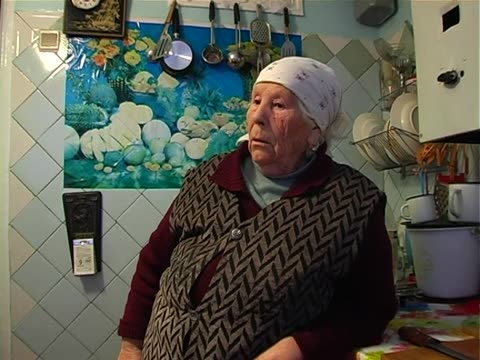
Pecherskaia and the team try the dishes she has prepared. She speaks about her son, who lives in a new district of Tul'chyn, and about relatives in Israel and America, including half-sisters whose city she does not know. She describes going to Pechera every year at Rosh Hashanah, where her family lies, and being photographed and interviewed there. She names her family and gives her name, maiden name and birth year; her father Yosif worked as a coachman or carter. She had four siblings, including her brother Hershl, killed in the army at seventeen, and her sisters Shele and Rivele, who died in Pechera. She gives a long account of Pechera: her mother killed with shovels, her sisters' deaths, her escape and recapture, the German camp in Bratslav with its killings in the forest, and hiding in a pit and with a Polish woman until the partisans came. After the war she worked at a brewery in Bratslav and married in 1945. She talks about her husband Shune, her stepfather, her children and grandchildren, and a daughter in Israel. She recalls prewar Bratslav, a field wedding, her grandfather and prayer, Passover, the Bratslav tsadik's grave, and the hunger of 1933. She also talks about Tul'chyn after the war, her fasting, Passover matzo and gefilte fish.
Beyond the catalogue's outline, it covers the Bratslav German camp, schooling, the shoykhet, Passover matzo and gefilte fish.