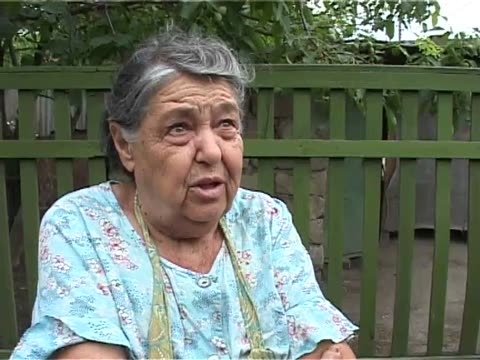
Street encounter with an elderly woman and others in Bershad'; local people name streets and the Soviet names of the town's quarters. The woman gives her name, says her father's family were Oystrakh, and mentions a relative who lived in Moscow and one in America. Kerler asks whether she can sing; she says she knows a song from the camp, and mentions that she survived the killings at the pit.
Includes the first hint of her survival of the shooting at the pit.
The woman tells of surviving the killings in the Bershad' ghetto, lying wounded and escaping from the pit, and wandering from town to town. She says she lived in the synagogue building, tells of a sister who fell at the front, and says her mother left the house. She now lives with her husband, a Jewish shoemaker, while her daughter lives nearby; Kerler and others discuss compensation payments from Germany.
Adds the postwar family situation, her husband the shoemaker, and the question of compensation.
Family: a sister who went to the front and an uncle in America who wanted to take her out. The father died in the 1930s, perhaps during the famine, leaving the mother with two children. The informant says her grandparents are no longer alive and recalls that the family lived in the synagogue building where her mother prayed. Her mother was a cook; Kerler wishes her health to enjoy her grandchildren, and the talk touches on Israel.
Adds the uncle who wanted to take her sister to America and the mother's work as a cook.
Gvinter is asked how her mother prepared fish for Jewish weddings and explains the recipe for chopped fish. Kerler suggests a name for the dish; she mentions onion and a little pepper. Another voice thanks her.
Kerler and others speak in Hebrew and Yiddish with a woman, probably Gvinter's daughter (?), who lives in Israel and works there. There is talk of San Francisco, Jerusalem and health; at the end Gvinter calls for someone to come over and asks about a name.
Gvinter is asked to repeat a sentence in Yiddish about how Jews lived on the streets before the war, and speaks of Jews living close together. She tells of reading books by Sholem Aleichem and Mendele and of giving her books away when she left for Israel. She also says the ghetto was very large and lists places from which Jews were brought, including Chernivtsi, Mohyliv and Sharhorod, and recalls Jews being bound in chains.
Gvinter's husband (Yuzl, per the catalogue) joins in. She says she has two daughters and four grandchildren in Israel. She speaks of living among mixed nationalities there, with Arabs and others, and of an Israeli's remark about preserving Jewish identity.
Gvinter recites a song she learned in the camp or ghetto, about the killing of a family at the pit, a child and the Jewish cemetery. She says she is an orphan who lived through it; Kerler comments on her strength.
Adds the content of the song about the shootings and her words as an orphan.
Closing the interview, Kerler asks permission to use the recording for research. Gvinter identifies photographs, an uncle who owned a factory in America, her husband (Yankel Itzker, per the transcript), and tells of her mother Sura Oystrakh the cook. Kerler hopes to bring her gefilte fish next year and they say goodbye.
Concluding the Bershad' visit, with wishes of health exchanged. Local people talk about the Jewish community, the Soviet and Jewish schools, and the writer Brodovsky (?), who lived in the town for some years and had no luck there. Part of the passage is town footage with voices in Russian.
The second part of the tape takes place in Uman' and is a formal interview with the cousins Efim Isaakovich Rubin, born in 1922, and Matvei Vladimirovich Rubin, born in 1928 (part 1 of 3. See MDV 734 and MDV 735). The interview is recorded at the grave of the Tsadik Nahman of Bratslav. They discuss the name of the town Uman'.
Kerler asks how Yiddish speakers say the name of the town; the second speaker says Uman and tells a story about why it is called that: a tavern keeper's Jewish wife Manya, hence a form like Umania, used by Jews in earlier times. Kerler asks whether Jews or non-Jews say it, and begins the interview proper.
Kerler takes down contact details and names: Matvei Vladimirovich and Efim Isaakovich. Both were born in Uman' and moved with their parents to the town of Buki, fifty kilometres away. Matvei was born in 1928 and Efim a little earlier. He says many Jews were killed in the area and the family fled to a smaller town; in 1940 he was at a military school in Odessa.
A Rubin describes his wartime service: the officer school leaving Odessa for Moldova on the first day of the war, a first fight with a German, being encircled, then Moscow, the Volkhov, Kalinin and Smolensk fronts. At 18 he commanded forty soldiers and burned tanks with bottles. He tells of being shot and wounded on the Smolensk front, with six operations, and is now a disabled veteran, with a pension of 180 hryvnia, who attends prayer with a rabbi.
Rubin says he and the other go to services on Sabbath. Kerler asks about the year of his marriage, and when he went to Odessa and when he was drafted: he says he was in the army before the war, in 1940.
Adds the dating of military school and the Sabbath minyan.