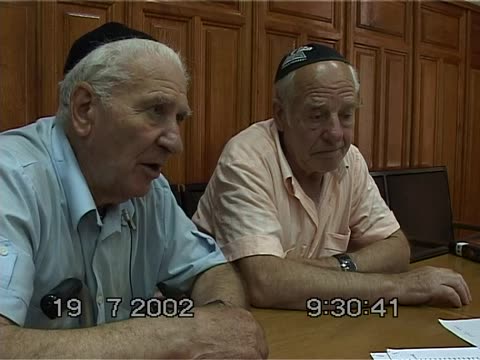
Efim recalls boyhood in Buki, when he studied four years in a Yiddish school before the communists closed it. He then moved to a Ukrainian school and finished ten classes, and was drafted into the army in the year he finished. He says he can still read and write Yiddish and mentions a small book printed in Hebrew and Yiddish.
Kerler asks Efim to write some Yiddish words, such as the word for Sabbath and the word for friend. Efim says his handwriting is poor now. He then recalls that his mother was a pious woman who prayed and read Hebrew, and gives her birth year.
Efim's mother and her Hebrew learning are introduced here.
Efim gives his mother's name and maiden name (Shtutman) and tells how she travelled to Israel and died there in 1991 (?). His father is buried in Buki, and he has visited his sisters' graves in Israel. He mentions his daughter, a dentist in Kharkiv, and grandchildren and great-grandchildren. He says he was the eldest of three siblings and that his father was a barber, as was Motl's father, a butcher. His own work as a dental technician comes up, as do the death of Motl's father in Buki and the family names.
Adds a trip to Israel to the family's graves, his daughter in Kharkiv and the fathers' occupations.
Efim and Motl describe Jewish Buki as a large town with many Jews, mostly locally born. It had one large synagogue with separate women's and men's sections, three shochets and a rabbi whose name is partly remembered (Zarnitski?). Kerler asks what the town was called in Yiddish, and the electric station is mentioned.
Adds the shochets, the rabbi and the synagogue layout.
Motl and Efim talk about the first hydroelectric station, built near Buki on the river Hirskyi Tikych and shown at an exhibition in Moscow. It was later merged into a chain and closed. Kerler stops to ask for the Yiddish name of the river. Kerler then turns to cheder.
Efim says he did not attend cheder but a Yiddish school that was soon closed after four years. He learned reading and writing there and recalls the Yiddish textbooks. Kerler asks whether he remembers a poem or song.
The passage is about the Yiddish school and cheder, not the dam.
Efim sings or recites a few Yiddish songs, including one with a Rebbe Nachman refrain about dancing in hard times and a wedding song. He then speaks of the family of klezmer musicians in Buki, especially his uncle Hershl Bonder, who played the cornet. A relative named Nadya played the drum (?). He also mentions that during the famine of the 1930s hungry children were told to dance.
Adds the wedding song, the cornet and the famine children's dancing.
Efim recalls the famine of the early 1930s, when people ate frogs from the river and many died, though he does not remember Jews of Buki dying. He lists the town's Jewish trades, such as tailors, hatmakers, shoemakers, tinsmiths and wheelwrights, and explains the terms for those who make wheels and wagon parts. He also tells his father's story of straw roofs being burnt so that tin could be sold.
Adds the trades, the terms for wheelwrights and the roof story.
Efim describes Passover customs: bringing down the Passover dishes from the attic, baking matzo communally and the foods made from matzo. He also describes the seder and the four questions, which the son recited, though he has forgotten them. Kerler asks about Chad Gadya and Hanukkah, and they discuss lighting candles and potato (?) latkes for Hanukkah. Latkes are said to be called blinis in Russian.
Efim says a memorial was erected after the war at the killing site of the town's Jews and offers to drive there. Kerler asks about words for tombstone and Jewish and non-Jewish cemeteries. Motl says his mother took him to synagogue as a child. The closing of the Yiddish school in Buki is discussed, along with the father's work as shochet until the war and kosher meat.
Adds the memorial at the killing site, the closing of the school and the shochet father.
Motl, with Efim, explains how gefilte fish was made, from skinning and chopping the fish to stuffing the skin and cooking it with sauce, and discusses whether it was sweet or peppery. They also describe fish cooked in layers with beets, and also sweet meat dishes made with jam or sour salt. Kerler asks for Yiddish names for potato latkes, rugelach-like pastries with raisins and nuts, honey cake and kamishl, and for the braided breads kuletsh and challah baked for Sabbath. Some Russian and Ukrainian terms are named.
The passage also covers the gefilte fish recipe in detail, baking and Sabbath breads.
Kerler puts dialectological questionnaire items to Efim and Motl: words for bed, headache, cry, how, please, forgive me, street, and for the cross and for convert. They discuss the Buki word for "cross" and how "he became a Christian" or "became a Jew" is said. Some items are answered in Russian.