0:00
Town footage of Uman
Town footage of Uman
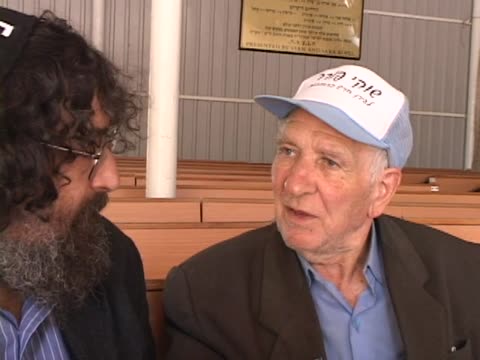
Informal chat with Yuri Rafulovich Krasheny
Rubin tells of a friend's funeral in Buki, apparently before the war (the transcript gives 1938 or 1939), at which the man woke up and walked home. He asks Kerler to greet Matl, a relative from Buki whose wife has died and whose son lives in Ashkelon, and says that a few Jews still pray in Uman' and that their rabbi is Rabbi Fish from America. He and Kerler recall an earlier visit about three years before and discuss an illness that doctors could not cure.
The speaker is Rubin and the content is the funeral story and his relatives, not an informal chat with Krasheny.
Information about potential Yiddish-speaking interviewees
Kerler asks whether Rubin remembers the name of an old Jew aged about 95 or 96 and where he lives; the answers are brief and the name is not clear in the transcript.
The catalogue entry (potential interviewees) fits.
Celebration of holidays today
Rubin says that great numbers of people come to Uman' for Rosh Hashanah, Purim, Hanukkah and Passover, and that he has been going for fifteen years. He gets kosher matzo at Passover, reads Yiddish letters only a little, and says there are no prayer books in translation. He and Kerler talk about a Yiddish story book and a siddur with a Yiddish translation. Rubin also speaks about Matl's ill sister, a son who lives in Jerusalem and works at a dairy firm (?), and his own visits to his mother's grave in Israel.
It also includes Rubin's reading of Yiddish, a siddur with translation, and his relatives in Israel.
Potential interviewees
Kerler explains to those present that he wants to find the old Jew (Yidl) in order to sit with him and record his Yiddish, and that the team records interviews with elderly Jews. A man (S3) asks Kerler questions in Russian: Kerler says he is from Moscow and left in 1971. Rubin says he does not know what to say. The talk also touches on a man's daughter in America and on a woman, Fanya or Pani (?), whose name is not clear.
Discussing Jewish buildings
Kerler and a local man (S3) discuss the buildings of Uman' as seen from the deck: the choral synagogue, a plant (zavod) on the site of buildings from Reb Nahman's time, and a large building opposite. They mention Gonta, Zheleznyak and Khmelnytsky. Kerler asks whether Jews went to the grave in Soviet times and is told that they did not know of it.
It also covers Soviet-era visits to the grave and the Cossack figures.
Yiddish song and religious life before the war
Rubin recites or sings short Yiddish songs, including one about a tailor and one about a girl sewing, together with a saying attributed to Reb Nahman about dancing in hard times. Kerler asks him to repeat them for the microphone and asks about their source. Rubin recalls his grandfather, who died before the war and who took him to the beys-medresh and sang Sabbath songs. Rubin says he studied in Odessa before the war.
It also includes Rubin's grandfather and his Sabbath prayers at the beys-medresh.
Military service
Rubin tells of his service at the start of the war: he left Odessa on the first day for Moldova and then Romania. He describes a fight with a Romanian, digging trenches and setting German tanks alight with bottles, and says he was only about eighteen yet the oldest in his unit and was nicknamed for it. Kerler follows with questions.
The catalogue entry (military service) fits.
Memorialization
Rubin says that 25,000 Jews were murdered and lie in a long dry ditch about five kilometres from Uman', which S3 names as Sukhoyar (?). Many of his friends lie there, and he asks Kerler to write the names down.
The catalogue entry (memorialization) fits.
Town footage and stories about Buki
Kerler and S3 discuss a saying of Reb Nahman, then the origin of the name Uman', with a story about a woman named Manya who drank tea. Kerler says the team is going to Bershad. Asked about Buki, Rubin recalls that houses were roofed with straw, and that a man was paid to set fire to the roofs at night so that people had to buy tin from merchants.
It contains a story about arson in Buki and the origin of the name Uman', not footage.
Jewish education and Yiddish song
Asked about school, Rubin says there were several Jewish schools and workers' schools (for tailors, shoemakers and others) where reading, writing and singing were taught. He recalls a gramophone and songs, including a wedding song about seating the bride. He describes his family of klezmers who played clarinet, flute and fiddle, and Hershl Bonder (?), the leader of the klezmer group, whose four daughters also played.
It also includes the klezmer family, instruments and Bonder's daughters, and Jewish schools.
Religious life before the war
Rubin describes prewar religious life in Buki: Jews gathered in small groups in a house away from the centre to form a minyan, and quietly so as not to be seen. He recalls that his uncle Velvl, a butcher, brought kosher meat, and notes the word the Jews used for meat.
It names the uncle who was a butcher and the word for meat.
Family visiting Buki from America before the war and life today
Rubin recalls a large family (about twelve sons and eight daughters) and a relative who visited from America, who was allowed only as far as Kyiv and had to hire a taxi at night. He also speaks of an old woman, Frida or Fanya (?), who survived the war hidden among Germans, now receives money from Germany and parcels from America. He ends with his own work as a taxi driver.
It also covers Rubin's survivor acquaintance and his taxi work.
Entering Krasheny’s apartment
The team enters Krasheny's apartment, and S3 and S4 explain to Kerler that Krasheny does not speak.
Religious life today and family
In Krasheny's flat Kerler tries to get a deaf man to talk about Uman' and Yiddish life there. S4 and S3 explain in Russian that photographs show a first minyan some fifteen years earlier, and that a man in them went to America. An elderly man (S2) rambles in Yiddish about the first pilgrims to arrive, Yom Kippur, his grandfather the tsadik and a dream; the transcript is too garbled to follow in detail.
It adds the long Yiddish monologue by the deaf man and Kerler's repeated requests.
Showing Israeli passport and life today
Kerler and the others keep trying to communicate with Krasheny, who is deaf: showing a map, talking on the phone, and urging him to speak. S2 says he cannot understand when he does not speak and wants to look at the siddur, and says that he prayed.
The Israeli passport named in the catalogue entry is not clear; the transcript shows a map and talk of the telephone.