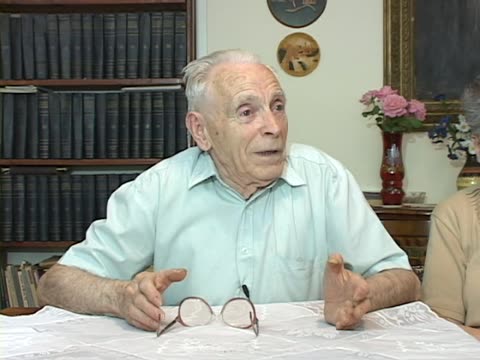
Ernest talks about Jewish life under German occupation in general and how little they knew about the fate of the Polish Jews and how they had no knowledge of Auschwitz. He then talks about his life during the war and his imprisonment in a labor camp. He received a letter from his wife, who was imprisoned in Auschwitz. At the beginning of World War II, under Hungarian occupation, they set up the ghetto in Mukacheve and took young people to labor camps in Hungary. When the Red Army moved forward in Hungary, they resettled the labor camp prisoners to Germany and Austria, at end of 1944. Everyone else was sent to Auschwitz.
From the machine transcript
Halpert explains how little Jews under Hungarian rule knew of the fate of Polish Jews or of Auschwitz, which they took for a labor camp. He describes being taken as a young man from the Mukacheve ghetto to a labor camp, then to Austria at the end of 1944, and receiving a letter from his wife. The passage opens with a brief exchange about Hungarian and Tubi's father in the Budapest ghetto.
opens with talk about Tubi's father and Hungarian, and includes the Polish-Jewish refugees expelled from Hungary
Tubi talks about her life during the war, in particular the transport from the Mukacheve ghetto to Auschwitz. The postcard she sent to her husband from Auschwitz was supposed to include twenty-five words with the content that life is good in the sanatorium in Wannsee, near Berlin. Tubi arrived in Auschwitz on May 20, 1944. In the Mukacheve ghetto, Tubi worked at a sugar factory; before they were sent to Auschwitz in trains, loaded with eighty people in every car. Tubi stayed in Auschwitz for three months, before she and 150 other women were taken to a forced labor camp Reichenbach. In Auschwitz, they awaited work assignments. Tubi then talks about her arrival at Auschwitz with her brother and mother Hilde, and the initial selection. She and her brother were separated from their mother, who was taken away in a car. Every morning, she reported to roll call for two hours. Ernest’s two sisters were also sent to Reichenbach. Tubi worked in an electric factory for nine months until May 8, 1945. She recollects the terrible working conditions during winter.
From the machine transcript
Tubi describes the postcard she was told to write from Auschwitz, supposedly from a sanatorium, and her transport from the Mukacheve ghetto in May 1944 in crowded wagons. She tells of the separation from her mother Hinde at selection, the roll calls, and the three months at Auschwitz before about 150 women went to Reichenbach. There she made radio equipment for the army until the war ended in May 1945, in poor conditions.
the mother's name and age, and that the work was making radio equipment
Ernest returns to discussing life before the war in Mukacheve. In particular, he addresses his school years at religious school (cheder). The school was located in the courtyard of a study house (besmedresh). Rebbe Hayyim Eleazar Shapira/Spira of Mukacheve was an important figure in prewar Mukacheve and Ernest met the rebbe during shiraim esn (distribution of the rebbe’s leavings). Ernest met his grandson, who purchased his grandfather’s former hasidic court. They organized the Shpira’s great-grandson’s bar mitzvah there.
From the machine transcript
Kerler returns to prewar Mukacheve and Halpert recalls his cheder in the courtyard of a study house on a street whose name is given, with the melamed Reb Mendl, and how he stopped at bar mitzvah to work. He recalls the Shapira rebbe, whose leavings he went to eat, and the grandson who later bought the old court and held a bar mitzvah there.
names the melamed and the cheder curriculum
Ernest talks about life before the war under Czechoslovak rule in Mukacheve. According to him, Jewish life could flourish. He attended a Jewish Czechoslovak school. The language of instruction was Czech and a religious teacher would regularly teach classes. Ernest mentions the different level of religious education between boys and girls. Ernest recalls the place where the ritual slaughters worked (“shlogbrik”), where two or three shokhtim slaughtered chickens for hundreds of people Thursday afternoons in preparation for Shabbat. According to Ernest, Jews had a peaceful relationship with their neighbors before the Hungarian occupation. There were some young antisemitic Hungarians, but the situation remained stable overall.
From the machine transcript
Halpert describes Jewish life under Czechoslovak rule: full rights, religious instruction in the Czech school, and Jewish books in Czech. He talks about Sabbath preparations at the slaughterhouse and mikveh in the Jewish street, with shochets working on Thursday and Friday. He says Jews and neighbors lived well and that antisemitism came only with the Hungarians, among a few young fascists.
adds the mikveh, the slaughterhouse term and the contrast with Hungarian rule
Ernest talks about his name change, Ari, Arn (in cheder), Arnusht (Czech), Ernu (Hungarian), Ernest (Russian), Ari bácsi (uncle Ari, today among friends), Arn ben Yoshua (in the synagogue) under different occupations. He then talks about his family and prewar Hasidic life. His father Shi’ye (Yoshua) owned a small general store. His mother’s name was Pearl, nee Kalush, and was born in Kalush. His father’s family is descended from Mukachever Hasidim. Ernest remembers several rebbes, including the rebbe of Shpira, who blessed him. Ernest recalls the burial ceremony of the Mukachever rebbe, which the Shpira rebbe also attended. He also recalls the wedding of the Shpira rebbe’s daughter Frime to Borukh Rabinovich. The children from cheder were sent out to wave at them with small flags. After the wedding, people were celebrating for seven days. Rabinovich became the rebbe of Mukacheve.
From the machine transcript
Halpert explains the forms of his name in different settings (home, cheder, Czech and Hungarian school, Russian, the synagogue), and gives his birth year and his parents' names: his father Shiye ran a shop, his mother Perl was from the Kalush family. He recalls Hasidic life and rebbes in Mukacheve, the visit of the Spinka rebbe, and the wedding of the Shapira rebbe's daughter to Rabinovich, with a week of celebration and cheder children greeting the rebbe with flags.
adds the parents' names and origins, rebbes of Spinka and Belz, and the details of the wedding
Ernest describes a regular school day, focusing on his time at the cheder and punishment. In the morning, he went to cheder (6 to 8am), then school (8 to 12pm), then home for lunch, then school in the afternoon, then cheder until evening. He would also study with his father and grandfather.
From the machine transcript
Halpert describes a typical day as a boy: cheder in the early morning, Czech school until noon, lunch at home, then cheder again till evening. He recalls the strict melamed's Thursday examination, with beating for failures, and his fear of it, and studying with his father and grandfather on Sabbath.
adds the Thursday test with the stick as punishment
Ernest discusses his school days at the Czech school. He remembers how he spoke with his classmates in Yiddish and with the teachers in Czech. Ernest talks about Yiddish, Czech, and Hungarian literature and remembers one book in particular, written by his uncle Shloyme Moshkovich from Mukacheve called “A-do vos se gayt inter” (The place where things go down). He was able to purchase Yiddish books in religious bookstores.
From the machine transcript
Halpert describes the Czech school, where Jewish children spoke Yiddish among themselves and Czech with the teachers, who were not antisemitic. He talks about his reading in Yiddish, Czech, Hebrew and Hungarian, including Sholem Aleichem, Mendele and Wells, and a satirical Yiddish book on Jewish life by his uncle Shloyme Moshkovich of Mukacheve, whose family went to Haifa. Jewish bookshops in the Jewish street sold Yiddish and Hebrew books.
adds the languages read, the uncle's relation and Haifa, and the Jewish bookshop
Tubi and Ernest talk about prewar Purim celebrations, including Purim shpiels. Tubi quotes parts of a Purim play, she performed during her childhood.
From the machine transcript
Halpert and Tubi recall prewar Purim: the children's Purim-shpil going from house to house, with Tubi reciting verses of the rhyme, and shalakhmones, noisemaking and dancing in the street. Halpert recalls one long Purim play about Joseph sold to the Arabs, which he saw once as a child, and Kerler asks who played in these plays.
Ernest discusses his family, in particular his grandfather Paysekh, during holiday celebrations. He then sings Passover songs and remembers melodies.
From the machine transcript
Halpert recalls the family Passover seder, with his father in the kittel and the stealing of the afikoman, and the siblings' quarrel over it. Asked about songs, he mentions a few melodies and Hebrew and Yiddish songs, and Kerler asks about Mukacheve melodies.
the catalogue's mention of the grandfather Paysekh is not clear in the transcript; the afikoman story is the centre of the passage
Ernest explains the difference between a besmedresh and a synagogue. He then talks about prewar political movements in Mukacheve such as Mizrahi and Zionist organizations.
From the machine transcript
Halpert explains the difference between a besmedresh, which was Hasidic, and a shul, which was more modern, and answers Kerler's questions about prewar movements in Mukacheve: Zionist organizations, Mizrachi, the Jewish gymnasium, Hashomer Hatzair, Betar and others, and the absence of the Bund. The passage ends with drinks and a chat about Tokay wine and Jewish communities today.
adds the Bund question and the closing chat about wine and communities