Recordings › Uzhhorod

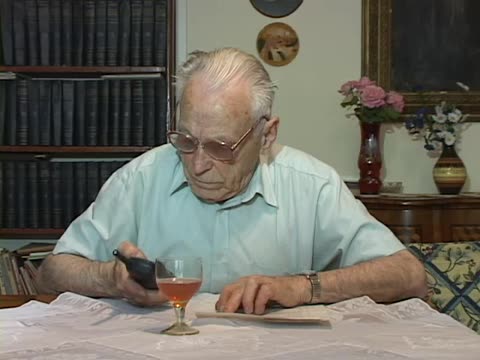
MDV 744 · Ernest Osipovich Halpert; Tubi Halpert

Uzhhorod, Ukraine 7 July 2005 Interviewed by Dov-Ber Kerler, Jeffrey Veidlinger, Dovid Katz Part 3 of 3 60 min · 6 passages

One conversation with Ernest Osipovich Halpert; Tubi Halpert, continuing over MDV 742, MDV 743, MDV 744.

This tape is not yet on the project's channels.
Watch it on Media Collections Online — the time links below open the player there at the right moment.
Passages

0:00

The first part of the tape is a continuation of a formal interview with Ernest Osipovich Halpert and his wife Tubi Halpert. Ernest helps to set up interviews for the team on the phone in Hungarian.

Informal life today · MCO
From the machine transcript

Halpert speaks Hungarian on the phone and then in Yiddish about arranging the team's further interviews, giving an address and a phone number so that a local man, a former head of the Uzhhorod Jewish community who speaks good Yiddish, can be met. Kerler asks about local prayer times (minyan only on Friday night and holidays) and for more phone numbers; then Kerler announces he will put some sentences to translate from Russian.

Also covers local prayer times, and the move to questionnaire work at the end.

3:26

The team asks Ernest and Tubi a number dialectological questions from the AHEYM Yiddish questionnaire. They also remember childhood games at the beginning of this segment.

Questionnaire before the war Yiddish language and dialectChildhood · MCO
From the machine transcript

Halpert and his wife answer Kerler's dialectological questionnaire, with some input from Katz. The items cover greetings and replies, thanks, words such as groats, cholent, glass, ear, dumpling, and cat and mouse, a children's rhyme about a cat (which they recite), comparatives (cold, high, fast, near), honest, pious, converts, a gentile woman, forms of address (ir, zi), farewell blessings, numbers, and sample sentences. Their answers also show Hungarian-Yiddish usage, for example mizl for luck. They add that few Jews are left in the nearby place and that Halpert remembers better with help.

The catalogue sentence is accurate: the passage opens with games and then goes through the questionnaire; the transcript also shows a child's rhyme and a closing remark about few Jews.

41:25

The second part of the tape includes a tour through the former Jewish parts of Uzhorod with Nusn Leyb Naybauer, born 1924 in Velké Kapušany in today’s Slovakia. They drive to the three former synagogues of Uzhorod. Today the buildings are used as a concert hall, local phone company, and university building. His mother was born in Mala Dobron. His family moved to a village when Naybauer was one year old, where his father worked in an equestrian military facility. His father’s friend arranged work for him. His family lived in Mala Dobron until their deportation to Auschwitz.

From the machine transcript

The team meets Naybauer, who says he is the only survivor of six children. They look for a quiet place to sit and drive toward the centre, passing three former synagogues that are now a concert hall, a phone company building and a university building. Naybauer says he was born in a village near Uzhhorod where his father worked at a military horse stud, and that his father's family came from Mala Dobron (Kish Dobron), where they lived until they were taken to Auschwitz. He also mentions needing a visa to travel and recalls cheder and matzo baking in the area.

The transcript adds the introductions and the problem of visas for travel, and that the family's village home is unclear.

47:28

They stop at a former religious school (cheder). Naybauer points out the former matzo bakery, at today’s university of Uzhorod. Naybauer talks about prewar Jewish life.

Tour before the warlife today Religious educationLocal Jewish historyPassover · MCO
From the machine transcript

At a former religious school and matzo bakery now used by the university, Naybauer says the Uzhhorod Jewish population before the war was ten thousand, and that many more (a figure he gives as fourteen or sixteen thousand) were taken from the ghetto, where he was from the first to the last minute. He says he was born in 1924.

The transcript adds the population figures and the ghetto deportations.

49:00

Naybauer talks about life during World War II, during his imprisonment in the Hungarian forced labor (i.e. "Munka Tabor") within the labor battalion of the Hungarian army. They arrive at the former Great Synagogue. Naybauer discusses religious life after the war. The Jewish community used the synagogue until it was closed down in 1948. When the former head of the Jewish community, Bergider, heard that the Great Synagogue was about to be closed down, he went to Moscow to speak with Golda Meir to prevent the closure. As soon as Bergider returned to Uzhorod, he was arrested and sentenced to twenty-five years in jail. Bergider was in jail for seven years and died two weeks after his release. Naybauer then briefly remembers prewar Hasidic life; before talking about holiday celebration today. Naybauer remembers that Jews hid their belongings in two synagogues, before they were forced into the ghetto. He then returns to talking about prewar Jewish life and institutions. Naybauer grew up as the oldest of five siblings. His father could not work for health reasons and therefore Naybauer had to help the “kosher sausage dealer “ carry meat.

From the machine transcript

Naybauer describes being drafted in 1944 into the Hungarian labor battalion and being kept in the ghetto instead. At the Great Synagogue, which he says served the Jewish community until the Soviets closed it, he tells how its head, whose surname is given as Bergida (the transcript is unclear), went to Moscow to see Golda Meir to stop the closure and was arrested and sentenced to twenty-five years. He mentions the removal of the Star of David, the many small prayer houses, Hasidic life, the cemeteries, and that in 1944 Jews hid belongings in the synagogues and used a trade school as a hospital. He then talks about his family: he was the oldest of six, his father Avrom was sickly, and he carried goods for a kosher sausage maker. He also notes the family name Neubauer and an uncle named Bookbinder.

The transcript adds the hospital in the commercial school, the cemeteries and a rich uncle in America, and the family names.

59:21

They enter the former Great Synagogue, which is now used as a music hall.

Tour life today Synagogue and prayer · MCO
From the machine transcript

At the former Great Synagogue, now a concert hall, the team talks with the staff at the entrance, with Russian and Hungarian talk about whether they can look inside and that they have come from America.