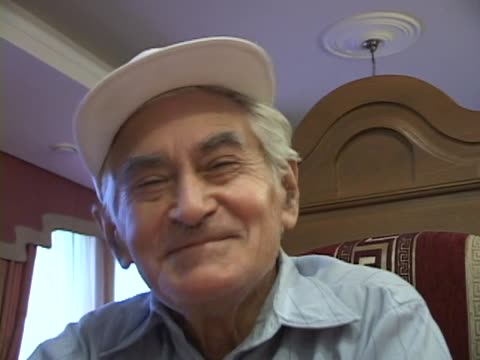
Naybauer talks about life in the immediate postwar period in a DP camp. Naybauer had to move to another camp once the Russians took over. When they arrived, he encountered a Jewish official in charge of the camp. The official told them there is no room for them in the camp and sent Naybauer and his brother-in-law to stay in a sugar factory, where they were brought food regularly, before moving further to Prague. There they received money to travel to Budapest. They set up their camp near a former girls’ school. Naybauer explains that he would go to the school building every day in order to check the list of camp returnees. Naybauer signed up for moving to Palestine.
Naybauer recalls the days after liberation: the Russians carried him and his brother-in-law on their vehicles, and a Jewish Soviet officer in charge of a camp had no room for them and sent them to a sugar factory where they were fed. He then went on to Czechoslovakia and Prague, where a Czech soldier recognised him and gave him money. In Budapest he registered near the synagogue, signed up for Palestine and checked the lists daily. A girl, a relative, embraced him and told him his mother was looking for him.
Includes a Czech soldier who recognised him and gave money, and an exchange with a relative.
Naybauer talks about a Yiddish language book on the history of Uzhhorod. He continues his recollections of life in the DP camp. He explains that he met a cousin, who had been in the same concentration camp as his mother, and who told him that his mother was still alive and was looking for him. In the hopes of finding his mother, he decided to purchase a train ticket to Uzhhorod instead of going to Palestine. Naybauer then talks about the reunion with his uncle and mother.
Kerler and Naybauer discuss a Yiddish handwritten book about the Uzhhorod Jewish cemetery. Naybauer mentions the chevra kadisha gabbai who made gravestones and his son in Israel. He then returns to his time in Budapest, where a cousin told him his mother was alive and searching for him; he gave up Palestine and took a ticket home. At the train station he met his uncle Mendl, who led him to his mother.
Begins with a book (apparently in Yiddish script) on the cemetery, and the gravestone-maker and his son.
Naybauer talks about life after the war in Uzhhorod. He then turns again to his experiences in the ghetto under Hungarian occupation. He was forced to work in the woods in Czechoslovakia for the German war effort. Naybauer worked transporting weapons. He was then sent to several other camps, such as the labor camp Auschwitz III or Monowitz-Buna, Gleiwitz (a sub-camp of Auschwitz), and Mittelbau-Dora (subcamp of Buchenwald concentration camp). Naybauer recalls the experience in Monowitz-Buna as more bearable due to work assignments and regular food supply. Naybauer recalls the difficult conditions in the camps and the deadly conditions in the transports, during which the prisoners were deprived of food and water.
Naybauer describes returning home and his mother's remarriage, then goes back to the ghetto under the Hungarian occupation. He hauled munitions for the Germans and prepared a hospital for wounded soldiers. He recalls Auschwitz-Monowitz, the starvation transport to Gleiwitz and then Dora, and the deaths of his brothers, naming David and Mordechai.
Includes his mother's remarriage, a wealthy village family that emigrated to America, and the deaths of two brothers.
Naybauer talks about his brothers and one sister, who perished in the concentration camps. He then recalls the arrival at Auschwitz in June 1944, where they were led to different camps. Naybauer explains that as soon as he reached the central camp, he was forced to go to Dora. He speaks about the food rations they were provided with.
Naybauer names his brothers and sister killed in the camps. He recalls arriving at Auschwitz around Shavuot in June 1944, the separation from his father and youngest siblings, the tattooing, and being driven to Monowitz and Gleiwitz. He describes Dora, the hospital barrack, the work details and the meager food, and the daily marches.
Focus on siblings' names, selection on arrival and camp conditions at Dora.
Naybauer talks about the death marches that took place in the last months of the war, before he was liberated by the Americans. He stopped in the Wieda camp, before being transported to another camp by train. When they reached the other camp, Naybauer explains that they were forced to march into the woods for a mass execution, where ultimately 1,200 people were killed. Naybauer survived the massacre and escaped with a Polish Jew. In detail, Naybauer explains their escape, search for food, and liberation by the Americans.
Naybauer tells how the camp was bombed in the last weeks of the war and the prisoners were moved to the Wieda camp and then by train. About 1,200 prisoners were marched into a forest and shot; he survived with a Polish Jew and hid in bushes. He tells of searching for food and meeting American soldiers, who fed and clothed him and sent him to a hospital.
Gives details of the escape and the Americans' arrival.
Naybauer returns to the woods shooting, saying a bullet hit his left foot. He lay in the woods, then went to a village and town and was taken to a hospital. There he met an American Jewish doctor from Berehove, and describes his liberation at the end of April.
Answering Kerler, Naybauer says he did not know of the killing of Jews, even in Auschwitz. Kerler asks about his work as a boy after his father fell ill. He describes carrying goods from villages to town in the ghetto period and an episode on Passover; the passage ends mid-sentence.
Adds a Hungarian-era Passover episode and ghetto episode.