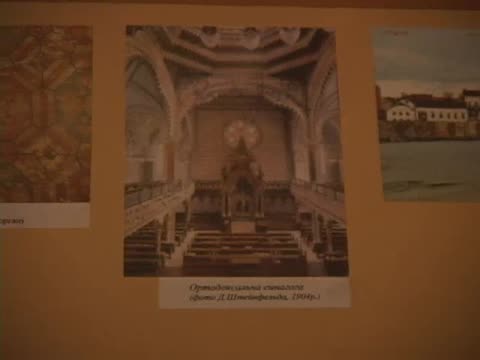
The camera collects footage of the former Great Synagogue, which is now used as a concert hall. Naybauer talks about the architecture of the synagogue. Naybauer explained that he used to pray in the Great Synagogue after the war until it was closed down in 1948. A plaque was put up in 1989 commemorating the concert hall’s history as a synagogue, but was taken down soon after by hooligans.
At the former Great Synagogue, now a concert hall, Naybauer and a guide (Russian-speaking) describe its architecture, including the women's gallery, the pseudo-Moorish style and the hall's acoustics. The hall was built in 1904 (per the Russian). Katz and Kerler ask about the layout of the men's synagogue, the ark and the bimah. Naybauer says he prayed here for some years after the war until it was closed. He regrets that no plaque marks it; one was put up and taken down after a few days, and the guide dates this to 1989. The guide recalls American rabbis offering to buy and dismantle the building, and talks about musicians who played there. Kerler thanks the staff and the group moves on.
The guide speaks in Russian about the concert hall's acoustics and the American rabbis' offer.
Naybauer continues the tour through town and points out a former Jewish theater and they walk along the former Jewish street. Naybauer talks about his observant family. His parents and siblings were killed in Auschwitz. He then talks about a typical Sabbath afternoon in Uzhorod before the war, explaining how people would stroll through town. He discusses the religious school education he received until the age of thirteen. They arrive at another former synagogue, now used by the local telephone company. In this building, Jews hid their belongings before being forced into the ghetto. The former mikva is now used as a cafeteria for students. Naybauer tells as tory about how his uncle was murdered by the police. Naybauer moved to Uzhorod in 1935.
The tour continues past a former Jewish theater and along the former Jewish street, where Naybauer points out Jewish shops, the rabbi's house and a bridge destroyed in the war. He says his father was a very pious man and that his parents and siblings died in Auschwitz. He describes the Sabbath afternoon promenade, going to cheder until thirteen, and the former mikveh and shoykhet's house. He recalls that Jews hid their belongings in a former synagogue before the ghetto and tells how a policeman or soldier threatened his uncle. He also mentions his grandmother's death in 1935 and the word the Jews used for non-Jews. The garbled stretches make the details uncertain.
Includes the word for non-Jews, the Sabbath promenade and his grandmother's funeral, which the catalogue does not mention.
The team meets Ernest Osipovich and Tubi Halpert on their tour. Halpert remembers the Talmud passage he read at the Mukachever yeshiva, when he was studying with the rebbe of Shpira. Naybauer then talks about his working life before the war. He went into apprenticeship with his uncle, who was a tailor. After the war, he successfully worked as a tailor for forty-five years, specializing in suits, and had a variety of business contacts in Moscow. He then talks about family, before talking about life today. He has two children in Uzhorod.
The group meets two local men on the street; one is a former yeshiva student. They talk in Yiddish about Hungarian versus Yiddish at home and the yeshiva. Naybauer then talks about his working life: he learned tailoring with his uncle, later made suits for the intelligentsia including professors from Moscow and Budapest, and worked forty-five years. He also talks about his late wife, his children and grandchildren, a kidney operation by Professor Polansky (?) in Kyiv, and the economic hardship of pensions and rent today. He says he was in a concentration camp at the age of twenty. He ends by pointing out the site of a former Jewish mill.
Adds details on grandchildren, his wife's death, the Kyiv operation and the former mill.
Naybauer and the group approach a former synagogue building and discuss neighboring buildings, including a former large restaurant that employed many Jews, a shop owner, and a house of Dr. Neumann (?). He talks about the Jewish market and the community's size of about ten thousand. He says the Czech period was a good time, followed by Hungarian rule. He also talks about a Jewish bank director who sent money to America.
The team begins the formal interview in a restaurant. Naybauer talks about his family. His father and sister perished in Auschwitz. Naybauer then talks about his childhood memories of Mala Dobron, in particular his father Avrum, who died of the flu in the 1930s. He then lists several Jewish families who lived in Mala Dobron and discusses prewar religious life.
In the restaurant, the formal interview begins with Naybauer's family, whose parents died in Auschwitz. He describes his childhood in a poor family in Mala Dobron (Kis Dobron), where he was born in Natkapash (?). His father, from Dubove, died when Naybauer was ten or eleven, after a failed shipment of cabbage; Naybauer then helped support the family. He talks about his grandfather and uncle, lists the Jewish families of Mala Dobron and describes its stone synagogue, rabbi, shoykhet and mikveh. He also mentions receiving compensation in Budapest and being liberated by the Americans.
Includes his grandfather Moshe Preyz, the Dubove origins and a list of local families.
Naybauer talks about life after the war. When he was liberated by the Americans, he stayed in a DP camp in the former Salzwedel women’s concentration camp. He signed up for moving to America, but missed the transport. The refugees then came under Russian command.
Naybauer talks about being liberated by the Americans after four hospital stays and his stay in a displaced-persons camp in a former women's concentration camp at Salzwedel. He says he registered to go to America but missed the transport, and was then handed over to the Russians.