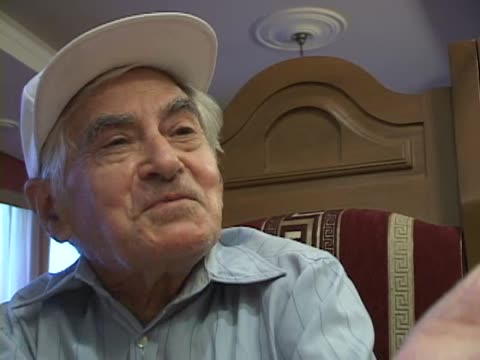
Naybauer discusses life before the war, in particular holidays like Purim. He frequently attended Purim shpiels at a neighbor’s house. Naybauer remembers plays in his home town, as well as in Uzhhorod.
Naybauer first tells of a rich neighbor's family and a priest who was sentenced after the war. Asked by Kerler about Purim before the war, he describes Purim customs: drinking, a Purim play put on like a theater, and children going from house to house reciting the play in the morning and bringing shalakhmones in the afternoon. The play was staged in a widow's house and the children were taught by their cheder teachers. He tells a joke about a matchmaker and a rich man. He recalls the roles of Haman and Esther. He also answers questions about Purim in Uzhhorod.
Adds a story about a rich neighbor and a priest, a matchmaker anecdote and the widow whose house hosted the play.
Naybauer discusses prewar antisemitism, before addressing contemporary religious life. He then recites prayers, before discussing religious life after World War II. Naybauer got married in 1957 and his son was circumcised in 1959. His mother agreed to bring Naybauer’s son to the mohel and was sentenced to three years in jail, but with the help of Jewish journalists she could evade the sentence. Naybauer then talks about synagogue activities after the war.
Naybauer speaks about the start of antisemitism and the pressure on observance, then recites a few prayers when Katz asks. He recounts that he married in 1957 and that his son was circumcised in 1959. The KGB harassed the family for half a year, and his mother, accused of arranging it, was sentenced to three years but escaped the sentence through Jewish journalists and acquaintances. He then discusses the synagogue after the war, including which buildings were returned, a small prayer house and a mikveh.
Adds a brief prewar antisemitism passage and how the synagogue was returned after the war.
The team briefly asks Naybauer a number of dialectological questions from the Yiddish AHEYM questionnaire. The camera cuts to the outside of Naybauer’s home. He shows the team a number of family photographs and other documents.
Kerler and Katz ask Naybauer a few questionnaire items, among them the word for 'fast' and for 'willingly', and the name for Yom Kippur and Rosh Hashanah. Then there is talk about where to sit and the practicalities of the visit. Naybauer confirms he was born in 1924, and the team looks at a document or photograph connected with a gravestone maker and a chevra kadisha official. After the cut, Kerler announces that he will ask for Russian words and phrases to be rendered into Yiddish.
Adds the photographs and documents, including one linked to a stonecutter and the birth date, and the practical talk.
Kerler, with some input from Katz, continues the dialect questionnaire with Russian prompts for Naybauer to translate. Items include greetings and replies, thanks, parts of the body, colors, animals, house and building words, food, terms for non-Jews and Christians, and comparatives of adverbs. Further items include words for people (the fool, the honest man, the peasant), time words, a few sentences with personal pronouns, and verbs of hearing and knowing. Naybauer also gives some remarks on dialect, such as jokes about the Berehove and Mukachevo Jews. Near the end he mentions failing eyesight and not having shown the ghetto site.