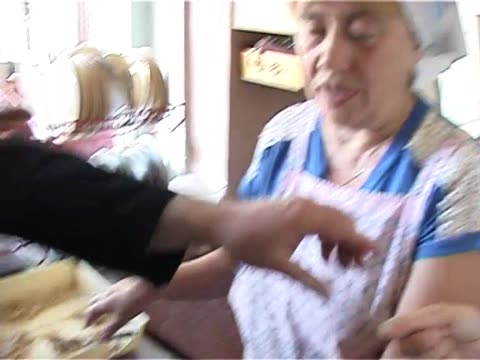
At the Berdychiv Jewish community there is singing by a man, followed by talk in Yiddish and Russian around the community kitchen, where food such as dumplings is made and tasted. Kerler then talks with people present, including a woman. He asks about their birth in Berdychiv, the family, a grandchild who attends a Jewish school, and whether they remember Yiddish being heard on the streets.
Mixed, poorly recorded material at and around the Berdychiv cemetery: talk in Yiddish and Russian, a man saying he was born in Berdychiv, and a long prayer-like text delivered by Kerler. Others discuss a building damaged some years earlier, antisemitism in Ukraine, and Jews emigrating. A name and dates on a gravestone are discussed, and someone photographs. Much of the speech is garbled and the attributions are uncertain.
Informal chat as the interview in Vinnytsya is prepared: jokes about age and looks, the couple's marriage in 1947 (?), and Russian talk about lamps and lighting. Kerler then begins the formal start of the interview.
Kerler opens the interview with the place and date, 11 July 2002, in Vinnytsya, and asks for the official names of the couple, Lyudmila and Grigorii Shor. They talk about whether the name Shor is known in Berdychiv and Zhytomyr. An address in Vinnytsya is given in Russian.
Gives the interview's date and the couple's names and address, and mentions Berdychiv and Zhytomyr.
Shor says he was born in Kopayhorod in 1925, and the couple recall that Jews outnumbered non-Jews there before the war. The Yiddish name of the town is discussed and the later district reorganisation. He studied in the Jewish school for seven grades, then in a Ukrainian school until the ninth grade. The war and occupation by the Romanians, life in the ghetto and camp, liberation in 1944 and his call-up to the army follow.
Adds the town's Yiddish name, the district reorganisation and the talk about the family names given to the archive.
Shor describes his Red Army service, which lasted until 1971, and says he held the rank of lieutenant colonel, deputy to a regimental commander for the technical side. His wife interjects admiringly, and Kerler comments on his Yiddish.
Shor names his father Yosl and mother Dobresh. His father was a ritual slaughterer who also led services, officiating as a cantor after the war in a Vinnytsya synagogue. Liudmila's father Yidl sold flour in a shop; in the 1930s the family was dispossessed and expelled from their home and moved to Verkhovka, where he learned hairdressing. Shor recalls his own mother and children being evicted in the rain and the creation of a Jewish kolkhoz.
Adds Dobresh, Liudmila's father Yidl who sold flour, and the cantor's synagogue in Vinnytsya.
Shor says a Jewish kolkhoz called the Jewish Peasant was established in Kopayhorod. He describes the famine of 1932–33: his mother was a kolkhoz worker, grain was searched out and taken from peasants, the family became swollen, and many Jews and non-Jews died. Officials survived through special rations.
Adds the kolkhoz name and the account of death by hunger and privileges for officials.
Liudmila names her mother Dvoyre, who ran the household, and her brother Itsik, who died in Israel a year earlier. Shor names his siblings, a sister Hana Sore and a brother Leyb, both in Israel, with the sister in Karmiel. Their own children do not live with them, and they cannot travel because of Shor's heart attack.
Adds named siblings, their places in Israel and the couple's health and travel limits.