0:00
(Not described)
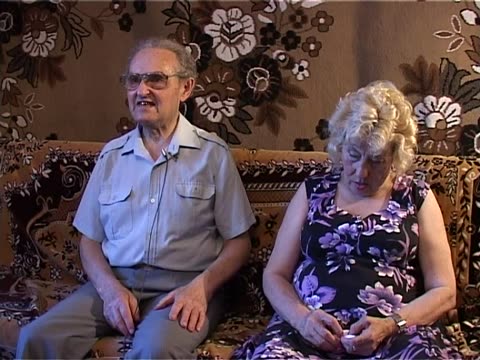
One conversation with Grigorii Iosifovich Shor; Liudmila Yudelevna Shor, continuing over MDV 749, MDV 750, MDV 751, MDV 752.
(Not described)
Introducing AHEYM project. Early childhood memories of Jewish Kapaygerod
Kerler explains that the recordings will go to a university archive, and the Shors are invited to begin telling about Kopayhorod. They place the houses near a river and describe a wholly Jewish town with a rabbi and several ritual slaughterers. Liudmila recalls seeing the rabbi praying as a girl and says she spoke both Yiddish and Ukrainian with her mother. Grigorii says four synagogues were reduced to two, closed in 1925 and 1926 (?), and they discuss a bakery and the street named after the synagogue.
Adds the closing of two synagogues in the mid-1920s, the rabbi, and the language with her mother.
His education
Grigorii says he began studying at age seven in the building of the former large synagogue, which had been turned into a Yiddish school. Kerler checks that it was a Yiddish Soviet school.
Synagogue architecture and service on holidays
Grigorii describes the wooden synagogue: a women's gallery upstairs, seats paid for and assigned along the walls, the central reading platform, the Torah ark and the decoration. He recalls his father taking him on holidays, and the Torah being carried and kissed. He says it was closed in 1935 or 1936 (?), and the Yiddish school building was later wrecked under the Romanian occupation.
Adds the women's gallery, seat purchase and decoration of the wooden synagogue.
During Romanian occupation
Under the Romanian occupation the former synagogue became a Romanian administrative office. Pressure began on the rabbi, the Torah scribe and the cantor to renounce religion, and it was announced in the district newspaper; those who refused were sent away. People then secretly gathered to pray.
Religious practice late 1930s and under Romanian occupation
After 1936, Jews prayed in private homes and asked that the authorities not know. Liudmila recalls her mother gathering women on holidays and reading to them in Yiddish from a prayer book, and being sent out when they wept. The couple name the Jewish holidays, then recall matzo baking in the war years, with Liudmila's mother ill, and communal baking by several families after the sale of machine matzo stopped.
Adds matzo baking and the mother's gatherings of women.
Shabbat celebration before the war
Asked about the Sabbath, they describe Friday evening: the father going to synagogue, the mother lighting candles, the welcome of the angels, and the meal with chicken soup with noodles or dumplings. They discuss sweet fish with sugar, and pepper and challah blessings.
Drinking customs and Jewish population before the war
Questions turn to drinking and wine, which Jews did not make themselves. Grigorii and Liudmila then describe the town: the poverty, the inn yard owned by their grandfather Hershl with its shops, and the smiths, tailors, shoemakers and leather workers. Several Jews were repressed in 1928, others fled, and those who remained lost their voting rights. Kerler and the couple also discuss occupational terms such as tailor, patch-tailor and leather cutter.
Adds the inn yard, Jewish blacksmiths and tailors, and the repressions of 1928 and loss of voting rights.
Life today
Liudmila says that today they speak mostly Russian with each other, because her husband served in the army after the war and the children do not speak Yiddish. She says their two children live in Israel and Germany, and Kerler wishes them good health.
Adds the children living in Israel and Germany.
Dialectology