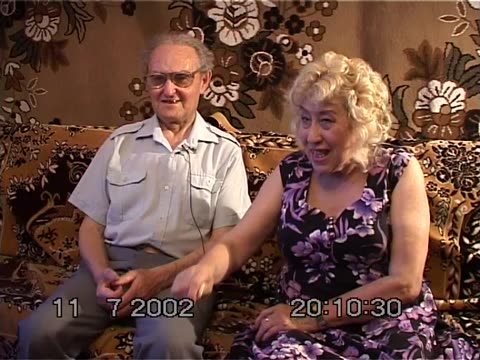
The Shors answer Kerler's questionnaire items, including words for 'sad', 'such things', 'breathe', and 'only Jews live here'. An anecdote follows about a schoolmate who stood outside the window to listen to the lessons, and a rhyming couplet in a school class is mentioned.
Includes an anecdote about a boy outside a school window.
Kerler asks about Yiddish chastushkas, and the Shors say there were few. Liudmila sings a short rhyme about Yosl, said to be from Odessa, and says that its author is unknown.
Sets the song in Odessa, as the Shors describe it.
The Shors continue to answer dialectological questions from the AHEYM Yiddish linguistic questionnaire, as well as questions about Yiddish terminology.
The Shors answer questionnaire items such as 'pleasant', 'attic', 'potato' (including bulbe), and what Hanukkah latkes were made from. They say the latkes were made from potatoes, not buckwheat flour. They also say they have not spoken Yiddish for fifty years and rely on a dictionary. Other items include words for 'blue' and 'belly'.
Covers Hanukkah latkes and the couple's remark that they have not spoken Yiddish for fifty years.
Liudmila sings the beginning of a Yiddish song about the years passing without joy, then says she does not remember the rest. She continues with a Russian version of it and says she knows many songs her mother sang.
Questionnaire items continue, covering the words for 'deaf', 'groats' and 'golem'. Kerler asks about the interviewee's father as shoykhet and about the bime, and about the words 'bentshn' and 'gomel'. A last item asks for the word for a well.
Grigorii sings a Yiddish song by Itzik Feffer, he remembers from Yiddish school. He then recalls other Yiddish poets and poems and remembers how his school class performed together.
One of the Shors recalls songs sung at Yiddish school, including one about a well, and names the poets Itsik Fefer and Leyb Kvitko. They speak partly in Russian and recall class singing hours, though they are unsure of the details.
The speaker is probably INF2, not Grigorii, and the passage mentions Leyb Kvitko.
Questionnaire items about Hanukkah games (dreidel, Hanukkah money), and the words for 'soon', 'then' and 'rich man'. Kerler also asks what was eaten on Purim, and the answer leads into a song.
The Shors answer questionnaire items such as 'wagon', 'important', 'young man' (including 'mantsbul') and 'in-laws'. They say the word for 'in-laws' leads to a song.
The Shors answer questionnaire items including 'probably', 'near' (nave, nahent), floor and floorboards, 'cloth' and 'face'. They also say a few things in Russian and discuss the word for 'floor' and the swearing sense of 'tsire' (?).
Liudmila sings a Yiddish song she remembers from her mother, a girl's wish for a sweet life and a wedding canopy. She says she never heard it recorded and learned it only from her mother.
Questionnaire items on 'various', 'dinner', 'mountain', 'must', 'knock' and the word for Hanukkah latkes. Between items, Liudmila sings a short Sabbath-eve song fragment.
Liudmila sings the well-known Chanukka song "Oy Chanukkah." They then answer questions about cultural terminology. She remembers her father-in-law's work as rebbe. They also discuss prewar religious life.
Liudmila sings the Hanukkah song 'Oy Hanuke'. Kerler then asks terminology questions about words for a cross, 'litvak', the difference between rov and rebbe, hasidim and the silent prayer. The Shors say there were no hasidim in the shtetl but that people travelled to the good Jews of Bratslav and Uman, and that her husband's father was consulted by people as a rabbi (?). The passage ends with the start of a coachman's song.
Adds the rabbi-versus-rebbe question, the Litvak dialect remarks, and the Bratslav and Uman travel.
Liudmila sings a Yiddish coachman's song about driving horses, a tavern, and a wife and child at home. She says her father sang it and that she heard it from no one else, and she offers to sing more songs.