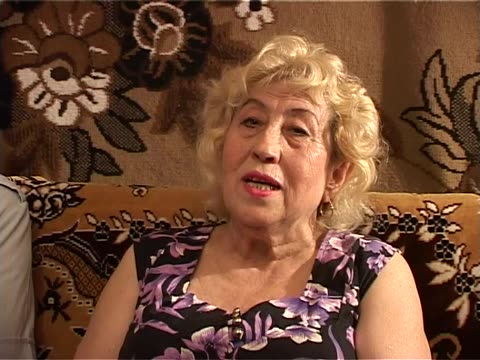
Shor recalls that her mother taught her the morning prayer and that she remembers little beyond it. At Kerler's request she sings Yiddish songs learned from her parents, including a song about a wagon driver and his horses on the road to a tavern, a lullaby-like song about life passing, and others. Kerler asks her to repeat a song so the words can be written down, and she says she wants her parents' songs passed on only to her own children.
The catalogue says religious customs and Yiddish song; the transcript shows mostly song performances, with the recall of her mother teaching her a prayer and a request not to give the songs away.
Shor talks about her activities today. She chairs the women's club, whose members meet on Saturdays to sing Yiddish and Russian songs and review the press. She has also organized a Yiddish choir that is preparing for a festival in Kyiv in October. Kerler asks about the club's address, the Hesed centre and whether he may come and photograph the group, and S3 helps with details.
The transcript shows the women's club and choir, with a Kyiv festival and Hesed, in more detail than a generic 'life today' label.
A new interview begins with Poberevskii. She looks at family photographs and identifies her father Shloyme, her mother, a brother who is the youngest and a doctor, and her husband. The names of her mother and brother are unclear in the transcript. She says she lived in Stanislavchyk and is 88 years old. Kerler wishes her good health and explains to the others that the interview is for the archive's camera.
The transcript shows the start of the Poberevskii interview with her identifying family members in photographs, beyond a bare setup.
Kerler records the basic data for the tape: place and date of the interview, Poberevskii's surname, her Russian first name and patronymic, her father's name Shloyme, and the beginning of a question about her address.
Poberevskii gives her birthplace as Stanislavchyk, a small town eight kilometers from a nearby town whose name is garbled in the transcript. Her parents came from there. Her father was the rabbi, and her mother, called the rebbetsin, did not work and had eleven children. She names several siblings, among them Bentse, Nokhum, Note and Rusya, and says some died young.
Asked about her earliest memories of Stanislavchyk, Poberevskii says there were many children in the family. The family left in 1921 for Zhuryn and then moved on to Zhmerynka. She also mentions studying in Russia at an institute, and Kerler explains in Russian why such interviews are done.
Poberevskii gives her birth date in July 1914 and says that Yiddish birthday greetings were brought to her by acquaintances. She finished the Jewish school in 1930 at sixteen and then worked as a typist in the court and procuracy. Her father, known as the Stanislavchyk rabbi, preached in Zhmerynka. She names an uncle Elye who was a ritual slaughterer in Moldova and later worked in a kolkhoz. She remembers Stanislavchyk as a Jewish shtetl with Jewish craftsmen and a market, where Christians worked the fields and her mother made ovens. Her father travelled to Proskurov and came back with accounts of a terrible pogrom there. She says there was no pogrom in their own town and relations with neighbours were good. The family left because her father wanted to go to Romania and sold the house cheaply, but they ended up buying a small house in Zhmerynka.
Beyond the school, the transcript shows her work as a typist, her uncle Elye the slaughterer, the Proskurov pogrom, relations with neighbours and why the family left Stanislavchyk.
Poberevskii recalls visits to the Yiddish theatre in Moscow, naming Mikhoels and Zuskin, and discusses Mikhoels as an actor, including the role of Tevye. Asked about Yiddish writers visiting Zhmerynka, she does not remember any. She says she was a good pupil in the Jewish school, which was closed in 1937 when people were arrested. Kerler then asks how her parents kept the Sabbath.
Poberevskii describes Sabbath before the war. Her mother lit the candles and went to synagogue, and on holidays and fasts as well. She says there were four or five synagogues in town, including the butchers' synagogue, the main synagogue and the beys-medresh, where women prayed upstairs. Her father died in 1937 and had given sermons in the beys-medresh. Kerler then says he will ask a few words.