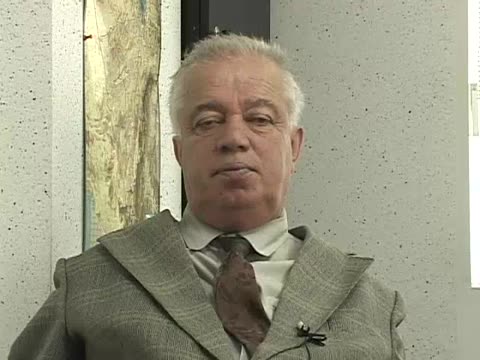
Tsodikovich answers Lemster's questions about Kopayhorod food customs, such as stuffed geese and cracklings, and says some things were not done in his family. He remembers his grandparents as very religious, with his grandfather praying morning and evening. They then discuss the town's tailors, barbers and shoemakers. Tsodikovich and Lemster try to recall local musicians and singers, a father and sons who played accordion and guitar, and Yiddish periodicals read in town.
Adds the talk about local musicians and singers and about reading Yiddish periodicals.
Lemster asks about expressions and terms: the evil eye, a dybbuk, a golem, an apostate, and the word for a cemetery. Tsodikovich often does not know them. He then says a few things about Vinnytsya after the war: Yiddish theater troupes visiting, and a small synagogue on one street where many Jews stood outside on holidays. He also answers a question about the phrase 'a good Jew'.
Adds the questions on evil eye, dybbuk, golem and cemetery terms, and the postwar Yiddish theater visits.
Tsodikovich says he left Kopayhorod around 1950, and that as a child he came to his grandparents for the school holidays. His grandmother was like a mother to him and his grandfather like a father. He kept visiting them after technical school and army service.
Lemster asks vocabulary items given in Russian, and Tsodikovich gives or fails to recall the Yiddish. They include greetings and thanks, house, skin, 'later', 'earlier', 'cold', 'colder', 'fast', 'near', and 'sick' versus 'sleepy'. Kerler joins in the discussion. Tsodikovich notes he has no one to speak Yiddish with now. At the end Lemster and Kerler return to dybbuk and golem and to a tailor from Kopayhorod.
Tsodikovich recalls a tailor's son in Kopayhorod who played the accordion. He says Yiddish songs were not sung in public, only among friends at night. They discuss the town's Jews after the war, and Yarmolyntsi, where few Jews remained. He mentions a woman from Kopayhorod now in Germany and a barber who cut his hair as a child. Kerler asks about non-Jews who spoke Yiddish: a classmate, a neighbor named Misha, and a teacher of Ukrainian who speaks it very well. They also discuss a Jewish school director, Weinstein, and the Chabad or Skverer rabbi, then Vinnytsya today, antisemitism and politics. Part of this is in Russian.
Adds the Yiddish-speaking non-Jews, the Jewish school director, and the talk about contemporary politics.
Kerler asks why Vinnytsya needs a Jewish mayor or official. Tsodikovich answers that people chose him, that he is doing a great deal of good, and that people are ungrateful. In part he speaks Russian. They also discuss earlier Jewish figures in Vinnytsya, a former deputy, and whether the present official is Jewish. Tsodikovich and Kerler disagree about whether there is antisemitism in Vinnytsya. Tsodikovich says people feel it, while Kerler says they do not.
Kerler and Lemster thank Tsodikovich and close the interview. Tsodikovich says Yiddish was spoken at home with his grandparents and mother, and recounts a long-lived woman. Kerler explains that the recordings will go into an archive for future generations and online. Tsodikovich is pessimistic about the future of Yiddish, and Kerler says he is optimistic. Tsodikovich also mentions children in Israel, and both wish each other good health.
Adds Kerler's explanation of the archive and the future of Yiddish.