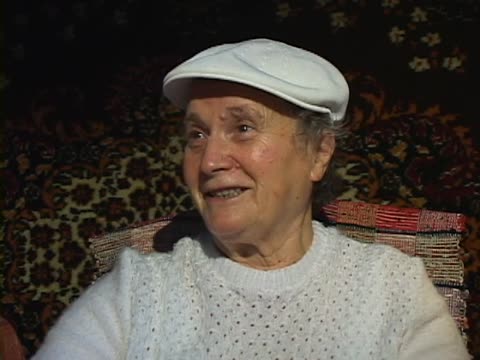
Gotlieb answers questions about cultural terminology. She also speaks about her life in Budapest and meeting fellow Jews from different regions before the war.
Gotlieb answers questions about terms for a cemetery, a good place and a good (pious) Jew, and says she does not know the expression 'Hungarian donkeys', the word for an opponent of the Hasidim, or the word for a Lithuanian Jew. In Budapest she lived among Jews who were less observant than her family at home. She met Polish and Ukrainian Jews but not Romanian ones, and discusses names for Polish Jews. She says that Polish Jews were called untrustworthy, and gives an anecdote about her husband's father, a trader.
Adds the Polish and Ukrainian Jews she met, a story about her husband's father, and the explicit negative stereotype of Polish Jews.
Gotlieb answers questions about the baked goods her mother made, which she calls very fine, and about wine and brandy (palinka). She then speaks about healing customs. As a very sick child she was given a red ribbon from Jerusalem and prayers were said for her. She and Kerler discuss extinguishing coals in water as a remedy, and the havdalah custom of putting money in the pocket for a blessing.
Adds the drinks, the havdalah money custom and her own childhood illness.
Gotlieb answers questions about terms for a non-Jewish cemetery and for a church. She does not know several of the words and says there were three churches. She recognises the word for ritual impurity (tume), used when Jews were not allowed to enter a church. At the end Kerler thanks her and asks her to repeat the second Purim play.
At Kerler's request Gotlieb repeats a short rhymed Purim play verse for him to write down. He asks for repetitions line by line, then asks her to say it with a melody, and she recites and sings it. The verse greets the company and names her siblings and parents. Kerler thanks her at the end.