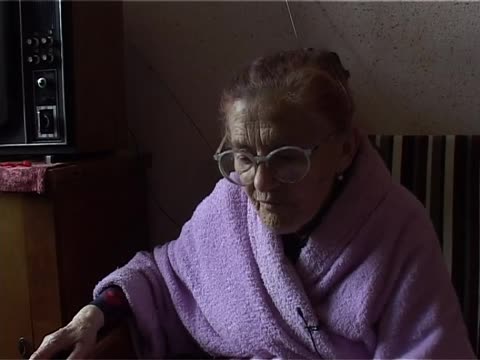
Lebvol talks about her education before the war. She attended a Polish school in the mornings and the religious girls' school "Beys-Yankef" in the afternoons.
Kerler asks Lebvol about her schooling in Zhovka: seven years of Polish school in the mornings and, in the afternoons, the religious girls' school. Part of the passage is garbled and drifts into other talk before Kerler moves on to Sukkot.
The passage's later lines are garbled and turn to other matters (a reader, someone named Poliya?).
Lebvol addresses holiday celebration, in particular Sukkoth and Simchat Torah. She also describes the Great Synagogue in Zhovka and recalls shofar blowing on the High Holidays.
Lebvol recalls the family sukkah built in the corridor, with meals, singing and prayer, and her memories of Simchat Torah when only boys and men went to the synagogue and women and girls came to watch. She describes the Great Synagogue and the difference between rich and poor worshippers and the large and small synagogues, and mentions going to hear the shofar blown on the High Holidays. The kinds of flags carried by the children on Simchat Torah are also discussed.
Also covers the social divide between the large and small synagogues and women's attendance.
Lebvol explains how Polish soldiers attended synagogue services at the Great Synagogue on a Polish holiday before the war. She then recalls food customs on Shavuot.
Lebvol explains that Polish soldiers were brought into the Great Synagogue on a Polish holiday before the war because it was famous throughout Galicia. She then recalls Shavuot food, which was all made with cheese: cheese varenikes and flat pancakes (blintzes) filled with cheese. Kerler and Lebvol then chat about his family and his American connection.
Shavuot food is followed by personal chat about Kerler's children and a Polish-speaking visitor.
Lebvol and others converse largely in Polish about trips to Poland, Wrocław, Kraków and relatives, and the train station that resembles the one in L'viv. Kerler then asks about her languages, English and German, and she tells of a flight to Moscow where she spoke Yiddish with a German.
Lebvol continues about a German-speaking fellow traveler and where she learned German, in school. Kerler returns to Shavuot and asks whether blintzes were eaten, and the talk turns to a woman from the team and the planned trip to Drohobych and Boryslav, where there are Jewish organizations.
The passage includes the planned trip to Drohobych and Boryslav.
Lebvol addresses contemporary Jewish life and mentions a Jewish organization that provides charity. She then answers questions about cultural terminology.
Lebvol speaks about the Jewish organization in Lviv that helps her with charity, which Kerler takes to be a religious one. A few vocabulary items about honest people follow, and the talk turns to her request for vitamins and glasses and Kerler's promise to send things.
The passage is in effect about her needs for vitamins and glasses, and includes a short word elicitation.
Lebvol speaks about life before the war, in particular Jewish occupational structure and conversion. Lebvol also addresses the relationsip between Jews and non-Jews. She then describes the store, where her family bought hering, and how her father exchanged his glass work for food in the fall season.
Lebvol lists Zhovka's Jewish occupations: tailors, tinsmiths, butchers, glaziers and several ritual slaughterers. She says many Jews converted to Christianity and that she doesn't know of non-Jews becoming Jews, that neighbors were non-Jews with whom they got along, and that older non-Jews knew Yiddish. She describes her poor family: bread wrapped in newspaper, herring bought from a shop, and her father the glazier bartering glass for food in the villages.
Also includes Jewish converts and the Yiddish of non-Jewish neighbors.
Lebvol answers dialectological questions from the AHEYM Yiddish questionnaire. She then discusses her childhood memories. Lebvol began her training as seamstress at thirteen. She recalls how she and her boss secretly worked on Sundays and hid when a soldier passed by the workshop.
Kerler asks a few dialect words (a tail, a shop, an honest person) and about sports and clubs in town. Lebvol then recalls that she began work as a seamstress at thirteen and that on Sundays they worked hidden from the police because work was forbidden, and hid when a patrol passed.
Begins with a short word elicitation and a question about sports and clubs.
Lebvol describes the Polish fire brigade in the courtyard, and the bathhouse and mikveh in Zhovka. She recalls a Hasidic neighbor, Frenkel, whose wife wore a wig, and the names of their three children and parents. Asked about a Jewish library or youth movement, she says she did not go.
Adds the fire brigade, the mikveh and bathhouse, and the names of the Hasidic neighbors' children.
Lebvol returns to the Yoysef play, in which twelve brothers and a sister were needed, and recalls a blind man who led the player of Jacob and ran a library. She says the play was organized by one man and tickets sold, and that all the shops in the old town were Jewish except one Polish and one Ukrainian. Kerler plans to drive her around to show prewar sites, and asks about a good Jew in Zhovka.
Includes plans for a driving tour of town and a question about a 'good Jew'.
Kerler asks Lebvol about the term 'good Jew' for a rebbe, charms and remedies, the evil eye, and a pilgrimage site, then about Litvak, gefilte fish (sugar, pepper, onion and matzo), vodka, dybbuk, golem and sentences for the prayers for the dead. Lebvol answers each of these, with some Polish loanwords. In the last seconds S2 asks about the war years.
Includes questions about charms, the evil eye and a holy site, a dybbuk and a golem.
Lebvol talks about her life during the World War II. She evacuated to the Stalingrad region and worked on a kolkhoz. Her mother and four children were killed in Belz.
Lebvol says she was taken to Stalingrad region, with her sisters and brothers, where she worked on a kolkhoz. Her mother and four children were killed in Belz.
Lebvol speaks about her life after the war. She returned to Zhovka in 1945 and worked at the civilian registrar's office and then worked at a legal office. Lebvol attended a Polish school for seven years. She then talks about her family. Her first husband, whom she married in 1940, died during the war. She raised three daughters, who live in Russia and America.
Lebvol says she came back to Zhovka in 1945 and worked in an office issuing passports. She had seven Polish classes and taught herself Russian and machine sewing. She married Mikhail (Misha) in 1940 without a chuppah, and has daughters in Moscow, Leningrad and Los Angeles, and a great-grandchild. She says one daughter lives as a Jew and another with a non-Jew, and that no Jews remain in town since the death of Leyner.
S2 asks Lebvol about the memorials in town, which she attended with the opening of the memorial where Jews were murdered. Kerler then asks about prewar weddings: the chuppah, music, klezmer musicians (local ones), and a song about a fiddler and bass player.
Begins with memorials and the unveiling of monuments.
Lebvol says there was a Polish gymnasium but no Jewish one or yeshiva, and that she attended the Beys-Yankev school as a younger child like cheder. Kerler then asks about Sabbath garb and burial and mourning customs, including a glass of water and bread on the windowsill for eight days, covered mirrors, a candle and sitting on the floor.
Burial and mourning customs are explicitly covered.
Lebvol speaks about prayer customs. In particular, she recites a prayer to avoid dog bites. She then describes how her father read out loud on Sabbath and explains how her family celebrated Sabbath.
Lebvol recites a protective formula against dogs that she said as a child. She says she can't read Yiddish, only Russian, and that her father read from the prayer book on Sabbath after the meal. He was not Hasidic, and a Sabbath goy named Stepan came to the house; Kerler then starts the language questionnaire.
Includes a protective formula, reading habits, and the Sabbath goy.
Lebvol answers Kerler's dialectological questionnaire, translating Russian and Polish prompts into Yiddish: greetings and thanks, body, house and food words, the pigeon, colors, adjectives, adverbs, breathing, comparatives and sentences. Some of the items are marked as not known to her.