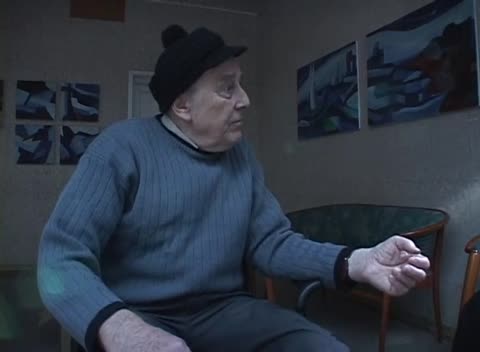
Rezmovits and Kerler discuss Yiddish poets (Mangar, Latshteyn, Sutskever and others) and Rezmovits's reading of their poems. He says he began writing his Yiddish poems late, after his wife died, when he was anxious about the responsibility for his two children and could not sleep. He adds that he can write better in Hungarian.
Kerler and Rezmovits name specific poets, and Rezmovits explains why he began writing.
Rezmovits speaks about his life in prewar Debrecen. He shares an episode about his mother going to the kosher butcher. Rezmovits then talks about his family and describes his mother's good spirits. He explains how his mother took care of her children, while his father was in prison. Rezmovits grew up with five siblings.
Rezmovits talks about prewar Debrecen and his Jewish community, including an episode of his mother and the ritual slaughterer. He describes his mother's humor and patience, and how she managed six children while his father was in forced labor. The family lived in a long courtyard on a street in Debrecen. He and Kerler discuss the word for a snack (a Hungarian-Yiddish word, "yaznt").
Includes the word for a snack and the family's courtyard address.
Rezmovits recalls poverty in childhood: bread spread with lard and paprika as a snack. He describes his father's attitude toward self-important people in the community, and the nickname "karpn-kop" (carp head) his father used for them. He and Kerler compare the fish word in Hungarian and in other Yiddish dialects.
Covers the nickname and fish terminology rather than only childhood memories.
Rezmovits and Kerler discuss who ate the carp's head with gefilte fish and how customs differed regionally. They then turn to Yiddish dialects: Hungarian-born speakers in Debrecen, the Carpathian region near Beregszász, Munkács and Nyíregyháza, and Budapest speakers' pronunciation. He recalls being annoyed by a Budapest pronunciation of a holiday name.
Rezmovits tells a couple of stories about "Froim der ganeydiker" (Froim the merciful) going to a restaurant and making a contract with a priest. He also addresses prewar Jewish life, particularly the local Jewish secondary school, and recalls antisemitism during his schooldays in Debrecen.
Rezmovits tells stories about Froim der ganeydiker (a trickster figure told by his mother), including a restaurant episode and a contract with a priest. He then discusses prewar Debrecen, with antisemitism and fights with non-Jewish boys when leaving cheder, and the large Jewish gymnasium and a famed Jewish athlete from Debrecen. Kerler asks him to write the stories down.
The passage opens with antisemitism and the gymnasium, and ends with Rezmovits's sister in Debrecen.
Rezmovits speaks about his family and their life during World War II. He then tells an episode about his father finding money during the economic crisis in the early 1930s. Rezmovits states that his father was also respected among non-Jews.
Rezmovits talks about his family, six children in all, including his sister Gitl, and the deportation of the mother and children, while his father stayed in Hungary on forced labor and kept kosher. He tells how his father found a wallet with 800 pengő during the economic crisis of the 1930s and returned it despite the family's poverty. His father was respected among Jews and non-Jews alike, as many non-Jews came to his funeral.
Includes his sister Gitl and Kerler's question about palinka.
Rezmovits addresses prewar religious life in Debrecen. He also describes his religious school teacher (melamed), Reb Falkovich, and shares an episode about being caught reading something else. Rezmovits then explains his melamed's teaching style.
Rezmovits discusses cheder and prewar religious education in Debrecen, especially his teacher Reb Falkovitsh (?). He recalls being caught reading a novel under the table and the teacher's reaction, and describes his harsh but respected melamed, who taught Humash, Rashi and some Gemara. He mentions other melamed names, and says the last year brought the worst beatings. The Germans occupied Hungary on March 19, 1944.
Rezmovits talks about contemporary community members. He then speaks about his father's friend and gives a glimpse of their political conversations in prewar Debrecen. Rezmovits then addresses regional Yiddish dialects. He then returns to contemporary community members.
Rezmovits describes an older community member who understood but did not speak Yiddish, and his father's friend Nosn Gotlib, with whom he discussed politics in Debrecen (the fall of Singapore). Kerler asks word-pair questions (such as 'zikher/gikher' and 'kokh/kekh'), and they discuss the Yiddish of Carpathian-area speakers. He then reflects on the decline of Yiddish and Kerler's mission, and describes encounters with ultra-Orthodox Jews, including a Satmar man and a Hasid seen in Debrecen dressed as a non-Jew.
Also includes Kerler's word-pair questions and Rezmovits's views on Satmar Hasidim.
Rezmovits and Kerler discuss Yiddish words with Hungarian and Slavic elements, such as the word for a notebook, a word for brandy and 'flask', and their etymology. Rezmovits then mentions an earlier interview by a woman who came from Israel and sent him a video cassette, and Kerler suggests ways to view it. He ends with a story of a Romanian-Jewish woman who asked where his family came from (Sighet).