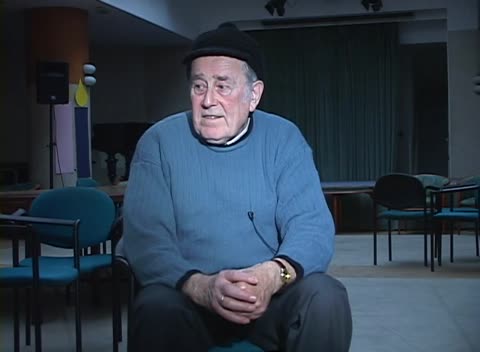
Rezmovits remembers a song he heard from Russian soldiers. He then speaks about his life today and visits to Israel immediately after the collapse of the Soviet Union. Rezmovits did research for his article on survivors of the Warsaw Ghetto Uprising.
Rezmovits and Kerler arrange a lunch invitation. Kerler asks about Rezmovits's years in Israel, and Rezmovits explains that he made a vow to meet Jewish fighters from the Warsaw Ghetto Uprising. He recounts a survivor's story of a transport toward Treblinka and an escape through the wagon, and then discusses Leon Uris and other American writers he read.
Details the Warsaw Ghetto survivor's story and Rezmovits's reading of Uris; the song from Russian soldiers is barely evident.
Rezmovits speaks about western refugees in Debrecen in 1941. He explains how they spoke at the local prayer house about the persecuation of the Jews in the west. Rezmovits also addresses Soviet Jewish writers and other Holocaust writings.
Rezmovits recalls Polish and Lithuanian Jewish refugees in Debrecen, who spoke in the local prayer house about what was happening to Jews. The Hungarian Jews would not believe them. He then discusses writers, among them Ilya Ehrenburg, Elie Wiesel and Soviet Jewish writers, with Kerler offering to send him a photocopy of a Yiddish book. They also discuss Rezmovits's own short piece on the Satmar Hasidim.
Adds long discussion of writers (Ehrenburg, Wiesel, Babel) and the Satmar piece.
Rezmovits speaks about Jewish collaboration during the Holocaust, mentioning Polish Jewish informers and the Hungarian Rezső Kasztner. He criticizes Kasztner's dealings with the SS (Eichmann, Kurt Becher) and the rescue train to Switzerland. He also recalls the controversy over Kasztner in Israel, and promises Kerler a book.
The catalogue says 'collaborators' generally; the transcript centers on Kasztner and a Polish Jewish informer issue.
Rezmovits talks about non-Jewish rescuers. He then addresses characteristic differences between Hungarian and Transcarpathian Jews, before discussing the local ignorance about the Jewish fate in Nazi occupied Europe.
Rezmovits speaks of non-Jewish rescuers, a reference to Raoul Wallenberg's rescue and arrest, in contrast to Kasztner, and describes a phone call with a Hungarian historian about Kasztner. He then turns to differences between Hungarian Jews and Transcarpathian ones: the latter mocked the Hungarians. He ends on the ignorance of what awaited deported Jews, recalling the Debrecen wagon at age fourteen.
Adds a historian's phone call and the Braham study.
Rezmovits describes being deported in a wagon from Debrecen and what he thought on the journey; he wrote about it in Hungarian. He then criticizes the idea of making a hero of Kasztner. He also recalls meeting Simon Wiesenthal, whose books he admires and who signed them for him.
Adds a reflection on the word for the scene of a crime and criticism of Kasztner.
Rezmovits sings a song he heard Soviet-era survivors sing about the Soviet Union, and sings the refrain again at Kerler's request. He then describes prewar Zionist training (hakhshara) in Hungarian places, and says that Zionism was weak because Jewish leaders opposed it.
Asked by Kerler about Yiddish theater in Debrecen, Rezmovits says only the Bucharest Yiddish theater came after the war. He also says Hungarian Jews had difficulty understanding Yiddish dialect. He then addresses Hungarian Jews' negative attitude toward Polish Jews, and being mocked in Israel for his Hungarian accent.
Adds Hungarian Jews' attitude toward Polish Jews and ridicule in Israel.