0:00
Short pause.
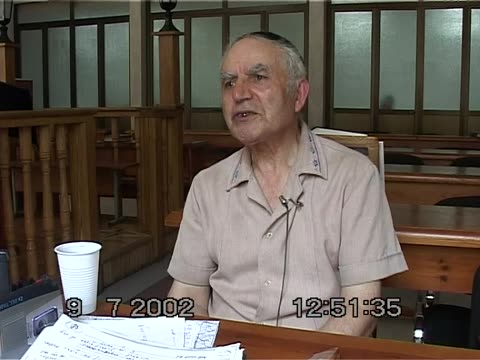
Short pause.
Life during the war.
Burshtein recounts the start of the war in Goworowo (Govrove) and the arrival of the Soviets and then of the Germans, who began killing Jews. His father refused to gather with the others and led the family toward the Russians. He describes crossing a bridge past German guards and meeting Soviet soldiers. He recalls the testimony of an elderly woman about the killings and burning of Goworowo. He then describes the journey via Zambrów and a committee that fed refugees, to Białystok, where refugees stayed in a club and later in empty apartments, a Polish village and a slaughterhouse. His father decided they should register to go further into Russia, and the family was taken to Babruysk, where they were disinfected and helped by local people.
Life in Babruysk and family.
Burshtein describes life in Babruysk, where he attended a Belarusian school at about the age of ten or eleven. The family lived at a factory that had trade with Germany, and his brothers worked as a tailor, a sweater maker and a shoemaker. He explains how his brother came to be called Alter Peysekh after a rebbe's advice cured the child's illness. He names his siblings and how names were given, including his own name Lazar after his grandfather, and Kerler asks whether he can speak Polish Yiddish.
adds his brothers' trades and the name of the brother who was called Alter Peysekh
Life in Gorove.
Burshtein talks about the languages spoken in Goworowo: Yiddish at home and in the street, Polish with Poles. He comments on life in Poland under Piłsudski and on being frightened as a child. Kerler asks about words for Polish Yiddish, and Burshtein mentions fear of going out at night and the custom of sleeping with the head covered.
Polish-Yiddish dialect and work.
Burshtein speaks about how Yiddish was spoken in Poland as against Babruysk and Riga, and Kerler asks for a word meaning small children. He explains how he worked in Zhytomyr from 1944 as a typesetter for the newspaper Radianska Zhytomyrshchyna and for a Yiddish journal. Kerler asks about the Yiddish word for typesetter, and Burshtein returns to the family's years at the Babruysk factory.
Life in Babruysk in 1941.
Burshtein recalls the German attack on Babruysk in June 1941, with days in a cellar and bombing, and the family's flight over the Berezina and by train through Belarus toward the Tambov region. He describes the village Strel'tsy near Tambov and then the district of Yelan', where he worked as a shepherd and food was plentiful, and the recruitment of his brother Peysekh into the army. The family went on to the Urals, where winters were harsh and food scarce, and where his parents died. He was sent to a metallurgical training school and beaten by Russian classmates until a Jewish man helped him. The surviving relatives left with Zhytomyr Jews in 1944 and arrived in June, without a place to stay.
Arrival in Zhytomyr after the war.
Burshtein describes arriving in Zhytomyr at fifteen and seeking work and training, and getting registered and food products from a director. He remarks on the ruined city, where the largest houses had three storeys. He says he did not know Ukrainian and learned it gradually, and that he writes and reads Russian and Yiddish well but finds Hebrew difficult. Kerler's question leads him to speak of prayer.
Prayers and Hebrew/Yiddish language.
Burshtein explains that he learned to pray on his own and from a grammar, and that he prays daily in Zhytomyr, though he did not learn modern spoken Hebrew. He discusses Ashkenazic and Sephardic pronunciation, a Polish form of pronouncing a prayer word, and the pronunciation he knew at home. Kerler asks which Yiddish is the most correct, and Burshtein speaks of a man from Israel whose Yiddish is best. They go on to contrast Polish Yiddish forms of words such as 'come', 'bread' and 'Warsaw', with the standard.