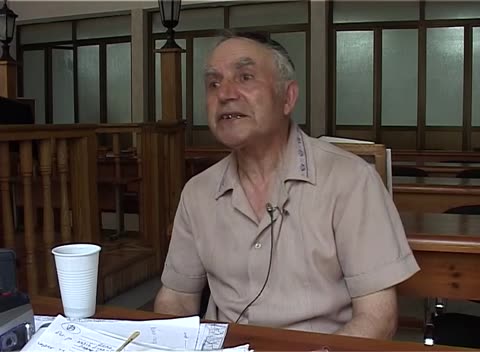
Burshtein sings a song he composed about leaving his hometown Goworowo and the longing for it, then a song of hope. Kerler asks about Hebrew songs; Burshtein says there was no Hebrew singing in cheder and mentions Sabbath and liturgical chants. He then sings Yiddish songs from Polish childhood about a wedding, an orphan child, love, hope of going to the Land of Israel, and a prisoner's return, with remarks on how they were sung.
Also includes talk about cheder, Sabbath chants and a song on the future State of Israel.
Kerler asks whether the songs had words. Burshtein explains that many were wordless tunes sung in company, though most he remembers had words, and he hums one. Both say they are tired and Kerler thanks him to end the interview.
After the break, the camera turns to a second man, who talks about Yiddish newspapers in Kyiv and the Soviet Yiddish magazine, which he used to read. He mentions a Polish-born cantor with a good voice and Burshtein's talent for singing. Kerler asks him questions in Yiddish.
The second man sings a children's song about learning the Hebrew letters. He then chats with Kerler about sayings and Kerler puts terminology questions to him. Kerler asks about the wedding entertainer (badkhn) and the master of ceremonies; the man mentions the rabbi, the engagement contract and a term for the one who leads the wedding. He also reflects on history and storytelling.
He talks about prayer in Zhytomyr today: how the gabbai and cantor lead the service, and the prayer book he received. An American rabbi, Samuel Plotkin(?), brought him his first tallit and prayer book in the 1990s and opened synagogues in Berdychiv and Zhytomyr. He prefers his old prayer book. Kerler asks about the phrase 'mother's prayer book' and whether women taught prayer instead of cheder.
He recalls childhood in Ukraine as a time of constant fear, with fear of Whites and Reds, kolkhoz, war, and price rises. He then compares life today with the Soviet period: his pension, the price of bread, and paying for medical care. He mentions the Jewish charity (Hesed) that provides meals.