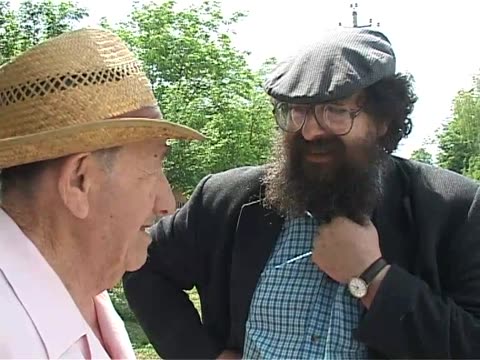
Skobilitskii points out the house of a wealthy local businessman (named something like Magazanik, uncertain). He ran a large farm with cattle, sent dairy products to Zhytomyr and Kyiv, and owned a leather factory that exported to Czechoslovakia. Many Jews lived in his buildings and worked for him. Skobilitskii also mentions a four-year Jewish school after the revolution, an old ornate door, and a visitor from Canada who no longer knew Yiddish.
Camera and walking footage of Berdychiv streets. The guide points out the synagogue, a children's polyclinic, and an old journalists' building, and the group finds a gate closed and rings to be let in. They then reach a newly built yeshiva complex, where a mikveh is being built. Its funding is attributed to a rich man living in America, named something like Mendelevich (unclear). Much of the speech is garbled.
The team enters the Berdychiv yeshiva building and sees the prayer room, a Torah scroll and the dining hall. They briefly speak with students, who say they study mostly in Russian with Russian translation and that Yiddish plays only a small role. Kerler remarks on the former building being bought and taken away, and on the 'great miracles' of Jewish children studying there again.
At the mass-grave site and memorial near the old airfield, Russian voices say where Jews were shot and where the pits and the obelisk are. Skobilitskii recites Kaddish and discusses how many Jews were killed in the area. The figure is heard as roughly eighteen thousand six hundred (uncertain). Most of the Yiddish here is garbled.
Skobilitskii shows the house on Kachenivka street where he lived and his younger brothers were born. It belonged to a rich man whose family name sounds like Krupnik (?), and tenants paid him rent. He remembers sledding in winter, and describes the large synagogue that stood nearby, with a mikveh and bath fed by the river. He mentions friends from Berdychiv now in Haifa and Netanya, the mostly Jewish surroundings, and walking to synagogue on Shabbat.
The Berdychiv visit ends with farewells. Skobilitskii points out his third-floor flat. The talk turns to Ruzhyn (Ruzhene) and Jews still living there, and to a plan to visit again, including his grandfather Nachman, a rabbi. Both sides express thanks and good wishes.
Geller, in the Zhytomyr synagogue, says he comes from Pyatka, a small town between Berdychiv and Chudniv. He talks about the Zhytomyr rabbi and his Russian, about Jews living in Zhytomyr as if in exile, and about the lack of proper Jewish burial for a 93-year-old man. He also describes young visitors who know no Yiddish, a dictionary he gave one, and who in Zhytomyr still speaks Yiddish. The rabbi's trip to Polonne, where a wall for a tsadik was built from gravestones, leads to a note on a Pyatka word for a small wall.
Adds Pyatka's location, burial difficulties, and the rabbi's trip to Polonne.
Geller says he left Pyatka in 1936 and that his father worked in the fields. He recalls the Yiddish heard in Vinnytsia region and Zhytomyr, then tells a folk tale about a matchmaker, three daughters and a suitor made to chop wood, which he performs in a rhyming refrain. He did not attend cheder. The Yiddish school became a Ukrainian one with the same director, Frenkl, and he learned a little from his older brother. He also mentions grandfathers killed in earlier violence (details unclear).
Adds a folk tale about a matchmaker and three daughters, and his schooling.
Geller speaks about family names, including how a relative received the nickname Tatele. He remembers writing home from the front and hospital in Russian with Yiddish letters to get past the military censor. Today he and Leyzer speak Yiddish every morning, which he says keeps Yiddishkayt alive as it dies out.
Geller discusses Yiddish today. He says a Kyiv paper has little Yiddish, and that new Jewish schools teach Hebrew rather than Yiddish or Ukrainian. He notes that the Lubavitcher rebbe on television speaks Yiddish and equates Yiddishkayt with Torah study.
Geller gives his Yiddish name as Binyomin, nicknamed Mime, and says he is nearing eighty. His father Yankl was a glazier until 1932, and his mother and her family's names are discussed, including a grandmother Etshi and another named Mintsi. His parents had no child for ten years until the rebbe promised one, and his mother lived to 93. A relative of his grandmother had 23 children. His mother was taught by a tutor, studied two gymnasium classes, and loved Pushkin and Tolstoy.
Geller describes childhood games in Pyatka, mainly the spinning top (tsurke) marked with letters and scored by the steps taken, and rolling a hoop. He also recalls a cyclist from Petersburg in 1929 whom the children chased. He compares this with today's children and telephones and television. Kerler asks for local Yiddish words for the games.
Adds the cyclist from Petersburg and comparison with today's children.
Geller describes the prayer houses of Pyatka: a shul, a beys-medresh and a kloyz. He explains the differences when Katz asks, saying the kloyz was small and used for a minyan. In 1941, 169 people were gathered from the kloyz and driven to the river and killed. The beys-medresh was closed around 1931–32, was used as a carpentry shop, and was then burned, with a local man named Itsik the Krimer blamed. The shul stood until the war, and a wooden building from it was taken to Berdychiv.
Adds Katz's question on shul, beys-medresh and kloyz, and the burning of the beys-medresh.
Geller recalls Sabbath in Pyatka. He discusses terms for tidying up and for taking the candles off the table, and a child's memory of carrying his grandfather's tallit and a neighbour's request on Shabbat. He also tells an anecdote about forgetfulness after a wedding held in a restaurant. Kerler asks about local words for these things.
Adds the Sabbath anecdotes, the Yiddish word questions, and a wedding anecdote.