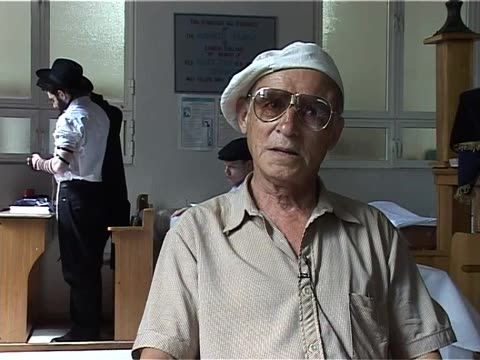
Brief discussion of the successive names of his hometown. Kerler states the date and place of the recording. Shraibman explains that his patronymic was changed in his army-college documents in 1949 and how a general reacted to it.
The passage also covers the town's changing names and the army-college general.
Shraibman, born in 1930, was due to start school in 1937. There was a Yiddish school in the town, but it was closed, so he attended a state (Russian) school. His father, a gymnasium graduate, began to teach him, but the war ended his studies.
Shraibman gives the names of his parents and of both grandfathers; the two grandfathers were brothers and his parents cousins. One grandfather starved to death in the war. He also mentions his archive research, including the story of a girl in the records. He says history is his hobby and that he served 26 years in the army.
The passage also covers the family names and his archive research.
Shraibman describes his army career: ten grades, the army college, a lieutenant's rank in 1952 and discharge as a major after 26 years. He spoke Yiddish with non-Jews and met few Jews in the army. He describes the value of mame-loshn and recalls an Argentine girl who spoke Yiddish. He also served at a site where an atomic bomb was tested on living people, and he mentions being behind the German lines for about a week and a half.
The passage also covers the role of Yiddish, a meeting with an Argentine girl and the atomic-test site.
Shraibman describes his grandfather the tailor, who served the villages around the town with a sewing machine. Old non-Jews still remember him and speak Yiddish in the town. He says that few Jews are left, whereas before the war the town was about eighty percent Jewish, and he recalls his grandmothers.
Shraibman describes the war: they fled in the summer, were taken to Tambov and then to Uzbekistan, where hunger killed six of twelve family members. One grandmother stayed behind and was killed by the Germans together with the remaining Jews. Kerler asks for the grandmothers' names (Beyle, Gitl).
The passage also covers the grandmother left behind and killed in the town.
Shraibman recalls his father, who was sent to collect wheat in the 1930s, received damp grain that spoiled, and was imprisoned for three years. After his release the father worked as a bookkeeper. His mother was a housewife and a sister died in infancy; he was an only child, and he describes growing up in the household of his two grandparents.
Shraibman talks about religion in the family: the grandmothers were very pious, while his grandfather kept holidays but smoked on Sabbath. He tells how during the Civil War an armed band (Budyonny's men?) nearly shot his grandmother. Katz and Kerler then greet someone arriving and mention their song collecting.
The passage also covers the grandmother's brush with soldiers and the arrival of a visitor.
Shraibman is asked about songs. He mentions his grandfather, who played the violin and sang, and sings a tear song and a tailor's song. He also mentions Paul Robeson and a recording of Sholem Aleichem's Motl, and a second man joins in a lullaby. The talk then turns to antisemitism in the army.
Shraibman describes antisemitism in the army, with 1953 hard and the Doctors' Plot mentioned. He served at Yakutsk in the 1960s among many nationalities who lived on good terms in severe cold. He left the army in 1975 and settled in Zhytomyr with his mother's sister, and he explains that the relatives who had been planning to leave went to America and Israel.
Shraibman talks about Jews in Zhytomyr today, which has about two thousand, and about its history. He discusses an old Hebrew press, the rabbinical college in the nineteenth century, a card index of victims of the 1930s and rabbis' meetings in the 1920s. He describes working in the archive and what his late wife said of it.
The passage also covers archive research, a rabbinical college and a card index of 1930s victims.
Shraibman describes working after the army, first in a power-supply job and then repairing household appliances. Kerler remarks that this is a handyman and then turns to the atomic-bomb experiments in the army.
Shraibman describes the secret atomic-bomb test of 1954, including the Totskoye exercise. He was a lieutenant who escorted generals to the site, and he reports that about twenty-five of his colleagues died of radiation. He describes the dosimeter rings used and how little was known at the time. Kerler then asks about childhood.
Shraibman recalls two very pious Jews, Moshe Yosl and Zelik, killed by the Germans; at eleven this was a tragedy for him. He describes holidays in his childhood and the grandmothers' Sabbath. Kerler asks about holiday food: foods for Yom Kippur eve, the sukkah of Moshe Yosl, dairy foods and blintzes for Shavuot, latkes for Hanukkah and hamantashn for Purim. He mentions his grandfather, the tailor, who walked on foot to Chernyakhiv, 25 km away, and shows photographs of his family.
The passage also covers holiday food items, the sukkah and the family photographs.
Shraibman mentions his granddaughter in Haifa and a cousin from America whom he had not seen for 26 years. Kerler asks him to show the town on the map. Shraibman recalls his grandfather's Purim custom of visiting the poor first and then the rich, and shalekhmones are mentioned. He says he likes having guests but has no kosher kitchen.
The passage also covers the map and the grandmother's Purim visiting.
Dialectological questionnaire. Shraibman and Kerler discuss terms for a pious or good Jew, a dybbuk, golem, ladder, house and entrance hall, and the Litvak versus local pronunciation of 'groats' and 'near'. They also cover words for pigeon, ear, drinking up, greetings and building types. A second man joins the discussion of song collecting and of pronunciation, and some Russian words are used to prompt translations.