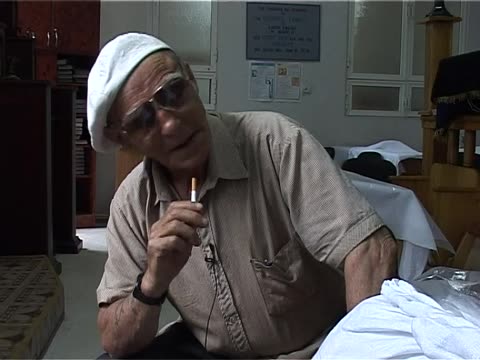
Dialectological questionnaire with the older man (presumably Shraibman), Kerler and Katz asking for Yiddish equivalents of Russian words and phrases. Items include the Soviet-era words for 'state' and 'work', verbs of looking and escaping, 'honest', 'head hurts', 'where from', 'grandmother' and midwife, 'tree', 'vodka', 'bed', 'well/spring', 'oak', 'shop', 'flowers', 'potatoes', 'ceiling', 'wealthy man', 'fence' and 'suddenly'. Kerler and Katz also test prepositions and grammatical constructions such as 'on the street' and 'on the road'. The informant often comments on whether a word is Yiddish, Russian, Ukrainian or Belorussian and whether he used it at home.
Closing exchange of the questionnaire session, with a few remarks among Kerler, Katz and the informant and a short bit of talk about stopping. The words are mostly garbled.
Little can be made out beyond a few closing remarks.
Burshtein, interviewed by Kerler, says he was born in Goworowo, a small town near Warsaw (Polish Goworowo, Yiddish Govrove). The recording date is given as 23 May 2003. He came to Zhytomyr in June 1944 after evacuation in the Urals (a kolkhoz in the Elansk district), having first gone with Zhytomyr Jews, who then left. He recalls that his brother was taken into the army and was reported killed at the front.
Burshtein's birthplace, Goworowo near Warsaw, and the Urals evacuation are given; the brother's death is mentioned in the transcript.
Burshtein tells anecdotes about his family in Poland. His father was waiting for a sister in the woods near a town, where he was followed by two silent figures. Another anecdote tells of a man in the woods in 1938 who predicted the war. His father and grandfather, both tailors, were fooled on the way to a fair by a sack of salt that proved to be a demon's trick. He mentions the religiosity of the family, where men slept in yarmulkes, and an incident in which his brothers entered a Polish sausage shop and the rabbi was told. He then begins to recall the start of the war, apparently in September 1939.
The anecdote about the father's meeting in the woods is placed in 1938; also the shop-and-rabbi story and the tailor-fair story.
Burshtein recalls the start of the war and the bombing of his town. His family took refuge in the prayer-house, where the Torah scroll was opened and psalms said. After Polish soldiers announced the Germans' approach, the family fled by night with his father, mother, two sisters and two brothers. They ran into German motorcyclists and reached Ostrów Mazowiecka, where Jews were driven out of their homes and assembled and some were held for days. He describes hunger, bread thrown over the fence, shooting and a curfew, a German officer's cruel jokes, and the Germans' searches. His father and a brother were held, and the family searched for them. They crossed a bridge to the Russians' side, where the rabbi's wife told how Goworowo's synagogue was burned with people inside.
Katz's question about timing: events in the first week of the war in 1939.