0:00
The team walks with Rezmovits to a restaurant, where they continue the conversation.
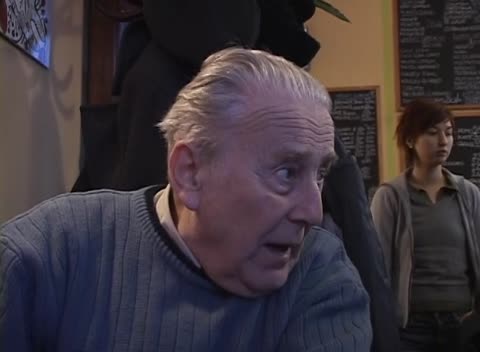
One conversation with Andor Rezmovits, continuing over MDV 78, MDV 79, MDV 80, MDV 81.
The team walks with Rezmovits to a restaurant, where they continue the conversation.
Rezmovits speaks about his life in Debrecen after the war. He worked in the metal business. He then shares an episode when he encountered a Yiddish-speaking Polish family.
Rezmovits talks about forced labor in the early 1950s (?), when he was given only unskilled work smashing material with a large hammer in a factory, and wagonloads were packed each day. He then tells how he and a colleague, caught in a storm, asked a Polish peasant woman for a night's shelter. She turned out to speak Yiddish because she had once been a servant in a Jewish household. She offered them pork and gave a parting gift of a kind of red tea.
The Yiddish-speaking woman was a Polish peasant, a former servant in a Jewish household, and gave the men tea; the year and place of the work are unclear.
Rezmovits tells jokes. He then speaks about his life during World War II, particularly recalling shootings. They then discuss Holocaust writings and films.
Rezmovits recalls wartime scenes involving soldiers, Russian and Jewish officers and shooting at Germans, and says that Polish people were hostile to Jews and that many Jews were betrayed or had to hide. He then discusses with Kerler books and films about the Warsaw ghetto uprising and its Jewish historians, including Rezmovits's reading of one such book in Hebrew, and how many Germans were killed by the insurgents. The discussion turns to the importance of the fact of Jewish armed resistance.
The passage covers the Warsaw uprising books and films and Polish antisemitism, which the catalogue sentence does not name.
They talk about life today, before Rezmovits speaks again about Jewish collaborators during World War II.
Rezmovits speaks about a Polish official who, according to him, helped the Polish administration yet saved many Jews, and about his son, who became the first prime minister after communism fell. The talk then turns to Kerler's book of poems, which Rezmovits has begun to read and praises. He mentions that he writes in three languages and was told about Kerler by a woman, Sonya (?).
The passage includes an extended exchange about Kerler's poetry book and Rezmovits's reading of it.
Rezmovits discusses Jewish poets and his work as translator into Hungarian.
Rezmovits discusses the Hebrew poet Nathan Alterman, whom he considers unique in Israel, and says he has translated four or five of his poems into Hungarian. He explains that translating feels to him like a duty, and that he has shown the poems to an expert but they are not yet published. Kerler suggests he should publish the translations, and both reflect that the more one learns, the less one feels one knows.