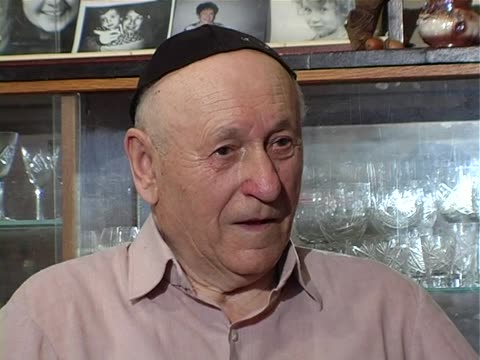
Nibulskiy explains how cholent was made for the Sabbath, including its ingredients (potatoes, herring, etc.). The oven door was sealed with clay so the food stayed warm till the Sabbath. Kerler asks about the sealing.
The sealing of the oven with clay is brought out by Kerler's questions.
A short exchange about the date, and about how Kerler and Nibulskiy last met in January. Nibulskiy gives Russian, Ukrainian, Yiddish and literary words for "flower" and mentions a song with the word. They then turn to a Yiddish word he says he will explain through a tale.
Besides dialect words, the passage has talk about the date and the previous meeting.
Nibulskiy tells anecdotes he heard from his grandfather: a bad son hammering nails into a gate, the Ba'al Shem Tov marrying a young couple and the feast and gifts from the landowner, and a story of babies suffocated by a sorcerer in cat form. He then tells of a carpenter in Pulen and the Makarever rebbe, and of other rebbes' power over visitors. Kerler asks questions on the words and the stories, and S2 occasionally speaks.
Beyond the family anecdote, the segment contains the Ba'al Shem Tov wedding, the sorcerer, the Pulen carpenter and the Makarever rebbe.
Nibulskiy tells a story he heard from his friend, a fellow student at the institute, about the friend's paralysis. His mother prayed at a rebbe's grave and he was cured. Kerler asks where they studied (a faculty of history and philology) and what became of the friend, who is from Narodychi and may have gone to Israel.
The friend's name, origin and later fate emerge in Kerler's questions.
Nibulskiy tells a story from Berdychiv in which the rebbe is imprisoned and the Jews bribe the guards so that they can keep Sabbath and sing there. A baptized Jew sent by the tsar investigates and hears a story about a landowner's son, and the Jews' accusation is shown to be false. Kerler asks where the rebbes lie buried, and the discussion mentions Levi Yitskhok.
The catalogue entry names only Berdychiv; the transcript shows the prison story with the baptized Jew and the tsar.
Nibulskiy invites his wife Ida to come and sit beside him so she can be seen on camera. He says that the next day they will have lived together for 62 years. She then announces that she will recite something by Itsik Fefer.
Ida's announcement of the Fefer recitation and the 62 years of marriage.
Ida recites verses by Itsik Fefer about a small boy, Shayke(?), whose father is angry at him for singing revolutionary songs in the street and threatens to beat him with a belt. She also recites a children's rhyme and has trouble recalling the continuation. Kerler identifies the poem as Fefer's, and Nibulskiy fills in lines and prompts her.
Nibulskiy sings a begging song about a poor man's hard life. He says it came from a blind old Jew who sat begging in Korosten, and he is asked to write the lyrics out. After a short exchange with Kerler about a word for abandoning one's family, Ida recites a poem about the coming of electricity. Nibulskiy adds a Russian verse about poles and wires, and recalls the first radio, the first silent films and the first power station in the shtetl. He also mentions a brother who was killed at the front.
Adds the poem about electricity and the memories of the first radio and cinema.
Nibulskiy mentions the small Jewish population of his shtetl, about 300 families, a minority of whom did not keep kosher. He then sings a song about shtetl life in Pulen (as heard), with shoemakers, tailors, wagon drivers and the hope for the Messiah. Kerler asks about the tune, which letters the text was written in, and how a word like 'khaver' is pronounced. Nibulskiy sings a song about vanished childhood years and a house now replaced by a chimney. Kerler also asks whether the song was popular, and Ida reads about it in a newspaper.
Adds the shtetl song about Pulen and the talk about its melody and Yiddish orthography.
Kerler asks about Yiddish poets and prose, including a work 'By the Dnieper' whose author is unclear in the transcript. Nibulskiy says he reads Yiddish periodicals every day at 83 and keeps tefillin. He recalls carrying his tailor grandfather's prayer shawl to the tailors' synagogue every Sabbath, and the few kopecks and sweets he earned. He remembers poverty, carrying Hanukkah gifts, and a childish prank in his grandfather's workshop that frightened the tailors. Kerler then asks which stories he still wants to tell.
Adds Yiddish reading habits, his grandfather's synagogue and childhood earnings and prank.
Nibulskiy sings a Yiddish song about lost childhood years, home and family. Kerler asks whether the word for the chimney is the Pulen form, and Nibulskiy says he reconstructed the song from memory. He says it was sung by a man named Khanine Shlepak (?) from Pulen, who was evacuated to Kazakhstan and became a dentist. Kerler asks whether anyone in Korosten still speaks Yiddish. The talk turns to a relative in Israel who is writing a book about Korosten's Jews and was a military commandant after the war.
Nibulskiy tells a short anecdote in which a man asks his rebbe why rich people turn away from him while poor people greet him. The rebbe has him compare a window with a mirror, which has silver behind the glass. Nibulskiy says he also read it in a magazine. Kerler then asks about a different story, connected with Abimelech (?) or with vareniki.
After the song about childhood, Kerler and the couple discuss Chaim Segel, now in Israel. Ida says he is her sister's child. He is writing a book about Korosten, and was a commandant there after the war. They then discuss a professor son-in-law and how many sons-in-law they have. Kerler pursues Yiddish forms, such as the Pulen word for 'bee' or hornet versus the Ukrainian form, the expression for an idea getting into one's head, and neighbor forms and plurals. Nibulskiy says what his grandchild was called and that he hopes to reach ninety.
Adds the family talk about Chaim Segel and the sons-in-law, and the dialect word questions.
Kerler asks about plural forms of 'rebbe' and 'rov' and about the term for a 'winter fool'. Nibulskiy then tells a Chelm story about two halves of the town quarrelling over how to lay the boards of a bathhouse floor until the rebbe's ruling. He follows it with a Hershl Ostropoler story in which a miserly rich man is tricked by a multicoloured hat made by a hatter. The hat is sold on at a profit, and the miser is cheated of a meal and drink in several places.
Adds Kerler's questions on plurals and a 'winter fool', the Chelm story and the hat story.