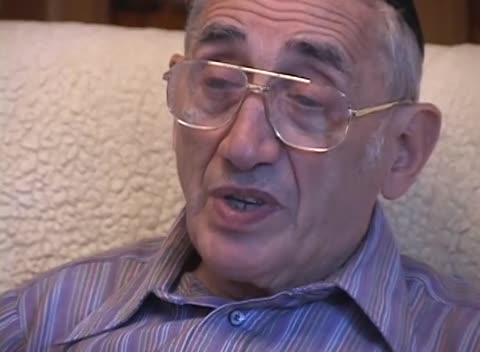
Herbst speaks about his life after the war. He worked as nuclear technician at an institute of physics. Herbst was married in 1961 and he raised a son. He then provides personal information and speaks about his hometown Bornobash (Yiddish: Berlabashe).
From the machine transcript
Herbst mentions his flat on a hill in Budapest and that he received it through work. He says he married in the 1960s (?). Asked by Kerler, he places his birth in a small village in the Carpathians known as Berlebash (Bornobash in Hungarian), between Rakhiv and Trebusa (?). It was a village of about three hundred inhabitants, mostly Ukrainians, with a minyan of Jews. He describes the surrounding mountains and wild animals.
The transcript shows his flat and workplace in Budapest and the village's setting among mountains and wild animals.
Herbst describes his childhood home and life before the war. He then addresses celebration of Tisha B'Av during World War II.
From the machine transcript
Herbst recalls his childhood home at the foot of a hill, with a few geese and hens, and a story of wolves coming down from the forest. He speaks of Tisha B'Av, when the children fasted and did not work. During the war he picked raspberries in the mountains with friends because of the bears. He and Kerler briefly discuss a Yiddish word for a children's game, and he says he began working in Hungary in the late 1930s.
Raspberry picking with friends in the mountains and a wolf story from his childhood home.
Herbst speaks about his work at a lumbermill between 1938 and 1941. He then addresses his life after the war. He was hospitalized between 1945 and 1951.
From the machine transcript
Herbst says he worked at a sawmill and then after the war lay in hospital for several years from 1945 (?). Kerler asks whether he had been to Budapest before the war. Herbst says he knew it only from a picture and had stayed in Berlebash until 1944.
Herbst speaks about his life and travels to Romania before the war.
From the machine transcript
Herbst recounts that he travelled once to Romania, to a married sister in Vişeu de Sus (Oyber Visheve), where her husband was a melamed and he stayed a year before the war. He describes the border crossing with a one-month passport and how people advised him to buy a half-price train ticket. Kerler then asks when the war began.
A trip to a sister in Romania, with details of border crossing and cheap train tickets.
Herbst describes his family's life at the beginning of the German occupation in 1944. According to him, Jews from his hometown had to assemble and were deported to Rakhiv, before deported further to the 13:58 ghetto. Herbst then describes the conditions of the ghetto, where they had to sleep at the cemetery for six weeks. Herbst continues and explains how Jews from his family was deported to Auschwitz. Herbst stayed in Auschwitz for one week and then was sent to the Mauthausen concentration camp for a forced labor selection procedure, which also lasted one week. As a forced laborer, he was sent to Ebensee to work in a quarry for three years.
From the machine transcript
Herbst tells how the Carpathians changed hands several times (Czechoslovakia, Hungary) and how the Germans entered Hungary in March 1944. After Passover the Jews were ordered to Rakhiv and then taken to the ghetto at Mátészalka, where they lived for six weeks in the cemetery. From there the family was taken to Auschwitz in the first transport, where his sisters and their children, and probably his parents, were lost. He was selected at Mauthausen and sent to Ebensee, where he helped to build tunnels, and he mentions a cousin now in New York.
A joke about the changing of countries, and a young work leader who offered to let him stay behind in the mountains.
Herbst speaks about his liberation by the American army in Mauthausen. He explains that the forced laborers were rationed to one meal a day and therefore he became too weak to work. Herbst was sent to the hospital in the Mauthausen concentration camp, where he was liberated by the American army. He then recalls prisoner functionaries (Kapo) that helped him to recover in the hospital and describes the conditions at the hospital. Herbst specifically remembers the Polish Jew Boryslav Biyalik.
From the machine transcript
Herbst describes the liberation of the camps by the Americans and the Russians, his work at the quarry on one meal a day, and his return to the Mauthausen infirmary when too weak. There a Polish Jew from Krakow, whose name is given roughly as Boleslaw Bialik, shared bread and hid him from selections. He also speaks of Kapos, one of them a one-armed Hungarian Jew named Singer (?), and of overcrowded bunks. Kerler asks about the Russian word for bunks and about conditions in winter, and Herbst also mentions Hungarian Jews arriving in the autumn of 1944.
A Hungarian Jewish Kapo and the camp's sleeping conditions.
Herbst speaks about Jewish life in the region during German occupation in 1944. He then mentions how he always kept a prayer book (siddur) when traveling to Mauthausen.
From the machine transcript
Herbst speaks of the Budapest ghetto, whose Jews were not sent to Auschwitz, and of Hungarian Jews who arrived at Mauthausen. He tells how he found a prayer book and tefillin at Mauthausen and kept the tefillin with him, naming their owner as Chaim Meir Weiss (?). The last part is a muddled exchange with Kerler about a seminary and a teacher or acquaintance who wrote an article about Herbst.
The tefillin found at Mauthausen and a conversation about a seminary teacher.
Herbst shows his prayer book and recites prayers for the fourth and second days.
From the machine transcript
Herbst and Kerler talk about his prayer book, and Kerler asks him to read something aloud. Herbst then reads or recites prayers, which are largely garbled in the transcript; Kerler remarks that they are for the Monday and Thursday service. Kerler then asks where he learned to read Hebrew.
Kerler's remark that the prayers are for Mondays and Thursdays, and a question about where he learned Hebrew.
Herbst addresses his prewar religious education and speaks about religious institutions in the region. He attended a yeshiva high school for one year in Vişeu de Sus, Romania, (Yiddish: Oyber Visheve).
From the machine transcript
Herbst says he last studied Jewish subjects during his year in Vişeu de Sus, at a yeshiva with some two hundred and fifty students (?). He and Kerler mention larger yeshivas in Pressburg and Cluj. Kerler explains his own interest in collecting Yiddish and then asks Herbst for more about Berlebash.
A chat about Kerler's collecting of Yiddish.
Herbst speaks about Jewish life in his hometown Bornobash. In particular, he describes how the local inn produced wine for the community on Rosh Hashana. He then mentions a wealthy Jew from Rakhiv who gave out wine before Passover.
From the machine transcript
Herbst describes Berlebash as tiny, with barely a minyan and boys without tallit until marriage. The wealthiest family kept an inn that obtained grapes for Rosh Hashanah wine, which was distributed to each family. A wealthy Jew from Rakhiv with a sawmill, Abish (?), gave out kosher wine before Passover, and raisin wine was otherwise made at home.
A wealthy Rakhiv sawmill owner who provided wine before Passover.
Herbst discusses his family. His father owned a grocery shop. Herbst grew up with four sisters, who worked as seamstresses, and three brothers. He then describes his family's life before and during the war.
From the machine transcript
Herbst says his father kept a small grocery shop largely on credit, while four sisters did handwork and sewing for the local Ukrainians, paid in food. He grew up with four sisters and several brothers, one of whom studied tailoring. The sisters went to Auschwitz with their children and did not return, the youngest brother was lost before the war, and another brother survived Mauthausen and was liberated in 1945. He also mentions living in a sukkah-like hut in the mountains.
Details on the sisters' needlework, the family's economic situation and the brothers' fates.
Herbst depicts his return home from Mauthausen (by car), via Melk (on foot next to horse and wagon), Bratislava, Slovakia, (by train), Győr, Budapest and Debrecen in 1945. Herbst mentions that the Joint Distribution Committee supported the community in Debrecen in the immediate postwar period.
From the machine transcript
Herbst describes his return in 1945: by lorry from Mauthausen to Melk, then on foot with a horse and wagon in the Russian zone toward Bratislava, then by train to Hungary. The Joint helped him in Budapest, where he went straight to hospital, and he was then sent to Debrecen, where the Joint supported the Jews with clothes and food. He later went back to a Budapest hospital and a sanatorium and began to learn a trade.
His later stays in hospital and sanatorium and the start of his vocational training.
Herbst talks about his life and work after the war.
From the machine transcript
Herbst recounts how a physicist invited him to work at a physics institute, with a trial month, and how a doctor friend had helped him find work and a post. He says it was hard because the others were highly educated, and mentions kosher supervision.
Herbst speaks about his school education at a Ukrainian school in his hometown. He then returns to his life in the postwar period in Debrecen, which included attending synagogue services. Herbst gives snippets of postwar religious life in Debrecen.
From the machine transcript
Kerler asks about Herbst's schooling, and he says he attended a four-class school in Berlebash, taught in Russian or Ukrainian. He then returns to postwar Debrecen, where he lived in a small room and received meals and money from the Joint, and mentions a yeshiva. He describes attending synagogue and meeting a Russian rabbi (Moshe Weiss, ?) and speaks of a rabbi's sermon in a mixed Hungarian and Yiddish setting.
Postwar religious life in Debrecen, including the Russian rabbi and a sermon.
Herbst speaks about his life today and recalls a prayer. He then briefly addresses prewar Jewish life in Bornobash and shows his parents' photographs. Herbst also speaks about languages spoken at home.
From the machine transcript
Herbst speaks about a recent operation and hospital stays, and a prayer for protection. Kerler asks whether the Jews of Berlebash wore beards, and Herbst says his father did and shows photographs of his parents, naming them as Ephraim Fishl and Perl. He says the family spoke only Yiddish at home and Russian with non-Jews, and that after the war he had to learn Hungarian.
A recent operation, photographs of his parents and the family's languages.
Herbst speaks about his childhood memories. He describes his childhood home and animals. He then addresses prewar Sabbath food customs.
From the machine transcript
Herbst recalls that the family had a cow, geese and hens but did not sell milk, because eight children needed it. His mother baked round bread and challah and some flat dough cakes, and they ate meat on Sabbath only rarely. He mentions a goose slaughtered once a year in winter and a simple dessert of noodles with sugar.
Herbst explains how his mother koshered meat.
From the machine transcript
Kerler asks whether Herbst remembers how his mother salted meat, and Herbst describes a homemade wooden implement. Asked about anything she used to say while salting, he says he heard it but did not understand. Kerler then says he must change the cassette.