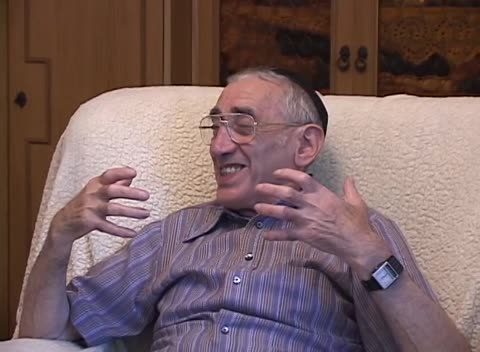
Chat about Kerler's plans to travel to Jerusalem and to be there for the Sabbath, and about Kerler's feelings for Jerusalem versus Tel Aviv. Herbst mentions a young grandson who is ill with an ear complaint, and begins to say that he has not sung Sabbath songs for anyone.
The transcript shows talk of travel plans to Jerusalem and a grandson's illness rather than a biography of the family.
The transcript does not show the song itself clearly. Kerler and Herbst talk about finding older Jewish people in Budapest to visit, a kosher kitchen, and an acquaintance Herbst knows. Herbst mentions a prayer book and a brother of someone from Nyíregyháza, and Kerler asks about a song from yeshiva life.
No song is clearly visible; the transcript shows a search for elderly people to interview and talk about a yeshiva song.
Herbst mentions a cousin in America, then he and Kerler talk about drinking and drunkenness: the saying that a drunk is a non-Jew, and the habit of having a snack with a drink. Kerler remarks that many books will be written by many people, and Herbst says there will be nothing without his name.
Herbst talks about a female friend in Jerusalem, an ethnomusicologist who wants to write a booklet about him, and gives his address. Kerler remarks on the dangers he survived and asks about a Polish man who saved him. Long Hungarian stretches concern friends and acquaintances in Budapest and people to visit. Kerler compliments Herbst's Hungarian and asks about Yiddish speakers in Budapest after the war.
Adds the Jerusalem friend, a rescuer in the war, and the long Hungarian conversation about acquaintances.
Herbst and Kerler talk about Jewish speakers of Yiddish in Budapest after the war, and about Herbst's wish to keep speaking Yiddish. He says Yiddish, the mother tongue, comes from deep in the heart, more than Hungarian does. He says he came to Budapest after the war.
The Debrecen move in 1951 is not shown clearly in the transcript.
Kerler and Herbst close the formal interview: Kerler leaves his address. They talk about another interviewee, Reiznovits (?), with whom Kerler spoke for hours by phone and in December, and Kerler says they did not talk enough with Herbst.
Talk around Herbst's pictures (paintings) and the people who looked at them, with talk of a woman who studied Russian in a Hungarian school. Herbst begins a song about a burning town, and there are mentions of Drohobych and Zhytomyr. Kerler reads out the date of the recording as 20 June 2007.
The transcript shows spoken talk, a song fragment and the recording date as well as the paintings.