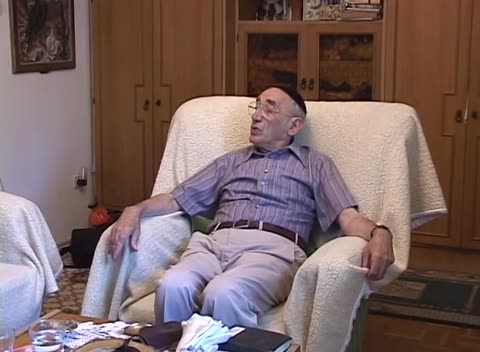
Opens with a remark about which languages a woman knew: Russian, but not Hungarian. Kerler then asks Herbst about Purim in Upper Vişeu and in Bornobash. Herbst recalls being alone one Purim in a strange town, cared for by a friend of his sister, and children going from house to house with Purim rhymes. Kerler asks whether there was a Purim play about a chimney sweep, and Herbst does not remember one. A side conversation with S2 turns to work and jobs. The passage ends with Kerler asking whether non-Jews in Bornobash spoke Yiddish; there were too few Jews for that.
Also covers the opening remark on languages, the Purim play question and the non-Jews' lack of Yiddish.
Herbst speaks about a non-Jewish friend who worked with him at the sawmill, handling timber and owning a bicycle. The friend knew no Yiddish but took his place at work on the Sabbath. Kerler ends the passage by asking for the Hungarian word for 'peasant'.
Herbst answers dialectological questions from the AHEYM Yiddish linguistic questionnaire. He then discusses his childhood memories, including games and daily food customs.
Herbst answers questions on what Yiddish speakers called forest workers and peasants, and on how the word 'goy' was used. He then describes childhood games, including sledding and a ball game with homemade equipment. He recalls how one big loaf of bread, baked by his mother, had to last a week, and what he took to work. He mentions wild berries and fruit picked in the woods. Towards the end Herbst turns to his plot in the cemetery and the stone on which he wrote his ancestors' names. Kerler discusses function words such as 'oder' and 'ober' and mentions a scholarship at Bloomington.
Adds the bread and lunch routine, wild fruit, a function-word question and the family gravestone.
Kerler asks how certain sentences were said in Yiddish, such as asking someone to pour water, and about the older phrase for asking where a person is from. Herbst answers. Between the questions the talk turns to preparing for death: he has set aside his old tallit and kittel, and he wants a Psalms book placed with him when he dies. The transcript does not clearly show the gravestone inscription mentioned in the catalogue.
Adds burial preparations (tallit, kittel, Psalms) in place of the shown gravestone.
Prompted by Kerler's question about Hasidim, Herbst recalls meeting many Hasidim in Upper Vişeu and now in Budapest. He talks about the Kalever rebbe's grave in Budapest, visited by Jews from America and Israel. He tells of writing a note to place at the grave and of the Sabbath meals with visiting rabbis in Vişeu, with Kerler and S2 asking about the Hasidic groups. Kerler and Herbst also discuss making a copy of the recording on DVD.
Adds the Kalever rebbe's grave in Budapest, the note written for the grave and the talk about copying the recording.
Herbst and Kerler talk about memory and lost phones. They then discuss how Herbst can get a copy of the recording and about relatives abroad. Herbst recites a series of prayer or psalm passages and says he reads the day's psalms daily. Herbst asks Kerler about his family; Kerler has a wife and two children of seventeen and fifteen.
Herbst shares proverbs from his childhood. He then returns to prewar Hasidic life in Vişeu de Sus. In particular, he recalls a rebbe from Rakhiv and poverty.
Herbst gives blessing and wish formulas he knew from childhood. Kerler then asks about the Hasidic rebbes he saw. Herbst explains that the old Rakhiv rebbe lived in Upper Vişeu, while the younger one headed a yeshiva. He attended his Friday night table and recalls his Hasidic fervour, and says he lived in nearby Bornobash. He describes how poor the area was, with only wild apples, cherries and plums. In answer to Kerler's questions he says potatoes, a potato soup and a potato kugel were eaten.
Adds the proverb-style wishes, the Friday night table, and potato dishes.
Herbst explains how his mother made mamaliga, layered with cheese, sour cream and butter and baked in the oven. He also says how it was eaten with milk, and what he and Romanians called it (a word possibly tokan). Kerler then asks about cultural terminology: what 'a good Jew' meant (a Hasidic tsadik), and the word for a cemetery as a holy place. He goes on to ask about the golem and the dybbuk, the latter of which Herbst knows only by hearsay. The passage ends with Herbst saying he began work at a sawmill after his bar mitzvah.
Adds the golem and dybbuk questions and the start of sawmill work.
Herbst speaks about his life before the war. After his bar mitzvah, he began to work at a lumbermill. He then turns to his life after the war and also mentions his friend Anton Revis, a painter.
Herbst says he worked at the sawmill with Russians, Ukrainians and Romanians and heard no Yiddish there, and that after the war he met few Yiddish speakers outside the hospital. He and Kerler talk about his Yiddish, which resembles that of Hungarian-Jewish Debrecen, and about the words 'Litvak' and 'pani' (thief) as Yiddish usage. Kerler asks about photographs, and Herbst describes postwar friends, including musicians, a pianist he met in hospital, and professors. He mentions a painter friend (name unclear, perhaps Anton Revis) who painted his parents.
Herbst explains the paintings on his living-room wall. The portraits of his parents were done by a painter friend and his wife. Another friend, a disabled artist whose name is unclear, gave a gift picture. A woman's first large work from art school, made from his father, and a village landscape and still life by another Jewish painter also hang there. He gives the Hebrew name Yona Binyomin ben Moshe Yisroel for one friend and tells how that friend asked him about the shofar blast. He adds that people in the hospital at first laughed at him.
Kerler asks what languages were heard among the Jews in the camps. Herbst says most of his fellow prisoners were Hungarian speakers and that the Germans forbade Yiddish. After a short remark on the Haggadah, Herbst offers to sing table songs (zemirot) next time. Kerler asks for a Hasidic tune or a Yiddish song. Herbst starts a song about a butcher at the end.
Herbst sings a Yiddish comic song about a low-status butcher who goes into business, and then recites and repeats its words slowly so that Kerler can write them down. The transcript suggests the butcher deals in pigs, rather than being a kosher butcher as the catalogue says. Kerler asks Herbst to go through the lines again, and the passage ends with an offer of something to drink.
Herbst is largely silent. Kerler and S2 talk between themselves about the form of a Yiddish verb, and about money in dollars and the cost of live music. Whether the camera recorded the apartment cannot be judged from the transcript.
The transcript shows talk between Kerler and S2 rather than silent footage.
Kerler asks Herbst to repeat a song he has just given. Herbst sings a Yiddish song about a childless woman who goes to a rebbe, who gives a blessing. Kerler then discusses homemade schnapps and where it is made, including the Sighet area and a village near Cluj (Klausenburg), and the Hungarian saying that one does not drink alone. A picture on glass is mentioned at the end.
Adds Kerler's talk about homemade schnapps and drinking customs.
Herbst describes another picture on his wall, a Garden of Eden scene he received as a birthday or jubilee present. Kerler and S2 briefly mention more pictures and a song.
Herbst says he was with Polish Jews in a camp and knows some Polish, and that their Yiddish was different, mainly in its melody. Kerler explains that Podolian and Bessarabian Yiddish are close but not the same, and that articulation, dialect and individual words differ. He compares the case to Punjabi and Hindi. S2 joins in the discussion.