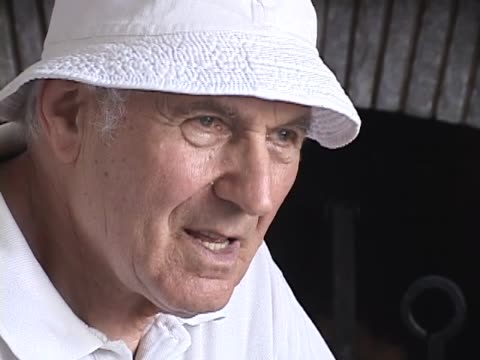
Pearl describes a folk cure for the evil eye from his childhood, in which pieces of bread (or coal) are dropped into water and the result is read; his father's sister performed it for him, and the water was poured at the doorpost near the mezuzah. Kerler asks for details, such as what the number of pieces means. Pearl says only Jews did this. The passage ends with Kerler's question about the mother's salting of meat and Sabbath fish.
The cure is explained in detail, with water at the mezuzah and an aunt performing it, and the passage ends on Kerler's question about Sabbath fish.
Pearl speaks about food customs before the war. He explains how he bought fish for Sabbath each week. After 1938, Pearl continues, the kosher slaughterer continued his work in secret. He then describes fish dishes.
Pearl speaks about Sabbath fish before the war: he walked to the Hernád river to buy from a fisherman almost every week. He explains that after 1938 kosher slaughter of cattle was banned and a Jewish butcher/slaughterer from a nearby place continued in secret. He then describes how his mother prepared fish, including gefilte fish and soup, and says his father liked it sweetened.
Adds the Hernád river, the ban on kosher slaughter and gefilte fish preparation.
Pearl names his father's sister, who died in Auschwitz, and then answers questions about strong drinks. His family made its own kosher wine, enough for Sabbath, holidays and Passover, and he explains the custom of buying grapes and pressing them. He then discusses brandy at services and at Passover, and Kerler asks the Yiddish word for it.
Adds Kerler's question about the Yiddish word for palinka and the issue of wine's kosher status.
Pearl speaks about prewar Passover food customs. The community in Tállya baked shmura and regular Matzo. Pearl then answers questions about cultural terminology.
Pearl discusses how matzo was made before the war: shmura matzo baked for weeks before Passover and regular mitzvah matzo baked on the eve of Passover, in a place in the village where each household did its own. Kerler then asks about what is said when mentioning a deceased person, and Pearl recalls that the dead were addressed at the grave with the name of a mother. He recalls this from age six or eight.
Adds a questionnaire on formulas for mentioning the dead and a grave custom that Pearl recalls.
Kerler asks about stories of a Jewish folk character and Pearl instead speaks about the old Rabbi Rosenbaum, whose table was reused after his death, and about his own cheder years. He says he attended a few Jewish weddings before the war and compares them with later ones. He also mentions the extra payments his father made to the rabbi and the shochet at holidays. Kerler then thanks him and wraps up.
Adds Rabbi Rosenbaum, cheder, payments to the rabbi and shochet, and a concluding thanks.