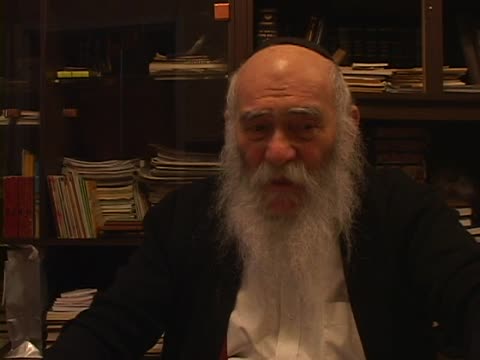
The camera cuts to the formal interview with Rabbi Abelsky. He discusses his contemporary work, as well as contemporary Hasidic groups. Abelsky owns a newspaper.
From the machine transcript
Abelsky speaks about his work writing articles and publishing in a Chabad newspaper and on the internet. He discusses at length the messianic controversy within Chabad about the Lubavitcher Rebbe and says he was among the first to write about it. He mentions disagreements with other Chabad figures and gives his name to Kerler. He also begins to say he was born in Moscow and evacuated during the war.
The passage also covers messianism and the internet articles, besides his newspaper.
Abelsky provides personal information and addresses his life during World War II. He evacuated to Tashkent, Uzbekistan. Abelsky then studied at an underground yeshiva in Samarkand, Uzbekistan. He then talks about his life after the war. Abelsky explains how he escaped from Samarkand in 1946 to Munich, Germany, where he continued his yeshiva studies for one year. Abelsky was then sent to Romania, where he lived for three years. He then speaks about his teachings and work in Israel after the war. Abelsky moved to Chişinău in 1989.
From the machine transcript
Abelsky tells of his wartime evacuation to Uzbekistan, living in Tashkent and studying in an underground yeshiva in Samarkand. In 1946 he left Russia with the yeshiva, studied for a year in Germany and was then sent on a mission to Romania, where he stayed three years and had trouble with the authorities. He went on to Israel, married, taught in Chabad schools in Kfar Chabad and Kiryat Gat, and came to Chișinău around the Hanukkah of sixteen years before the interview.
The transcript adds his marriage in Israel and teaching at Chabad schools, and the Romanian authorities' investigation.
Abelsky provides personal information and addreses his position as rabbi in Moldova. He then speaks about his work, Hasidic religious discourse and contemporary Chabad-Lubavitch figures.
From the machine transcript
Abelsky says he is the chief rabbi of Chișinău and Moldova and discusses the weekly Chabad press and the messianic question. He argues at length about the Lubavitcher Rebbe being the 'yakhid ba-dor', quoting the Talmud, and about opponents (mitnagdim) and Chabad figures. He also mentions yeshiva students and a friend from yeshiva days now in Paris.
Abelsky addresses contemporary Jewish life in Moldova, as well as his teachings.
From the machine transcript
Abelsky speaks about Jewish life in Moldova today: the uncertain number of Jews, people who do not know they are Jewish, and his students and community, with hundreds of families around him. He mentions the Russian-language newspaper he publishes, his three books and others he is preparing, and a kindergarten and a school with a yeshiva.
Abelsky talks about the contemporary Lubavitch yeshiva in Chişinău.
From the machine transcript
Abelsky describes the Lubavitch yeshiva in Chișinău, in which Gemara and Hasidic teaching are studied. Students are sent on to Israel or New York, and the teaching is in Hebrew.
Abelsky talks about the contemporary Lubavitch yeshiva in Chişinău. He also addresses differences in contemporary Chabad teachings and institutions.
From the machine transcript
Abelsky talks about a Chabad yeshiva in Jerusalem where his student teaches and the students learn Gemara in Russian. He discusses the place of Yiddish versus Hebrew in Chabad and other Hasidic institutions, with Katz and Kerler commenting. He notes that few yeshivas teach in Yiddish and that Chabad uses Hebrew as the easiest route to Jewishness.
Also covers the Yiddish-versus-Hebrew debate and Bundist Yiddish, not only the yeshiva.
Abelsky speaks about his family, before he addresses the work of his students.
From the machine transcript
Abelsky talks about sending his students to a yeshiva in Jerusalem and about a report in which one of the great Hasidim used a Yiddish expression. Kerler and Katz help with a Yiddish word that Abelsky does not catch at first. The passage is partly unclear.
The catalogue speaks of family, but the transcript shows talk about students and a Yiddish phrase.
Abelsky talks about religious customs, particularly seeing a rebbe for advice.
From the machine transcript
Abelsky explains how a person asks a rebbe for advice by opening a volume of the Lubavitcher Rebbe's letters with eyes closed after preparation and immersion in the mikveh. He also recites the formula invoking the Rebbe as messiah. Lemster then talks about his own books on Yiddish and religious vocabulary.
Includes a recited formula and Lemster's remarks on his own books.
Abelsky addresses contemporary Jewish life. He then speaks about prewar religious life in Moscow, as well as addresses his childhood memories, including holiday celebrations. Abelsky describes how his family celebrated Sukkot in secrecy.
From the machine transcript
Abelsky talks about the situation of Jews today and about his own childhood in Moscow, where the family had to hide its religious observance. He recalls not eating dairy or meat and not building a sukkah in the courtyard. As boys he and his brother wanted to fast, and a Tatar caretaker was kind to them.
Adds the Tatar caretaker and the boys' fasting.
Abelsky speaks about different Jewish groups in Moscow. He then talks about his family. Abelsky's maternal grandfather was the chief Hasidic rabbi of Moscow before the war. Abelsky's father was born in Vitebsk, Belorussia, and his mother was born in Chudey Bude?, Ukraine.
From the machine transcript
Abelsky answers Katz and Kerler's questions about contact with Yiddish writers and Communist Jews in Moscow. He says his maternal grandfather, named Yeshaye Zusya Shub (?), was the chief Hasidic rabbi of Moscow and was called the Buder rabbi after a town in Ukraine. His father was born in Vitebsk and his mother in Sredina Buda (?), and Kerler locates the town in northern Ukraine.
Gives the grandfather's name and the grandfather as rabbi of Moscow.
Abelsky talks about religious figures during the Soviet period.
From the machine transcript
Abelsky talks about religious families and figures of the Soviet period, including a rabbi born in Kutaisi (?) and a family of Lubavitch Hasidim. He tells of a man who saved a Jewish girl and was imprisoned, and of her later marriage to him after the rebbe's advice. He then begins a lighter story about a grandfather and a Mitnagdic rabbi in Moscow.
Abelsky shares episodes regarding intra-communal conflicts during prewar religious life, when his grandfather was the chief Hasidic rabbi. He then shares anecdotes about prewar Hasidic life from his grandfather.
From the machine transcript
Abelsky tells anecdotes about his grandfather, the Hasidic rabbi of Moscow, and a Mitnagdic rabbi who quarrelled with him, including how the grandfather attended his opponent's funeral. He relates the story of the etrog and lulav before Sukkot, and tales heard from his teacher about a miserly Hasid, a rebbe's fundraisers and a Hasid in a short coat.
Gives the quarrel with the Mitnagdic rabbi and several anecdotes.
Abelsky shares episodes about prewar Jewish life and locals in Moscow. He also describes his grandfather's reputation within the community.
From the machine transcript
Asked by Kerler for a tale about his grandfather, Abelsky describes a childhood episode near their Moscow home and a tram accident. He then tells how his grandfather was reputed for learning, how Mitnagdim feared him and how he sent emissaries to Ukrainian yeshivas. He also tells an anecdote about a melamed and sour cream, and recalls growing up in a Hasidic atmosphere.
Abelsky addresses contemporary local Hasidic life, as well as his family and childhood memories. He then talks about his students.
From the machine transcript
Abelsky speaks about students who return to Jewish observance against their parents' wishes, with stories of a boy who ran away and later married in a Chabad wedding. He compares his own Jewish upbringing in Moscow with theirs, describes attending the wedding paid for by the family, and tells of a Chabad wedding with a surprised, non-observant family.
The transcript centres on students' families and weddings.
Abelsky speaks about his and his grandfather's work, as well as shares episodes about advice-seeking people.
From the machine transcript
Abelsky explains that his blessings come through the rebbe, unlike his grandfather's own power, and tells Kerler of people seeking blessings. He describes a woman who needed milk for her baby and the sceptical doctor husband, and a man injured by an axe who recovered after the blessing and is now in Israel.
Gives the blessing stories.
Abelsky speaks about non-Jews who seek his blessing. They then talk about life today.
From the machine transcript
Abelsky answers Kerler's question about non-Jews who seek his blessing and explains that he tries to tie them to helping Jews, with an example of a woman whose livestock was stolen. Katz then says he lives in Vilnius, and they briefly discuss the synagogue there. Kerler asks about a Lubavitch song.
Adds the story of the woman whose livestock was stolen and Katz's talk about Vilnius.
Abelsky sings a Hanukkah song, sung in the Lubavitch-Chabad community.
From the machine transcript
Abelsky and a second voice sing a Hanukkah Chabad song and niggun, with long wordless stretches and Hebrew text; Kerler praises the performance in Russian and Yiddish at the end.
Abelsky sings and explains the Lubavitch song "Esn est zikh, trinken trinkt zikh" (eating and drinking happens by itself).
From the machine transcript
Abelsky discusses and sings a Lubavitch song about eating and drinking that happen by themselves while davening and learning do not. He explains it as a Hasidic problem and comments on children's wants. Kerler then asks for a melody from his father or grandfather.
Includes his explanation of the song.
Abelsky sings a Lubavitch song in Russian, he recalls from his grandfather.
From the machine transcript
Abelsky sings a Russian-language Lubavitch counting song remembered from his grandfather, with the refrain about one God and the Jewish friendship. The count runs through the commandments and Jewish numbers; Kerler then thanks him.
The team concludes the formal part of the interview with Abelsky. He also addresses religious customs.
From the machine transcript
Kerler and Katz ask for a blessing, and Abelsky gives one, explaining that a blessing is 99 percent from above and one percent the recipient's vessel. He mentions the Lubavitcher Rebbe as messiah. Kerler describes the archive's description sheet for him to sign.
Includes the explanation of blessings and the project description.
Abelsky speaks about life today.
From the machine transcript
A discussion among Abelsky and the interviewers about a Hasidic master and his teacher, apparently a story about a rebbe and a grandfather, unclear in the transcript. Katz speaks of living in Vilnius, asks for an address for sending the article, and says he wants it published.
The transcript shows a story about rebbes and the arrangements for sending the article, not life today.
Abelsky addresses Lubavitch-Chabad religious customs. The team then concludes the interview with Abelsky and the camera collects footage of the synagogue.
From the machine transcript
Discussion with the rabbi about messianic belief, the succession of Lubavitch rebbes and resurrection of the dead. Abelsky says he can read Hebrew-language articles but not Russian. Kerler asks for an address to send material, and the interview closes.
The talk is largely about messianic belief and resurrection.