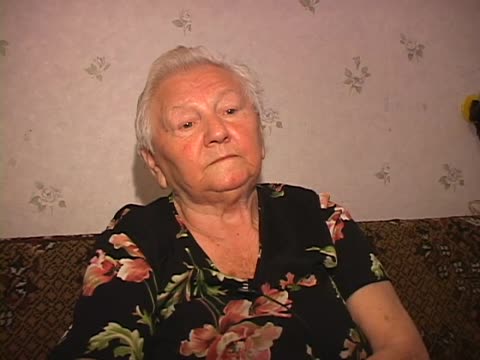
Yaruskaya provides personal information and talks about her family. Her father, who was born in Chișinău, worked as painter and her mother was also born in Hâncești. Yaruskaya grew up with one sister. She raised two sons, one of whom lives in America.
From the machine transcript
Yaruskaya gives personal data: born in 1925 in Hâncești and evacuated in 1941. She names her parents, her father Khaim, a painter from Chișinău, and her mother Khaye Dobrish, who was born in Hâncești and did sewing at home. She mentions a sister, Polia, and her parents' birth years. She names grandparents and their occupations, and says she named her sons after relatives; one son lives in America.
gives the grandparents' names and occupations and the naming of her sons after relatives
Yaruskaya speaks about her life and childhood home before the war. She recalls poverty and describes her grandparent's observance. Yaruskaya then talks about prewar Jewish life and recalls non-Jews who spoke Yiddish.
From the machine transcript
Yaruskaya recalls her childhood in Hâncești, living in rented rooms without a flat of their own. She remembers kindergarten and school, and the family's poverty. She describes her grandparents' synagogue-going on holidays and her father attending only on holidays. She says there were two synagogues, that Jews lived in town and non-Jews in the surrounding districts, and that Yiddish was spoken.
Yaruskaya talks about prewar holiday celebration, including Passover seder, at home.
From the machine transcript
Yaruskaya describes Passover preparations in her family's home. Matzah was hidden in the attic, Passover dishes were koshered, and the children went to fetch Passover wine. She tells the seder plate, including horseradish, and recalls what her mother told about the origin of matzah. She does not remember the four questions.
includes her mother's explanation of the origin of matzah and the koshering of dishes
Yaruskaya addresses prewar Purim celebrations in town. She describes a carnival and people wearing costumes. Yaruskaya also recalls a Purim shpiel.
From the machine transcript
Yaruskaya recalls prewar Purim in the town: a carnival with music, costumed people in the streets, and children following along. She remembers going from house to house with greetings. She recites a Purim rhyme her father used to sing and mentions a children's song, but does not recall further songs.
includes a rhyme her father sang and the children's greetings
Yaruskaya addresses prewar holiday celebrations, including Simchat Torah and Sabbath. She remembers attending synagogue services with her mother and grandmother. According to Yaruskaya, there were two synagogues in Hâncești. She then describes Sabbath food customs at home and shares her recipe for gefilte fish.
From the machine transcript
Yaruskaya speaks about Simchat Torah, Sabbath synagogue attendance with her mother and grandmother, and the town's two synagogues, a tailors' one and a larger one. She describes her mother's Sabbath cooking, including a dish made from chicken feet, and keeping food warm. She gives the method for gefilte fish and says they added no sugar.
includes the second synagogue and the keeping of food warm on Sabbath
Yaruskaya discusses Yiddish songs from her childhood. She then talks about traditional weddings before the war, before briefly returning to food customs.
From the machine transcript
Yaruskaya says she remembers Yiddish songs from childhood, including one about paper children, but not their words. She describes a traditional Jewish wedding before the war outside the synagogue, with candles and fireworks and a fiddler. She mentions the huppah at her son's wedding at home, then answers a question about the term for gefilte fish.
Yaruskaya speaks about her travels to Lithuania. She then speaks about her family and holiday celebration.
From the machine transcript
Yaruskaya says she has been in Latvia and mentions Riga and a sanatorium. She answers questions about travelling and about family visits to her grandparents in Chișinău on holidays. The passage is partly garbled.
the catalogue says Lithuania; the transcript points to Latvia and Riga
Yaruskaya sings a Yiddish song about the tailor's work. She then addresses her encounter with Polish Jews, before talking about her return to Hâncești after World War II. She describes how returnees buried the corpses and mentions that non-Jewish locals pointed out the mass graves.
From the machine transcript
Yaruskaya sings a Yiddish song about a tailor and recalls meeting Polish Jews during the evacuation, noting their different accent. She describes returning to Hâncești after the war. The murdered Jews of the town were dug up from graves shown by a local non-Jewish woman. Remains were found, including the rabbi's candlesticks and children's shoes, and were reburied in the field. Her mother's parents had stayed behind and were killed there.
includes the grandparents who stayed behind and the rabbi's candlesticks found in the grave
Yaruskaya talks about her life and education before the war. She attended a Romanian school for six years. Yaruskaya also speaks about her famil y and mentions her father's communist activities.
From the machine transcript
Yaruskaya recalls the family's poverty, including buying wood for winter. She says she finished six classes in a Romanian school, where pupils were beaten, and that street signs were in Romanian. She says her father was something of a communist who was once arrested and bought out, and who distributed leaflets at night.
Yaruskaya speaks about her life during World War II. She remembers the beginnings of Soviet occupation and the war. Yaruskaya describes her evacuation. She maintains that her family evacuated on foot to Rostov, Russia, via Dubăsari and Ukraine. Yaruskaya explains how locals helped out her family with food and water in Ukraine. She continues that her family evacuated further by train from Rostov to Makhachkala, Russia; and then on a steamship to Türkmenbaşy (formerly: Krasnovodsk) Turkmenistan. Yaruskaya describes this journey, before addressing her family's life in Türkmenbaşy and then in the nearby town Ufra.
From the machine transcript
Yaruskaya recalls the arrival of the Soviets and the outbreak of war. The family fled, walking for months to Rostov and passing Dubăsari. Local Ukrainians gave them bread and food, and the children briefly lost their parents. From Rostov they went by train to Makhachkala and then by steamer across the Caspian Sea in a storm, in which many people were lost. They lived on the street in Krasnovodsk, then in a camp-like settlement outside, where the parents worked and the mother was weak.
the transcript's route is only partly clear; the final place name is uncertain
Yaruskaya speaks about her life after the war. Her family moved to Türkmenbaşy, where they worked at a factory. She left the city in 1949 and moved to Chișinău.
From the machine transcript
Yaruskaya says she stayed in Krasnovodsk after the war, working in a factory. Her parents returned to Chișinău first and were given an apartment, while she stayed there, had a child and waited long for permission to leave. She travelled by ship across the frozen sea. The year of her own return is unclear in the transcript; she seems to say 1949.
Yaruskaya recalls Yiddish proverbs and songs. She then addresses her childhood memories of prewar Jewish Hâncești. Yaruskaya also talks about her family. She raised three sons. They live in Israel and America.
From the machine transcript
Yaruskaya tries to recall Yiddish proverbs and sayings and discusses the wording of one with the interviewers. She repeats the Purim rhyme and mentions songs about cigarette sellers. She names her husband Makhl from Nariv (?) and a saying about people from Nariv. She says she spoke Yiddish with her husband and sons. Her sons live in Israel and America and she did not join them; she has visited America and her relatives there.
adds her husband and sons' Yiddish, and their emigration abroad
Yaruskaya answers questions about cultural terminology. She then addresses folk and healing customs. Yaruskaya recalls her mother practicing them and explains how older Jewish women poured lead to get rid of a scare. She then speaks about prewar traditional weddings, including food customs.
From the machine transcript
Yaruskaya answers questions about cultural terminology: the meanings of terms for a bad or foolish person, and what a dibbuk is. She explains pouring lead to cure fright, which old women did in Hâncești, and her mother's charms. She says matchmakers were not used in the town. She also describes prewar weddings with fish, bread and brandy, and says her sons had bar mitzvahs in Chișinău.
adds pouring lead to cure fright, the absence of matchmakers and sons' bar mitzvahs
Yaruskaya talks about contemporary religious life, before discussing different periods of her life. She then talks about her family.
From the machine transcript
Yaruskaya mentions the synagogues in Chișinău today, including a new one. She answers the question of the best time of her life, speaking of her good husband. She counts her grandchildren and great-grandchildren in America, Ukraine and Chișinău.
Yaruskaya speaks about her life after the war. She was trained as motor-mechanic, but worked as conductor and dispatcher in a bus terminal for thirty-six years. She then talks about her family and contemporary religious customs.
From the machine transcript
Yaruskaya says she trained as a motor mechanic and, after the children were small, worked for thirty-six years as a bus conductor. She talks about visiting the cemetery where her mother, husband, sister and father are buried and what she says there. She speaks of her sons and grandchildren, and the son from America who phones and visits.
adds cemetery visits and the son in America
Yaruskaya talks about her life today and visits to America, as well as Israel. She then recalls prewar holiday celebration, including Sukkot Purim and Yom Kippur, at home. Yaruskaya remembers how her father played an instrument on Purim.
From the machine transcript
Yaruskaya talks about her visits to America and Israel, preferring Israel and its Sabbath observance. She recalls prewar holidays: Sukkot, with the sukkah and decorations, and Purim, when her father played an instrument. She also describes Yom Kippur fasting at home and going to the water. At the end Kerler asks for the Russian words for water, river and lake.
adds Israel and America and the Russian word questions at the end
The concludes the formal part of the interview with Yaruskaya. She returns to prewar Jewish life in Hâncești and describes how she and her siblings brought food to poor families.
From the machine transcript
Yaruskaya concludes the formal interview. She recalls quiet prewar life in Hâncești without envy between rich and poor, and describes how she and her sister took wrapped meat and bread to poor families at their mother's direction.