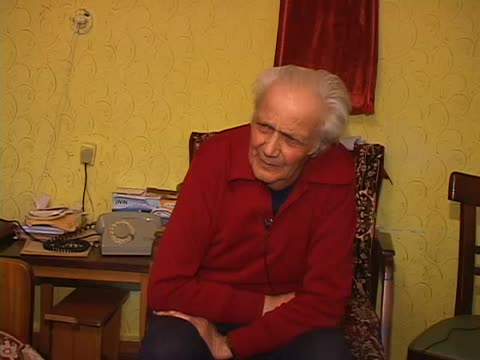
Sharhorodskij talks about contemporary Jewish life in the region. The formal interview then begins and Sharhorodskij provides personal information. He also speaks about his family. His father, who was born in Rîbniţa, worked as tradesman. His mother was born in Rîbniţa. Sharhorodskij then talks about his grandparents, who lived in Tiraspol. Sharhorodskij grew up with two brothers, one of whom fell ill with scarlet fever in 1937, and a sister, who passed away in 1958. His oldest brother was drafted into the Red Army in 1939. Sharhorodskij continues that his brother was mortally wounded during the liberation of Crimea and died at a hospital in 1944.
From the machine transcript
Sharhorodskij answers Kerler's questions on the number of Jews today in Israel, America and Moldova (a few towns, with only a few thousand left). After the formal introduction he gives personal data: born in Rîbniţa, as were his grandfather, grandmother and father. He names his parents and grandparents, with his maternal grandparents living in Tiraspol. He tells of his brother Shmilik, who died of scarlet fever in 1937, his sister who died in 1958, and his eldest brother Moshe, wounded in the war and dead in 1944.
The opening talk compares numbers of Jews in Israel, America and Moldova and mentions Russian-language switching; he also names his mother and maternal grandparents.
Sharhorodskij addresses his childhood memories and education. He attended the Rîbniţa Yiddish school for seven years and mentions subjects and teachers. The finished his school education at a Russian school.
From the machine transcript
Sharhorodskij recalls studying at the Rîbniţa Yiddish school, which he describes as a ten-class school. He names teachers (Markus for Yiddish literature, Garber for mathematics and physics, Khane for chemistry and Russian, and Kardonskij, a German teacher). He says Kardonskij warned the pupils that German would be of use if they ever met Germans.
Teacher names and subjects, with the German teacher Kardonskij.
Sharhorodskij speaks about his life during World War II. He was confined to the Rîbniţa ghetto in 1941. Sharhorodskij recalls how the Germans opened up a hospital outside the ghetto in 1943. Sharhorodskij explains how he worked at the hospital as trained carpenter for eight months. He also worked as translator for the Germans.
From the machine transcript
Sharhorodskij tells of the Rîbniţa ghetto under German and Romanian occupation. In 1943 the Germans converted an agricultural school building into a hospital and demanded carpenters from the ghetto. He worked there for eight months and picked up spoken German from the lessons he had had before the war, which led to his being used as a translator.
Details of the hospital in the converted school and his translating for the Germans.
Sharhorodskij returns to his school education, including the principal, who was deported in 1937. He then speaks about Rabbi Yosef Ber, who was deported in 1937 during the period of Stalinist political terror, according to Sharhorodskij. He then speaks about other teachers.
From the machine transcript
At Lemster's prompting, Sharhorodskij returns to the Yiddish school and its director, Yakov Pogorelskij, who was arrested in 1937. He speaks of Rabbi Yosef Ber, also arrested in 1937 and never seen again, and of the fate of his children. He then describes the teacher Fanya Borisovna, who taught Ukrainian, and remarks on how modestly people lived before the war.
Adds Rabbi Yosef Ber, the arrests in 1937, and the teacher of Ukrainian.
Sharhorodskij talks about prewar Jewish life in Rîbniţa, in particular his neighbor. Sharhorodskij then recalls what he studied in Ukrainian literature class, German class and Yiddish literature class. He also speaks about Yiddish writers.
From the machine transcript
Sharhorodskij talks about a neighbor who was a German prisoner of war in the First World War and did not expect the Germans to kill Jews, and about those who evacuated. Kerler asks what he learned in Ukrainian and German classes; he names Ukrainian writers (Shevchenko, Franko, Lesya Ukrainka, Marko Vovchok) and Yiddish writers (Sholem Aleichem, Peretz, Bergelson, Pfeffer), recalling the lives of Sholem Aleichem and Mendele.
A neighbor's wartime story, evacuation, and what he studied in Ukrainian, German and Yiddish literature.
Sharhorodskij talks about prewar Jewish life in Rîbniţa. He states that the synagogues were closed down in the late 1930s. Sharhorodskij describes the activities of a Yiddish club in place of the synagogue. He mentions peaceful relations among ethnic minorities.
From the machine transcript
Sharhorodskij says Rîbniţa had three or four synagogues before they were closed in the late 1930s, and that one became a Yiddish club with readings, performances and dances. He says there were more than three thousand Jews in town and that Jews, Moldovans, Poles and Ukrainians lived peacefully, each with its own school. He answers Kerler about his father's prayer and says he knows no Hebrew.
Adds the number of Jews and his father's prayer habits.
Sharhorodskij speaks about holiday celebration, including Purim and Yom Kippur, at home before the war. In particular, Sharhorodskij recalls his mother's baking and cooking.
From the machine transcript
Sharhorodskij answers Kerler's and Lemster's questions on how holidays were kept at home. He mentions Passover, Shavuot and fasting on Yom Kippur, and describes his mother's baking for Purim and the dishes she cooked. He does not remember the recipe for the fish dish.
Adds Passover and Shavuot, fasting on Yom Kippur, and his mother's cooking.
Sharhorodskij talks about his family, particularly his sister. He also mentions again his German literature teacher and addresses his parents' observance.
From the machine transcript
Sharhorodskij speaks of his sister Frume, who finished school in 1941, studied law after the war, worked as a notary, married in 1958 and died of tuberculosis. Her daughter lives in Israel with her family. Kerler asks about the neighbor Shepsl who served the Germans. Sharhorodskij also describes his parents' observance: his mother's Friday candles, his father's prayer shawl worn in the kitchen after the war, and the seder.
Adds his sister's later life and the neighbor Shepsl.
Sharhorodskij addresses his school education. He explains how his school was transformed into a Russian school in 1936.He speaks about History and Literature at the Yiddish school.
From the machine transcript
Sharhorodskij says he studied seven classes at the Yiddish school, which was closed in 1936–37 because few Jews were sending their children, and became a Russian school. He talks about the teachers' retraining, the fate of the literature teacher Markus, who he says went to the war and did not return, and the Jewish history lessons (Egypt, Mesopotamia). He also recalls how holidays were described in class.
Adds the school's change to Russian, the retraining of teachers and Jewish history lessons.
Sharhorodskij discusses his childhood memories and holiday celebration. He then speaks about postwar religious life, particularly the Rîbniţa rebbe, Chaim Zanvl Abramowitz. He mentions the rebbe's work as kosher butcher in postwar Rîbniţa. Sharhorodskij also recalls the rebbe from the Rîbniţa ghetto and how he went to forced labor services. Sharhorodskij then describes secret services with the Rîbniţa rebbe in the ghetto, as well as the rebbe's bathing in winter after the war.
From the machine transcript
Sharhorodskij recalls that Jewish children all came to school on Yom Kippur, and that matzo was baked at home. He talks about Rabbi Chaim Zanvl, a learned man who studied in a Romanian yeshiva and acted as shochet after the war, and about his hidden prayers in the Rîbniţa ghetto. He tells of his departure for Israel (?) and then America, his winter ritual immersion, his illness and death at about ninety-five, and how others saw him as a fanatic.
Details of the rabbi in the ghetto, his emigration, ritual bathing in winter and death.
Sharhorodskij speaks about Rabbi Yosef Ber and his deportation. He then speaks about prewar cultural life and his family, in particular his observant sister.
From the machine transcript
Sharhorodskij speaks about Rabbi Yosef Ber, arrested at night; he knew of it only from his mother, as he was a child of about fourteen or fifteen. He answers questions about a library of Yiddish books and says his father did not read. He then turns to his sister Frume, whom he describes as devout and honest, and begins a story of her behavior in the ghetto.
Adds the Yiddish book library and his sister's conduct in the ghetto.
Sharhorodskij speaks about his family's life in the Rîbnita ghetto. In particular, he describes how his father went to the market twice a week and received help from his former business partners. Sharhorodskij also speaks about his sister's career. She lived in Israel.
From the machine transcript
Sharhorodskij describes ghetto life: Jews could leave for the market for an hour on two days a week, and his father met old business acquaintances who helped. His sister, whose name appears as Perele, quietly brought food to their mother, and she graduated from an institute in 1944 as the top student. He mentions letters exchanged with her in Israel, her language ability and her schooling, and Kerler asks where she lives.
The name Perele (?), the letters from Israel and his sister's institute graduation.
Sharhorodskij shows a letter, written in Russian, from his sister in Israel.
From the machine transcript
Sharhorodskij asks the interviewers to read a letter written by his sister in Israel. Kerler says it will be read later and will not be taken away. Lemster then turns to the topic of Yiddish theater before the war.
The transcript shows only the request to read the letter and Kerler's reply; nothing about its content, and it ends with Lemster's question about prewar Yiddish theater.
Sharhorodskij recalls how Yiddish theater troupes would visit Rîbniţa. He also touches upon postwar cultural life and mentions Solomon Mikhoels.
From the machine transcript
Sharhorodskij recalls Yiddish theater troupes coming to Rîbniţa from Odessa and Kyiv before the war, performing in a garden hall where tickets were hard to get. He was too young to attend, but his parents went. He mentions Sholem Aleichem and Mendele as sources of plays, and singers visiting. Asked about the postwar period, he mentions Epelbaum and the director of the Moscow Yiddish theater, Mikhoels, and a communal event. He then answers questions about Lithuanian Jews and speaks of the Warsaw ghetto survivors.
The transcript adds the Warsaw ghetto and a question about Lithuanian Jews, and the singers who visited.
Sharhorodskij addresses traditional weddings and postwar religiosity. He then recalls the Rîbniţa rebbe's charity and speaks about contemporary Jewish life.
From the machine transcript
Sharhorodskij says Jewish weddings with a huppah took place after the war, including his own, and that people became more observant after the war. Prayer was held in private houses with ten or twelve men. Asked about wedding songs and melodies, he says he cannot sing or remember any. He then speaks of the Jewish duty to help one another, praising Khaim Zanvl, the Rîbniţa rebbe, for his charity. He ends with contemporary Jewish life, the Hesed and the matzo distribution, with little Jewish observance.
Adds that he could not recall wedding songs, that private-house minyanim were held after the war, and the Hesed and matzo distribution today.
Sharhorodskij speaks about a Jewish neighbor who converted before the war and remembers non-Jews who spoke Yiddish.
From the machine transcript
Answering Lemster, Sharhorodskij recalls one Jew in Rîbniţa who converted before the war and lived near the Jewish synagogue; he cannot recall the name. He knows of no cases of Christians becoming Jewish, says many non-Jews spoke Yiddish, and says that some Jews drank vodka heavily and others only liked it. The passage ends as Kerler asks about the word dibbuk.
The transcript adds the Jews' drinking habits.
Sharhorodskij answers questions about cultural terminology and addresses his childhood games.
From the machine transcript
Sharhorodskij answers questions about the meaning of words such as dibbuk and golem, with Russian glosses, and about other terms. Lemster then asks about children's games at the Yiddish school. He recalls reading books and playing with nuts, and mentions buttons as in Mendele's writing.
Sharhorodskij speaks about his life in the ghetto and mentions Jewish collaborators. He then speaks about the beginning of the war, when his family evacuated to Krasni Okny in 1941. Sharhorodskij describes how Romanian soldiers looted their home and beat them two weeks after the family's arrival. He continues that his family was forced to move out by Romanian soldiers and taken to the nearby mill "Napasiolok Flora" 16:25 for mass execution. Sharhorodskij explains how the community collected valuables to bribe the Romanian soldiers and his family returned to Krasni Okny. Sharhorodskij then describes how his family fled the town and hid in villages, before making it to the state farm in Ulmu.
From the machine transcript
Sharhorodskij recounts the Rîbniţa ghetto and an evacuation attempt in 1941. He and his sister left with another family and stopped some fifty kilometres from Donetsk, where Romanian soldiers searched for weapons and beat them. He tells of being driven out of Krasne Okne with others to a mill, where the community bribed the gendarmerie commander with valuables and they were turned back. They fled at night, wandered for a month in villages and forests helped by non-Jews, and reached the Ulmu state farm near Rîbniţa, while those who stayed behind were taken to Dubăsari and shot. He also touches on Jews who lived better in the ghetto, a brigadier named Shtrakhman who was a bad man, and holidays kept in secret.
Adds the secret holiday observance in the ghetto and the brigadier Shtrakhman; the transcript is unclear on the Donetsk detail.
Sharhorodskij speaks about his work and life after the war. He was trained as carpenter at the Ulmu state farm. Sharhorodskij served in the Red Army between 1944 and 1947. He then worked as tradesman for 45 years.
From the machine transcript
Sharhorodskij says he became a carpenter as a teenager but did not work at it after the war. He served in the army for three years from 1944 until 1947. He then worked in trade for 45 years, first as a salesman and later as a store manager, and says he did not get rich.
Adds that he later became a store manager.
Sharhorodskij returns to his life during the war and work at the Ulmu state farm at a carpentry, where he joined a Christian, who was a wheel repair specialist. Sharhorodskij explains how he worked there for one month and then moved back to Rîbniţa, where Jews were confined to a ghetto. He then describes his family's life, including forced labor and evading mass execution, in the ghetto for two years and eight months. Sharhorodskij also describes the situation in the ghetto two months before liberation, as well as gatherings of young people.
From the machine transcript
Returning to the war, Sharhorodskij describes working at the Ulmu carpentry shop with a Christian wheelwright who was kind to him and brought him food. After a month he went back to Rîbniţa, where Jews were confined to the ghetto under the Romanians, for two years and eight months. He tells of forced labor, and of standing three times to be shot, and describes Kalmyks, who came shortly before liberation and were worse than the Germans. Asked about singing in the ghetto, he says there was little, with an occasional Jewish melody, and Kerler asks about a melody of the Rîbniţa rebbe.
Adds the Kalmyks, singing in the ghetto, and Kerler's question about the rebbe's melody.
Sharhorodskij speaks about Jewish life today. He then shares episodes from his life in the Rîbniţa ghetto and speaks about German soldiers.
From the machine transcript
Sharhorodskij says he cannot recall the rebbe's melodies. He asks about Kerler's residence and discusses America and politics, comparing the American slogan to the German one. He says the Jewish situation in Moldova is painful because few Jews remain. He says that belief in liberation helped him survive the ghetto, and describes working in a German hospital, where he met a Hamburg field-feldwebel who read the paper and said Germany had lost after Stalingrad. A political argument with Kerler follows over fascists in Russia and democracy.
Adds the hospital episode, the argument on politics and fascism, and his questions about the interviewers' home.
The team concludes the formal part of the interview with Sharhorodskij.
From the machine transcript
Kerler thanks Sharhorodskij for his long account, which closes the formal interview. Sharhorodskij says he has told only one percent of what they lived through and speaks of the few Jews left and the lack of Jewish births. Kerler asks whether he remembers a melody of the Rîbniţa rebbe, which he cannot give, and the talk turns to photographs and a portrait of the rebbe.
The transcript is garbled; it shows the closing exchange and a portrait of the rebbe.
The camera records photographs and Sharhorodskij sends a message to American Jews.
From the machine transcript
The camera records photographs while Sharhorodskij identifies a picture of himself after the war and a portrait of a rebbe. He then sends a message to Jews in Moldova, Israel and America: stay Jewish, help one another, be good to non-Jews, avoid war, and support Israel. He thanks the Joint for its help and ends with greetings to the interviewers' families.
Adds a thank-you to the Joint and a wider message to Jews in Israel and America.