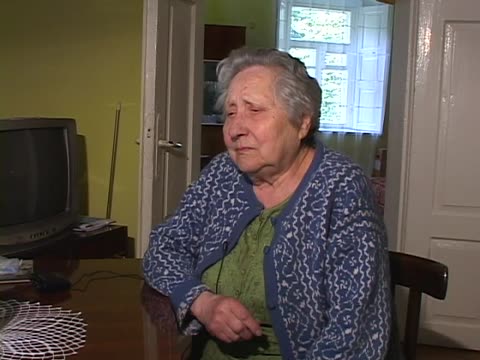
After collecting outside footage of the Soroca synagogue, the camera cuts to the interview with Plotnik. She talks about life today and provides personal information.
From the machine transcript
Start of the interview: Kerler confirms her Yiddish and Russian first names and her surname Plotnik. There is a brief aside in Russian.
The passage is mostly the confirmation of her names; the transcript shows no discussion of life today.
Plotnik talks about her family. Her father worked the land and owned an inn. Her parents were also born in Dumbraveno.
From the machine transcript
Plotnik gives her parents' names. Her family had a field worked by hired labourers and an inn. Her paternal grandfather was named Pesach, and the family came from Dumbraveni. Her maiden surname is heard as Vereta (?), which her granddaughter has taken.
The transcript adds her maiden name, her grandfather's name and that her granddaughter took her surname.
Plotnik talks about prewar Jewish life in Dumbraveno and her family. She also addresses contemporary religious life. In particular, she talks about life after her father passed away in 1934. Her sister attended school in Soroca.
From the machine transcript
Plotnik describes Dumbraveni as a Jewish town with several synagogues. Her father died when she was about seven, and she recited Kaddish for him for a year, going to the local synagogue. Her widowed mother ran the family field with hired workers and kept the family from feeling its loss. Her older sister studied at the gymnasium in Soroca.
Adds her Kaddish for her father at the synagogue and her mother's management of the field.
Plotnik mentions her school education. She attended a Romanian school for six years. She recalls how the local rabbi came to teach at her school twice a week. She then returns to life before the war, including her family, and also mentions non-Jews who spoke Yiddish. Plotnik grew up with two sisters. Her half-sister moved to Israel. She then talks about her grandmother, who stayed in the village of Lublin during the war and was shot by a Romanian soldier. Her grandfather owned two watermills. Plotnik then talks about her grandparents' arranged marriage.
From the machine transcript
Plotnik attended a Romanian school for six years. The rabbi came to teach there, and she recalls a Yiddish scolding term and a few words for money. Many local Christians spoke Yiddish. She talks about her sisters Yente (Yenta) and Rachel, the latter a half-sister who later left for Israel. Her grandmother in Lublin, a Jewish village near Vertiujeni (?), was shot by a soldier. Her grandfather had two watermills, and her grandparents' marriage was arranged by a matchmaker.
Adds Kerler's questions about words for money and a scolding term, and the evacuation of her sister to Uzbekistan.
Plotnik discusses and sings Yiddish songs, she learned after the war. The first song is about learning the alphabet.
From the machine transcript
Kerler asks about songs she knows, and Plotnik sings the Yiddish alphabet song about a boy learning the letters. She says she learned it after the war, and it was also heard in Soroca.
Plotnik talks about her life in the Bershad ghetto during World War II.
From the machine transcript
Plotnik recalls begging for food in the Bershad ghetto, and how her mother had sent poor guests to the house on Sabbath before the war. Kerler asks about songs of the ghetto and the camp at Balanivka (?), and he mentions a computer. She does not remember them, but sings a song about papers.
Plotnik sings a Yiddish song about the difficulty to collect documents after evacuation. She then discusses prewar cultural life, before Plotnik sings a song she remembers from a Yiddish stage production. The song is about aging and love.
From the machine transcript
Plotnik sings a Yiddish song about the difficulty of gathering documents. Asked about prewar culture, she says a Yiddish theater troupe visited Soroca and the young people walked there from Dumbraveni. She recalls and sings fragments of a song from a stage production about burning, love and sacrifice; Kerler and Lemster discuss its words with her.
Adds Kerler's and Lemster's talk with her about the wording of the theater song.
Plotnik talks about life before the war, in particular the work of a non-Jewish man, who heated the family's oven on Sabbath. She then discusses Sabbath, Passover and Purim celebrations.
From the machine transcript
Plotnik describes how a neighbor heated the oven for the family on Sabbath, and the Jewish-style chopped fish her mother made. She recalls her sister asking the four questions at the Passover seder, going to fetch matzo, and Purim customs such as masked visitors and singing. She also mentions her mother's charity after her father's death.
Adds her mother's charity and the seder questions asked by her sister.
Plotnik addresses life after the war, after she returned to Dumbraveno. She recalls how their home's basement was looted. She then talks about life today.
From the machine transcript
On return to Dumbraveni after the war, Plotnik found the house wrecked and the cellar plundered by people looking for gold. She mentions the family's vineyard and the barrels. She then talks, partly in Russian, about her troubles with a telephone company and about telephone use.
Adds the vineyard and the long exchange about phone and bureaucratic problems.
Plotnik talks about prewar Jewish life in Dumbraveno, in particular friends in the local Zionist youth organization. Her parents paid land workers. Her father produced wine for his inn.
From the machine transcript
Plotnik discusses Dumbraveni, which she says had around four hundred houses (?). Hired labourers from the villages worked the family's land. She recalls neighbors in the Zionist halutz movement and how some of them went to Palestine, and Lemster and Kerler ask about the halutzim and communists. She says her father made wine from his vineyard to sell at his inn, where people sang Romanian and Yiddish songs.
Adds the halutzim, hired labourers, the wine her father sold and the songs sung at the inn.
Plotnik sings a Romanian and a couple of Yiddish drinking songs, she heard at her father's inn. Plotnik then sings a Yiddish song about poverty and homelessness, she heard from her prewar neighbors.
From the machine transcript
Plotnik sings a Romanian romance and a couple of Yiddish drinking songs. She then sings a Yiddish song about a homeless person in the street who waits for a lover, which she learned from her neighbors at home before the war.
Plotnik talks about Jewish life before the war, as well as addresses traditional weddings and religious institutions. She remembers how her mother would not allow her hang around weddings.
From the machine transcript
Plotnik says her parents did not let her go to weddings, although a wedding canopy was put up near their house by the prayer house. She names several synagogues in Dumbraveni and Rabbi Sternberg (Shternberg), who came from Soroca. She does not remember folk beliefs such as the evil eye.
Plotnik mentions prayers and religious customs. She then talks about life today and sings a different version of the well-known Yiddish song "Tumbalalaika."
From the machine transcript
Plotnik says she remembers few prayers and customs, such as kapores, and recalls her Kaddish. She speaks of her son and family today, then sings a version of Tumbalalaika with a riddle verse. Lemster and Kerler ask about further songs and she says she cannot recall them. A second voice then sings a Yiddish song about Bershad.
Adds the Tumbalalaika version and the second voice's Bershad song.
Plotnik continues to watch a recording of a Bershad ghetto song (sung by Iosif Kogan). She then sings again the Yiddish song about the difficulty to collect documents after evacuation.
From the machine transcript
A recording of a ghetto song is played back, then Plotnik sings again the song about the difficulty of gathering documents (papers) and running to lawyers. Kerler and Lemster ask where she heard it (after the war) and whether she knew other songs, such as those of Zelik Bardichever (?). She says she does not remember them.
Includes questions about other ghetto songs and where she learned the song.
Plotnik talks about her hometown before the war, including agriculture.
From the machine transcript
Plotnik says that hearing about Dumbraveni makes her weep. She answers Lemster's questions about the colony: its Romanian head, the Jewish leader deported in the 1940s, and the good soil. She also mentions crops and a non-Jewish neighbour who sold pork and was sent away, and says relations with neighbours were good.
Covers colony leaders, deportation of a Jewish leader and a non-Jewish neighbour.
Plotnik addresses her return to Dumbraveno from the Bershad ghetto and then discusses life today.
From the machine transcript
Plotnik recalls coming back home after the camp to find the cellar dug up by people looking for gold, and a later visit to Dumbraveni with her boss. She describes yearly visits by her son to the family graves and walking the cemetery with her sister. Lemster asks about other people from Dumbraveni who might be interviewed, and the talk turns to one now in Israel.
Adds the cemetery visits, her son's yearly trips and suggestions of other Dumbraveni natives to interview.
The team concludes the interview with Plotnik.
From the machine transcript
Kerler closes the interview, noting the date of 1 June 2006 and that this was their second meeting with Plotnik. He thanks her and wishes her good health.