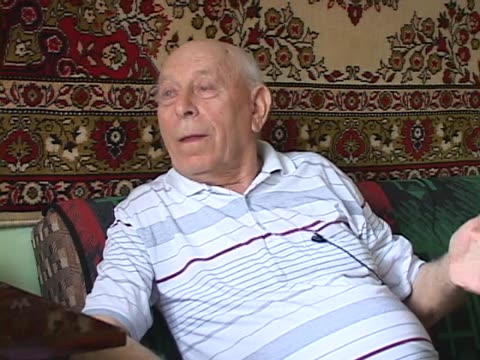
The Ryzhoys provide personal information.
From the machine transcript
The Ryzhoys give their names: Moisei's passport name and his father's name Yisroel, and Elizaveta's patronymic from her father Nusn. She gives her maiden name Gurfinkel and mentions relatives in America. Kerler then begins to ask for their address.
Includes Moisei's remark on the patronymic and a mention of relatives abroad.
The Ryzhoys provide personal information and talk about the modern history of the town Tighina, including the period under Soviet occupation.
From the machine transcript
Kerler states the date and place of the interview. Moisei then gives a long historical account of Bessarabia under Russia and Romania, the Soviet period, and why Moldova and Transnistria split. He touches on Romanian treatment of Jews, pogroms under the tsar, and perestroika and Gorbachev.
Most of the passage is a political-historical excursus on Bessarabia and Moldova, beyond personal information.
Moisei talks about the return home of his wife after World War II and then discusses postwar and post-Soviet politics regarding Moldova.
From the machine transcript
Moisei continues on the politics of Moldova: the difficulty wives faced in returning home from Russia after the war, then Moldovan nationalists, the creation of the border at the Dniester and the 1992 fighting for Bender. He talks about Snegur, Yeltsin and the Russian general Lebed, and the continuing disagreement between the two sides. Kerler brings him back to his own childhood memories.
Covers the wife's postwar return, then the 1992 conflict and the Dniester border.
Moisei talks about his family. His father was a carpenter. Moisei worked in a leather factory in 1936.
From the machine transcript
Moisei names his father Srul, his paternal grandfather Avrom and his maternal grandmother Malke. He recalls working in a leather-goods factory, where bags, purses and suitcases were made, after his father's workplace closed. Kerler asks about his mother Sarke, his father the carpenter and the year he started work, probably the 1930s.
Gives the grandparents' names and the factory's products.
Moisei talks about his life during the war and describes how his family evacuated in 1941. The walked to a train station in Revaca, near Chişinău and then took a train headed to Odesa, before evacuating further. He explains how his father did not make into evacuation and was shot.
From the machine transcript
Moisei describes the 1941 flight from Chişinău: they walked to Revaca, rode a flatcar to Odessa and then took passenger trains into Russia. His father left the train at a station to fetch water and was never seen again; Moisei says he was shot, aged about fifty-five. He also names a neighbour, Avrom Glozman, who did not want to leave.
Moisei talks about his family. His mother worked in a butcher shop. He grew up with a sister and a brother.
From the machine transcript
Moisei talks about his mother, who took over her mother's trade in offal and cheap cuts of meat sold to butchers and merchants. He mentions the little shops that sold them. He names his older brother Aron, who served in the Romanian cavalry, later studied and became a geography teacher, and his sister.
Moisei discusses his childhood memories and holiday celebration. He also addresses charity within the community.
From the machine transcript
Asked about childhood in Chişinău, Moisei recalls a courtyard with three synagogues, the street name Shmiter(?), and his father going to synagogue while he did not. He describes Passover under the Romanians, when a Jewish charity gave out matzo, potatoes, eggs and wine, and how dishes were koshered. He answers Kerler's question about Purim, mentioning baked goods and mishloyekh-manes.
Adds Passover charity under the Romanians, koshering dishes and Purim baking.
Moisei talks about life today. He then talks about Purim celebrations and prewar cultural performances.
From the machine transcript
Moisei compares matzo distribution then and now. Asked about Purim plays, he talks about a second Purim and the Purim story; Lemster asks about masked boys. He recalls Yiddish songs sung by workers in Chişinău, though he says he has forgotten them.
Adds matzo distribution today versus before, and workers' Yiddish singing.
Moisei talks about his life after the war. He worked in a canning factory in Astrakhan, Russia, during his military service. After he was demobilized in 1947, Moisei returned to Chişinău. He then describes the living conditions in his hometown. He moved in with his brother and mother at first. Moisei then worked in 29:40 as forwarding agent.
From the machine transcript
Moisei recalls wartime service in a canning factory in Astrakhan, where he went barefoot in the frost. He was demobilised in 1947 and returned to a ruined Chişinău, where the family lived in a mud barrack. He then worked twenty years for the railway administration as a forwarding agent, got an apartment, and mentions the shooting of Jews.
Moisei explains how he met his wife and talks about his life after the war.
From the machine transcript
Moisei explains how he met his wife through a relative of hers, and why they settled in Bender: her friends had moved there after the evacuation, then left for Israel. He says he has lived in Bender for eighty-three years (?), apparently a slip for his age.
Elizaveta talks about her family. Her father was a merchant for dairy products. Her mother passed away when she was thirteen years old. She grew up with two sisters and two brothers.
From the machine transcript
Asked about Chimishliye, Elizaveta says her father Nusn was a merchant dealing in dairy products and grain for an employer. Her mother died when she was thirteen and her father did not remarry. She names her siblings: three sisters (Sheyndl, Rayele, Risl) and two brothers, one called Shuke, and Kerler asks about Yiddish names for Grisha. Yiddish was the home language.
Adds the siblings' names and her father's trade.
Elizaveta discusses her childhood memories and talks about prewar Jewish life in Chimishliye. She worked as a seamstress before and as crane-operator immediately after the war. Until her retirement, Elizaveta worked as a milliner. She returns to her life before the war.
From the machine transcript
Elizaveta describes Chimishliye as a small town with a synagogue, where people spoke Yiddish and Moldovan and non-Jewish servants of Jews learned Yiddish. She says she remembers little from before the war, only that she learned sewing at sixteen. After the war she worked as a crane operator in Russia in severe frost and later returned to sewing.
Adds non-Jews speaking Yiddish and her learning sewing at sixteen.
Elizaveta talks about her life after the war and also addresses her Romanian school education, as well as the poverty at home.
From the machine transcript
Elizaveta answers Lemster's and Kerler's questions about her schooling: she studied in a Romanian (Moldovan) school and cannot say whether there was a Jewish school. She stresses that the family was poor and that five children shared one textbook. The interviewers argue over how to put the questions.
Adds Romanian-language schooling and sharing one book among five children.
Elizaveta discusses holiday celebration and prewar Jewish life. She recalls Sabbath preparations at home.
From the machine transcript
Elizaveta recalls holidays in poverty, including Passover, burning the chametz and Purim baking, and says there were no Purim players in the town. She says her mother did not make gefilte fish; she learned it herself. She describes buying on credit from a wealthy employer, the Sabbath hen and cholent, and how the family kept house after her mother's death.
Includes Purim baking, gefilte fish and cholent, and buying on credit.
Elizaveta talks about traditional weddings and addresses her life at home before the war.
From the machine transcript
Lemster asks Elizaveta about Jewish weddings in her town. She recalls watching as a child, the chuppah, the music from Jewish musicians and the dancing, but not the songs or whether the musicians were Jews or Gypsies. Kerler asks about singing at the Sabbath table, and she answers that she went to synagogue.
Elizaveta talks about her family. Her sister moved to Israel after the war.
From the machine transcript
Elizaveta says her sisters and brothers are all dead, some having gone to Israel, and that her father and two brothers were killed in the war. She talks about her mother Gitl, who died young, and the grandmothers she cannot name. She says the family speaks Yiddish, Moldovan and Russian, and Lemster asks about Sabbath candles.
Includes the loss of her father and brothers in the war.
Elizaveta discusses food customs. She stresses that despite the poverty at home, her father always made sure of proper food during holidays. Moisei also recalls conversions.
From the machine transcript
Elizaveta describes Jewish dishes she remembers, including fish, kneydlekh, stuffed items, a sweet dish with nuts, honey and lemon, and Passover dishes. She says she learned gefilte fish after her mother's death and talks about tsimes and beans. Lemster asks about the custom of throwing things at Jewish beards and about converts; she says she does not remember them.
Mixes food questions with a question about converts, which she says she does not recall.
Elizaveta and Moisei answer questions about cultural terminology. Moisei recalls the custom "forn tsu a gitn yidn" (to visit a tsadik).
From the machine transcript
Kerler and Lemster put terminology questions to the couple: a cemetery, a holy place, a dybbuk and a golem. Elizaveta says she no longer remembers much Yiddish. Moisei explains the term 'a good Jew' for a rebbe and the custom of travelling to a rebbe, and says there were enough rabbis in Chişinău.
Moisei talks about his religious school (cheder) education. Moisei maintains that when his father could not pay his cheder education anymore, he hired a private tutor to teach him at home. He then addresses prewar cultural life and anecdotes.
From the machine transcript
Moisei says he attended cheder, and when his father could not pay he took a private tutor who came to the house. Lemster asks about Yiddish theatre from Iaşi and Bucharest, the tea-house where his father went, and Yiddish songs and storytelling. He says little about the Jews of Arivë (?) and their business.
Adds Yiddish theatre visits, tea-house songs and a question about Jews of another area.
The interview concludes.
From the machine transcript
Moisei gives closing good wishes for peace in Israel, America and Moldova, and asks that greetings be passed to Bessarabian Jews around the world. Kerler thanks the couple and the interview ends.