People › Sami Kurtsberg › conversation

Sami Kurtsberg

Chernivtsi 29 May 2006 Interviewed by Dov-Ber Kerler, Jeffrey Veidlinger, Moisei Lemster 14 min · 1 part on 1 tape proposed
Loading the player…
  1. MDV 232 6:02–19:37 · 14 min · archive.org · a part of the tape
Passages

6:02

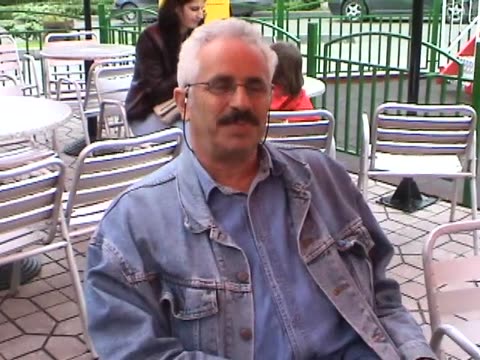
The team meets Sami Kurtsberg (see MDV 304, 305, 306 in Siret collection) in front of the synagogue.They then go inside in order to set up the interview with him, while he talks about contemporary Jewish life in Siret.

Informal life today Life todayLocal Jewish history MDV 232 · MCO
From the machine transcript

A long talk in Yiddish, apparently with a local man (probably Kurtsberg), about the small Jewish community of Siret. Only a dozen Jews are left, there is no minyan, and the speaker is one of the few who speak Yiddish. He tells of a man whose father died in Bershad and who became a president in Nazareth after the departures for Israel in the late 1940s. He also tells of a boy deported with his grandmother to Ukraine in the Transnistria deportations, and of a Rădăuți widow who married quickly to avoid being taken. Interleaved are chat about a bottle and about smoking.

The catalogue mentions meeting Kurtsberg and setting up; the transcript shows mostly an account of Siret Jews, deportations and emigration, and the speaker's identity is uncertain.

12:19

Kurtsberg talks about his life after the war. He worked in Rădăuţi in 1953. He recalls his co-workers.

From the machine transcript

A speaker recalls working in Rădăuți in 1953 with several colleagues, whom he names. Then the speaker asks the visitor whether he is a professor and what he teaches.

12:45

The camera cuts outside and collects town footage.

Footage MDV 232 · MCO
From the machine transcript

A short exchange about the subject taught: history, in Romanian and English, and the American town of Bloomington. A man then says in Russian that he once spoke Russian better than Romanian, and Lemster responds. The footage cut outside mentioned in the catalogue is not apparent from the speech.

A chat about history as a teaching subject and about the speaker's languages.

14:10

The team chats with Rabbi Noach Kofmansky about contemporary Jewish life.

Informal life today Life today MDV 232 · MCO
From the machine transcript

A chat in Yiddish with an older man, probably Rabbi Kofmansky, who exchanges good wishes with the team and says he is from Chernivtsi. There is talk of payment and of a very old man of 101 who still speaks. The conversation ends with a request to tell the team about the synagogue.

15:29

Kofmansky gives a tour of the synagogue and explains the history of the synagogue.

From the machine transcript

A guide, presumably Rabbi Kofmansky, shows the team the Chernivtsi synagogue and says that Chernivtsi had around eighty synagogues before the war and far fewer afterwards. He points out the painted decoration. It includes the sukkah and the guests (ushpizin) in order, Joseph's dream, Jacob, Abraham, Moses at the Red Sea and David. He explains how worshippers stand facing the elders depicted.

A walk through the painted figures and the ushpizin order, with the prewar number of synagogues.

18:05

The camera collects town footage of Chernivtsi while the team is headed to the next interview.

Footage MDV 232 · MCO