0:00
The camera collects footage of the Suceava region and Siret (Yiddish: Seret).
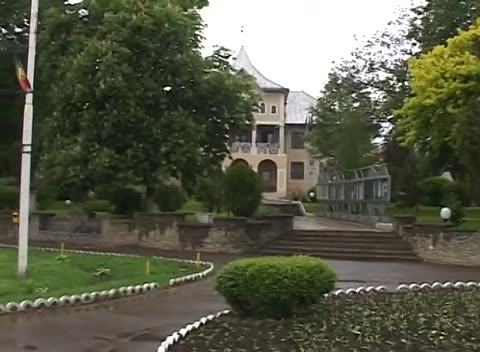
The camera collects footage of the Suceava region and Siret (Yiddish: Seret).
Kurtsberg speaks about contemporary Jewish life and his work. He worked in Rădăuţi (Yiddish: Radevits) in 1953.
Kurtsberg says he knew few Jews of Rădăuți but worked there in 1953 with several Jewish co-workers, whom he names. In answer to Kerler, he confirms that the Jews there spoke Yiddish.
names his Jewish colleagues and confirms they spoke Yiddish
The formal interview with Kurtsberg begins. He provides personal information and speaks about his family. His parents moved to Israel after the war.
The formal interview begins with Lemster asking for his official name as in his passport. Kurtsberg offers his ID instead, and Lemster confirms the name and the address in Siret. He mentions that his parents died in Haifa, Israel.
the parents' deaths in Haifa
Kurtsberg provides personal information. He also addresses social geography of the region. In particular, how people in Piatra Neamț made fun of Suceava (Yiddish: Shots) residents and called it "meshige Shots" (crazy Suceava).
Kurtsberg gives his Yiddish name Shmuel and his birth date, 4 November 1936. He explains where he was born (the street and the district names are garbled, and the town is Piatra Neamț only per the catalogue). He names the old counties of Bacău, Suceava and Siret. He then explains that Piatra Neamț people called Suceava "meshuge Shots", and tells a story of neighbors who quarrelled so much over a tree that it was cut down.
the story explaining the nickname
Kurtsberg speaks about his life before the war and family. His father, who was a kosher butcher, was born in Chernivtsi and moved there with his family before World War II. Kurtsberg's mother was born in Barticeşti and worked as tailor. Kurtsberg recalls his grandfather's work as plank deliverer. Kurtsberg grew up with one sister, who died in the Bershad ghetto.
Kurtsberg talks about his family before the war. His family left Piatra Neamț for Chernivtsi, where his father's relatives lived. His father worked as a butcher for a large firm. His mother, Matilda (Malke), was born in a village near Piatra Neamț (the name is garbled, Bălțătești per the catalogue) and worked as a tailor. His grandfather Shloyme worked in a boards factory in Storozhynets, whose boards were taken by wagon to markets. His younger sister died in Bershad in Transnistria.
gives his grandfather's name, Shloyme, and the sister's age gap
Kurtsberg speaks about his work as cinema technician, which he began during his school education at sixteen and continued full time after graduation until today.
Kurtsberg describes his work as a cinema technician. He began helping a projectionist at sixteen while still at school, and was formally employed from 1953. He still works although retired, because his wife is not yet retired and the Siret cinema would otherwise close. He talks about film damage and operator qualification.
Kurtsberg speaks about his life and interviews today.
Asked about Transnistria, Kurtsberg first tells how Romanian television once filmed him. He describes a trip of rabbis, a rabbi's wife from the Bucharest federation and yeshiva students to Siret and Rădăuți, where they met in the big synagogue and he told the woman a few episodes. Lemster asks him to tell what he remembers.
the visit of rabbis and students to Siret and Rădăuți
Kurtsberg speaks about his life during World War II, when he was imprisoned in the Bershad ghetto. He speaks about the journey via Marculesti, as well as arrival at the ghetto. Kurtsberg describes the night his family stayed in in the Marculesti woods and how they moved into a run-down house in the Bershad ghetto. Kurtsberg then speaks about daily life, including diseases, in the ghetto and how he went out to collect vegetable waste. Kurtsberg then describes how prisoners were taken from the ghetto to forced labor to dig mass graves. Kurtsberg also addresses moments from his childhood in the ghetto, including theater performances, prayer services and a visit of Romanian soldiers to his house.
Kurtsberg describes the deportation to Bershad: the night in the rain in the woods at Mărculești, the Dniester crossing where the sick were shot, and the winter in unheated houses. He tells of lice and typhus, of children collecting frozen vegetable peelings from Ukrainian yards, and of the yellow star. He describes street-by-street roundups, executions at an airfield and the mass graves, and children's games. He also describes theater performances, prayer in small groups, and two Romanian soldiers from the front who came to the house. Lemster also asks about songs.
adds typhus, roundups and executions at the airfield, the soldiers' visit and the playing children
Kurtsberg speaks about theater performances in Siret in the immediate postwar period.
Kurtsberg describes theater performances in Siret soon after the war, in the cinema hall, in which Kranenfeld, Herber Grafe and Dina König (?) acted. He gives the plot of a comic play about an emigrating woman who travels to America in a trough and a husband asking for coffee.
gives the plot and the actors, not only the fact of performances
Kurtsberg discusses his childhood memories before the war, as well as his family's observance. He then speaks about prewar Passover celebrations at home.
Kurtsberg recalls his prewar childhood: his father at work and his mother sewing. His father was very religious and prayed at the synagogue in Bershad and in Siret; Siret had a street of synagogues. He tells stories of his observant grandfather, including a Passover joke about wrapping, and the Four Questions with riddle-like questions.
the grandfather's Passover practices and the riddles
Kurtsberg speaks about religious services and holiday celebration, particularly Passover, in the Bershad ghetto. Kurtsberg recalls how people baked matzo. He then addresses the relationship between Jews and Ukrainians during his imprisonment.
Kurtsberg talks about prayer in small groups and matzo baked in the Bershad ghetto, made kosher with the little flour obtained. He discusses relations with Ukrainians, some of whom helped Jews while others denounced them. Kerler asks about the word for fruit. Kurtsberg comments that he is forgetting Yiddish since he has no one to speak it with.
Kerler's question on a fruit word, and Kurtsberg's remark about losing his Yiddish
Kurtsberg speaks about local Jewish life today. He also recalls how his grandfather criticized Polish Yiddish. Kurtsberg then shares an anecdote about a rebbe and his wife Sure, before telling another anecdote about a worried mother, whose son is about to be drafted. Kurtsberg remembers the stories from his grandfather.
Kurtsberg recalls meeting the rabbi's wife from the Bucharest federation and speaking Yiddish with her. His grandfather disliked Polish Yiddish, while Bessarabian Yiddish was praised. He tells two stories he heard from his grandfather: a rebbe and his wife Sure, who came to serve him food with uncovered hair, and a mother whose son Yosele is drafted and who is told he is still not leaving as the train departs.
two full anecdotes and the rabbi's wife
Kurtsberg describes Sabbath gatherings with his relatives before the war. He then speaks about Purim celebrations, including how he dressed up, after the war. Kurtsberg also addresses food customs.
Kurtsberg recalls Sabbath eve gatherings of his father's brothers and sisters, with a meal and stories. He then describes Purim in Siret after the war, with friends, costumes, going from house to house and Purim food such as hamantaschen and stuffed liver. He mentions the High Holidays that follow.
Kurtsberg speaks about postwar Passover celebrations, including food customs, at home. Kurtsberg also addresses Sukkoth and recalls how he and grandfather slept in the sukkah.
Kurtsberg describes Passover after the war: strict kashrut, matzo and beet dishes, and storing the Passover dishes in a large chest in the attic. He then speaks of building the sukkah with his grandfather, covered with corn husks, and says that he and his grandfather slept in it. He cannot recall the grandfather's stories at that moment.
Kurtsberg speaks about his family, particularly his grandfather. He then addresses his education at a religious school (cheder) and Romanian school. Kurtsberg states that he attended cheder for two hours in the afternoons. Kurtsberg then continues his recollections of holiday celebration, including Tisha B'Av.
Kurtsberg says his grandfather was a Hasid of the Chortkiv(?) rebbe. He tells of attending the Romanian school in the morning and cheder for two hours in the afternoon, where he learned Hebrew, Torah and Humash. He recalls the custom at the river, shaking out pockets, which Kerler identifies as Rosh Hashanah (Tashlikh), and jokes with his grandfather. He does not remember Tisha B'Av customs.
the rebbe's name or town (garbled) and Tashlikh
Kurtsberg talks about traditional weddings, including musicians and a wedding jester, in Siret.
Kurtsberg recalls traditional Jewish weddings in Siret, including those of his two uncles. He describes the chuppah, the ceremony, the broken glass, Hasidic and ballroom dances, and Jewish musicians, including an accordionist named Fisher (?). He names the master of ceremonies, Grünfeld, who led the wedding. Songs for the bride, groom and mother-in-law are discussed, though he cannot remember the jests.
names the musician and the master of ceremonies
Kurtsberg speaks about healing customs. He recalls how his mother practiced cupping therapy. He then speaks about a family in the Bershad ghetto, which was under Romanian and German command. The family's son sold dry goods and was busted by a Romanian soldier, Kurtsberg explains.
Kurtsberg talks about his mother's cupping (setting 'bankes') for colds and how it helped him as a child. He recalls a story from the Bershad ghetto, which was under Romanian and German command: a Romanian commandant had a young Jewish peddler who sold small wares dragged to death behind his motorcycle, and was later caught in Bucharest and shot at Siret. Lemster then asks about Jewish work in Transnistria.
The cupping is only briefly mentioned; the main part of the passage is the ghetto story of the peddler killed by the Romanian commandant, and a question about Jewish work in Transnistria.
Kurtsberg speaks about occupations, including tailor, barber, carpenter, dentist, doctor, in the Bershad ghetto. He then speaks about Sabbath celebrations, including food customs, at home. Kurtsberg also recalls how people went to the kosher butcher and describes how to kosher meat.
Kurtsberg lists occupations in the Bershad ghetto (carpentry, a barber, a blacksmith, doctors who made medical cabinets, dentists). Answering Lemster's questions, he describes Sabbath preparations at home, his mother's Friday cooking and the food of Sabbath and Shavuot. He also describes how chickens were slaughtered and salted at the kosher butcher.
Adds the Shavuot dairy food and the dialect terms for bean dishes and chicken dishes.
Kurtsberg speaks about Jewish life before the war, including non-Jews who spoke Yiddish and the Zionist organizations Yichud and Comitetul Democratic Evreiesc (Jewish Democratic Committee). Kurtsberg also addresses prewar cultural life.
Answering Lemster's questions, Kurtsberg discusses non-Jews who spoke Yiddish and says he has not heard of converts. He names the Zionist organizations in Siret (Yikhud, Maccabi) and the Jewish Democratic Committee through which people registered for emigration to Palestine. He also answers questions about a Yiddish library, newspapers, sports clubs and Yiddish theater performances in Siret.
Kurtsberg talks about prewar religious life, as well as the Siret cemeteries. The team then shows Kurtsberg how Iosif Kogan sings (see Tulchyn MDV 709,710,711,717,719,725,726).
Kurtsberg talks about Hasidim in Siret and describes the holy place (the Jewish cemetery area) with its old and newer parts and the graves of famous rabbis, visited by Hasidim from America and Israel. The team then plays him a recording of Iosif Kogan singing songs from the Bershad ghetto, with brief remarks identifying Kogan, now in Tulchyn.
Adds Kurtsberg's description of the three parts of the holy place and the visiting Hasidim from abroad.
Kurtsberg speaks about food and drinking customs at home. He shares his mother's fish recipe.
Answering Lemster, Kurtsberg describes his mother's Jewish dishes such as jellied fish and goulash from offal, and the drinks at Friday night and Sabbath meals (home-distilled grain brandy). He also answers a question about kosher sausage.
Kurtsberg answers questions about cultural terminology. He then addresses Purim performances during his childhood with his non-Jewish friends.
Kurtsberg explains the meaning of several Yiddish terms (dibbuk, golem, a foolish person, and a word his father used). Kerler then asks about Purim rhymes; Kurtsberg recalls the chimney sweep play and says that Christian friends joined the Purim players and that they were all friends.
Adds the explanation of terms such as dibbuk and golem and the point that Christian friends took part in the Purim performances.
Kurtsberg talks about folk and healing customs. He recalls how his mother practiced "leshn koyln" (extinguish coals) to avert the evil eye. Kurtsberg also shares episodes about locals from his childhood.
Kurtsberg describes how his mother cured the evil eye by extinguishing coals in a glass of water, and a similar cure used by his wife. He explains the term 'geshterkt' (starched) in an anecdote about a person with a strong will, and tells a story from his father about a melamed in Strazhynits (?) who cooked his food all mixed together.
Adds an explanation of the starched laundry word and a story about a melamed who cooked all his food in one pot.
Kurtsberg shares an anecdote about Hershl Ostropoler eating at a restaurant without paying. Another anecdote involves Hershl falling asleep at dinner and losing his beard. Kurtsberg remembers the anecdotes from his father. Kurtsberg then speaks about the Golem of Prague, which he read in Yiddish.
Answering Lemster, Kurtsberg tells two anecdotes about Hershl Ostropoler: one where he eats in an inn without money and persuades the innkeeper to forgive the bill, and one where a friend glues his beard to the table. He says he heard them from his father. He then recounts the story of the Golem of Prague and says he read it in Yiddish.
Adds the Golem of Prague story and the source of reading.
Kurtsberg addresses Yiddish literature. Kurtsberg then speaks about his religious customs today, particularly yahrzeit and visiting the local cemetery. Kurtsberg also mentions contemporary hasidic visitors.
Kurtsberg discusses his reading of Yiddish literature, saying he read Sholem Aleichem in Romanian. He describes his monthly visits to the Jewish cemetery to pay the electricity bill, light a memorial candle at his grandfather's grave and sit there. He also talks about the key to the Radauti cemetery and about visitors, rabbis and yeshiva students who come to Siret.
Adds the key to the Radauti cemetery and the tourists and rabbis who visit.
Kurtsberg speaks about contemporary religious customs of Christians, who pray at the Rădăuţi synagogue.
Answers Kerler's questions about Christians who came to the synagogue to light candles on Friday evening and pray to God in times of trouble. He says the practice also occurred in Siret and Rădăuți. The passage ends with his promise to tell a story about Hershl Ostropoler.
Also mentions that the practice occurred in Siret and Rădăuți, and leads into a story about Hershl Ostropoler.
Kurtsberg tells an anecdote about Hershl Ostropoler and God's judgment.
Tells a story about a poor, pious Jew who prayed all his life to earn a living. After his death he reproaches God for not helping him, and God asks whether he had ever played the lottery. Kurtsberg is unsure whether the hero is Hershl Ostropoler or Sholem Aleichem's figure. Lemster then asks about Chelm stories and about the crazy people of Suceava.
The anecdote's hero is uncertain (Ostropoler or another figure), and Lemster steers toward Chelm and Suceava stories.
Kurtsberg shares more episodes about "meshige Shots" (crazy Suceava). He also addresses contemporary Jewish life in Suceava and speaks about Shoyl Petraru (Suceava MDV 307).
Talks about Suceava as a "crazy" town whose people were always drunk and quarrelsome. He then discusses the current mayor and a teacher, a professor who also served as community president. He also describes a former Securitate officer, a Communist party member who had changed his family name. He begins to speak about his own father, a butcher, and says he does not want some of this recorded.
Includes talk of a local professor and community president and a former Securitate officer.
Kurtsberg speaks about his family. He raised a son and daughter, who live in Israel. Kurtsberg also raised another son with Tania, who lives in Suceava.
Answers questions about his children. His son and daughter live in Tel Aviv, and the daughter has no children. His second wife has a son in Suceava, an engineer, who is married and works with his wife. Kerler gives a business card with his email so the grandchildren can be reached.
Adds the second wife's son and his family in Suceava, a grandson who is also an engineer, and the exchange of contact details.
Kurtsberg speaks about prewar Jewish life in Siret, in particular episodes about the daily business routine. According to him, thirty-eight percent of the population was Jewish. Kurtsberg also touches upon prewar Jewish life in Mihăileni and shares episodes about locals' business life.
Prompted by Kerler, Kurtsberg describes prewar Jewish life in Siret. He says Jews were a large share of the population (a figure around thirty-eight percent is given), lived above their shops in the center, and sold to peasants on credit. He contrasts this with Mihăileni, where Jews were an overwhelming majority. He ends with a long humorous story, heard from his father, about cavalry horses quartered at an estate near Mihăileni and an officer whose horse grew horns. Kerler thanks him at the close.
Adds the cavalry-horse story and the contrast between Siret and Mihăileni.
Items of the dialect questionnaire asked here; each link plays the moment.