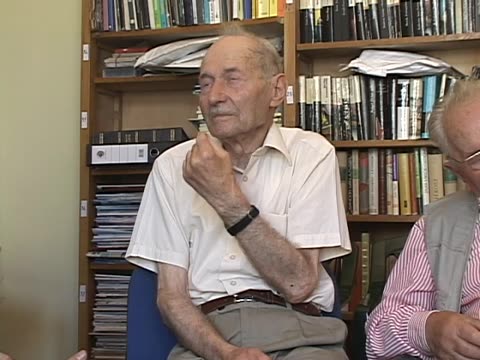
Miller joins the conversation and they answer questions about cultural terminology.
From the machine transcript
Miller arrives and is greeted. Kerler and others discuss a term for 'mother tongue' in Yiddish, Hungarian and Romanian, and the speakers briefly arrange the seating. The passage is partly garbled.
Miller talks about his family and discusses his childhood memories of an observant home. His father was born in Hanychi, Ukraine. He describes his father's appearance as Vizhnitzer hasid. Miller grew up with three sisters and two brothers.
From the machine transcript
Miller says his father, a Vizhnitz hasid, came from a village near Uzhhorod and moved to Cluj. He grew up in a thoroughly Jewish home with three sisters and three brothers (the count is as heard) in a poor household. He reflects at length on what real Jewish feeling means, learned at home, from washing hands and blessings at the table to the father asking the children about cheder.
adds Miller's reflections on Jewish identity learned at home, and the Uzhhorod area origin
Miller speaks about Sabbath celebrations at home before the war. He also chants prayers and sings songs, he recalls from Sabbath dinners.
From the machine transcript
Miller describes Friday night at home before the war, with a white tablecloth, candles and two large challahs, and his father singing and chanting the Sabbath hymns and prayers. He chants and sings long stretches, the transcript of which is too garbled to read, and tells a story about Joseph who honors the Sabbath and finds a jewel in a fish. He closes with remarks on Jewish tradition and the Holocaust.
adds a story about Joseph and a fish, and Kerler's questions about candle-lighting and the challah
Miller talks about his prewar family life. His father worked different jobs, including being a shammes.
From the machine transcript
Miller says his poor family never went hungry because his father was a prayer leader and shammes, and distributed Sabbath portions and tutored the children of wealthy families. Kerler asks about a Yiddish song his father sang. Another voice sings a short song about the collection box. Miller mentions songs sung at Simchat Torah and Purim.
adds the father's work as prayer leader and the short song sung by another voice
Miller speaks about life today.
From the machine transcript
Kerler asks Miller about songs and other voices respond in Hungarian. Miller says the Cluj community has produced good results, with Jews raised in Jewish homes who understand Yiddish and know what Jewishness means. The passage is partly garbled.
Miller speaks about his father's observance as Vizhnitzer hasid.
From the machine transcript
Miller explains that his father, a prayer leader, used his earnings to buy firewood, and in good years took the sons to the Vizhnitz rebbe's family in Grosswardein (Oradea, as heard) for the High Holidays. Kerler then asks the interviewee to talk with the research secretary, who speaks Hungarian. Miller begins to chant the Vizhnitz melody.
Miller chants Sabbath nigunim of Vizhnitzer origin.
From the machine transcript
Miller chants Sabbath tunes and hymns in the Vizhnitz style, including a piece sung before the blessing after meals. Kerler asks if he recalls a Vizhnitz melody without words. Miller says he is over 86 and mentions Rabbi Halberstam, the rabbi of the Orthodox community in Cluj.
Miller talks about prewar religious life and the fate of religious authorities in World War II. Miller maintains that Rebbe Alpershtein of Cluj was brought to America from Auschwitz by Dwight D. Eisenhower. Miller then addresses Alpershtein's inheritance that remained in Israel.
From the machine transcript
Miller tells how Rabbi Halberstam of Cluj, deported to Auschwitz, was freed by the Americans and, in his account, flown to America by Eisenhower. He tells of Halberstam's later life, including his money going to Netanya to build a yeshiva, synagogue and hospital. He then describes how in 1985 or 1986 (as heard) workers in Cluj found boxes of ritual objects and papers from his house on Dezsma street, and the dispute over them between Cluj, Bucharest and Netanya.
includes the discovery of Halberstam's objects in Cluj and the later dispute over them
The team concludes the interview with Miller and he talks about life in Israel.
From the machine transcript
Kerler concludes the interview with Miller, who is thanked and given good wishes. Miller reflects that it is easier to be Jewish in Israel than elsewhere, since one need not pray to be a Jew there. Kerler thanks everyone and begins to ask about yeshiva study before the war.
includes Miller's reflections on Jewish identity in Israel