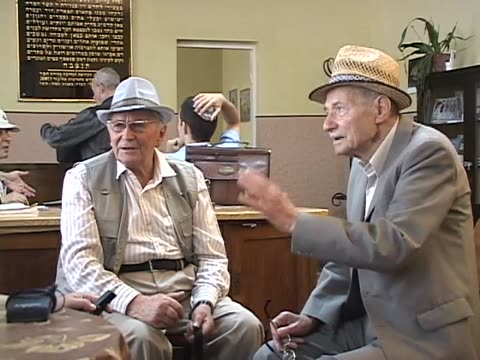
Miller joins the conversation and talks about contemporary Jewish life and memorialization.
From the machine transcript
Miller joins; Kerler introduces himself and explains the aim of the fieldwork. Miller describes a planned visit to Bistrița to mark the memorial of Moyshe Grin, a former prayer leader in Cluj, and says Bistrița had a large Jewish community.
Kerler's explanation of the project and the Bistrița memorial plan
Miller provides personal information and talks about his family. He states that his father was a Vizhnitzer hasid.
From the machine transcript
Miller says he was born in Cluj and that his father was a Vizhnitz hasid who prayed in a tallit and wore a black kaftan and shtraymel on the Sabbath.
They talk about life today.
From the machine transcript
Talk among those present about meeting up and joining the trip. Kerler asks whether a man named Hirsch, a Yiddish speaker, can be found in Dej.
The team continues to interview at a restaurant.
From the machine transcript
Brief exchange, little speech.
The formal interview with Miller begins. He provides personal information and discusses prewar Jewish life, including community structure, of Cluj-Napoca. According to Miller, 16,000 Jews lived in town.
From the machine transcript
The formal interview with Miller begins; he gives his birth year as 1922(?) and says he was born in Cluj. He describes Cluj as a large Jewish cultural centre with about sixteen thousand Jews and six large synagogues, with Orthodox, Reform and Sephardic(?) congregations and hasidim. He mentions languages spoken, Hungarian, Romanian and Yiddish, and Jews who came from Maramureș.
Miller talks about his family. His father was born in Ukraine. He then talks about traditional weddings and Purim celebrations before the war.
From the machine transcript
Miller speaks about his father, who came from Czechoslovakia (Uzhhorod) to Cluj, and his grandfather. He recalls weddings with a poor fiddler who played Yiddish songs, and Purim with a purim play and charity collections.
Miller speaks about his education at a religious school (cheder). He then talks about the difficulty to keep Jewishness today and contemporary Jewish life, as well as Jewish Studies.
From the machine transcript
Miller speaks about studying in cheder and about how hard it is to keep Jewishness alive today, with mixed families and few young people. He describes community efforts such as a talmud torah course and a Jewish studies institute at the Cluj university, formerly a Jewish school, whose students are mostly not Jewish.
Miller speaks about his father. He then recites prayers and sings the Sabbath song "Shalom Aleichem."
From the machine transcript
Kerler asks about the father's tefillin, and Miller recites or sings parts of the Sabbath songs, including 'Shalom Aleichem'. He recalls few Yiddish songs.
Kerler's question about tefillin and Miller's recollection of few Yiddish songs
The camera records footage of the Bistrita cemetery and films the yahrzeit memorial service of Moyshe Grin, led by Hershkovich and Miller.
From the machine transcript
Footage of the Bistrița cemetery with a memorial service for Moyshe Grin, with prayers in Hebrew and Romanian by two men, apparently including Miller, and El Male Rachamim and Kaddish. Interspersed are introductions, remarks in Russian and Hungarian and brief comments on tradition.
The camera collects footage of the Bistrita cemetery.
From the machine transcript
Footage at the cemetery with brief conversation. Kerler asks how old the cemetery is and is told it is over ninety years, with a reference to a tombstone. Near the end the group discusses how they will travel back and whether to eat together in a restaurant in the town centre.
The transcript shows talk about getting back and eating in a restaurant, and the age of the cemetery.
Miller talks about prewar life, in particular the influence of German residents. Miller maintains that the cemetery has existed for more than ninety years.
From the machine transcript
An informant talks about the town's German (Saxon) residents and their influence, which made it a good, orderly place. Asked about the cemetery's age, he says more than ninety years, and says he does not know the town's history or Hasidic life. He recalls a man named Grin, who spoke Yiddish, came to pray with them on the High Holidays, and was the last Yiddish speaker.
The transcript adds the recollection of the Yiddish-speaking Grin and the remark that only a few Jews remain.